Featured
 Martinez Zogo Affair: Biya must clean house and make way for a new generation
  Ambazonia People’s Liberation Authority explains motives for the new transition
  A year after Biya’s disputed re-election, CPDM remains without a timetable for next year’s polls.
 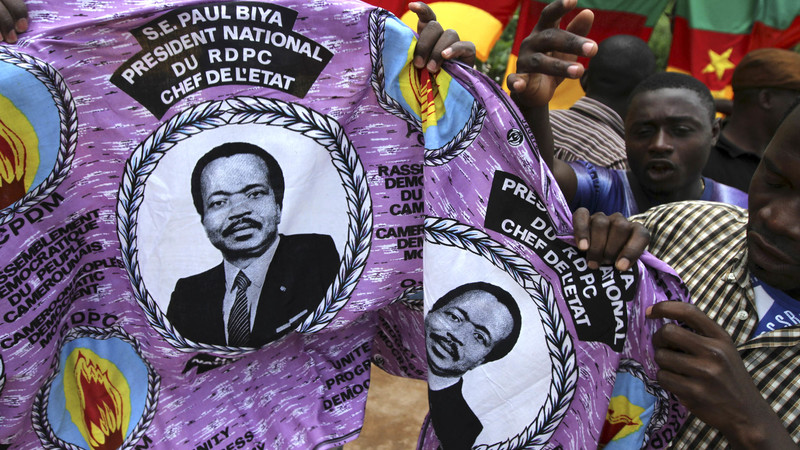 Ruling CPDM Party: When a political message runs out of the road
  Dion Ngute in Buea: Peace cannot be a slogan; Prime Minister must go beyond dialogue
Most Commented Posts
 4 Anglophone detainees killed in Yaounde
18 comments Chantal Biya says she will return to Cameroon if General Ivo Yenwo, Martin Belinga Eboutou and Ferdinand Ngoh Ngoh are sacked
13 comments The Anglophone Problem – When Facts don’t Lie
12 comments Anglophone Nationalism: Barrister Eyambe says “hidden plans are at work”
12 comments Largest wave of arrest by BIR in Bamenda
10 comments
Featured
-

Formula 1: Hamilton sets sights on racing in African grand prix
-

Yaoundé: anti-corruption agency calls for stronger powers after 20 years of limited progress
-

Martinez Zogo Affair: Biya must clean house and make way for a new generation
-

Biya’s health crisis is starting to alarm investors
-

Cameroon’s Eurobond yields hit record high after Fitch downgrade
-

World Bank Group launches first digital strategy to expand access and create jobs
-

Biya regime raises stake in Sonara to 98%, diluting TotalEnergies to 0.42%
19, August 2026
Yaoundé allocates CFAF400 million to SMEs 0
Cameroon has allocated CFAF400 million to finance small and medium-sized enterprises involved in the distribution of locally produced food, targeting a key bottleneck in the government’s import-substitution program: getting domestic products from producers to consumers.
The funding was announced on August 18, 2026 in a Trade Ministry release disclosing an agreement signed by Trade Minister Luc Magloire Mbarga Atangana and Amadou Haman, Managing Director of the Cameroon Bank for Small and Medium-Sized Enterprises (BC-PME).
According to the Ministry of Trade, the CFAF400 million was transferred to BC-PME under the ministry’s 2026 budget. The bank will provide financial and technical support to businesses operating under the Integrated Agropastoral and Fisheries Import-Substitution Plan (PIISAH).
The facility targets companies involved in processing, packaging, storage, logistics and distribution, with rice, maize, flour, palm oil and milk among the priority value chains. The objective is to build distribution networks capable of bringing locally produced goods to market under competitive conditions.
The initiative addresses one part of Cameroon’s broader import-substitution strategy: ensuring that increases in domestic production are matched by the capacity to store, transport and sell those products efficiently.
“Producing more is not enough,” Mbarga Atangana said, stressing the need to strengthen the link between production and consumers. The financing comes as food imports continue to weigh heavily on Cameroon’s import bill. According to data from the National Institute of Statistics (INS), the country spent CFAF543.7 billion on cereal imports in 2024, up 40.3% from 2023.
Rice imports alone reached CFAF318.6 billion, an increase of 58.6% year on year, while wheat imports stood at CFAF214.1 billion. In the first quarter of 2025, cereals accounted for 11.2% of Cameroon’s total import expenditure, with rice representing 7.1% and wheat 3.8%.
The pressure extends beyond food products. INS figures show that Cameroon’s overall trade deficit widened by 22.8% to CFAF2,145.2 billion in 2025, from CFAF1,747.3 billion a year earlier, while total import expenditure increased by 4.6%.
Against that backdrop, the government is seeking to strengthen the commercial side of domestic production. According to the Trade Ministry, locally produced goods must not only be available in sufficient quantities but must also meet requirements related to quality, traceability, regular supply and competitive distribution.
Mbarga Atangana said the partnership with BC-PME is intended to make trade a more active part of the country’s production and industrialization drive.
“This agreement reflects our shared determination to make trade a genuine lever for economic transformation and wealth creation,” the minister said, adding that the partnership is also intended to improve “the competitiveness of Cameroonian enterprises.”
PIISAH covers the 2024-2026 period and forms part of Cameroon’s import-substitution policy under the National Development Strategy 2020-2030. The government has again identified the plan as one of its economic priorities for 2026.
Mbarga Atangana said implementation will require coordination among public institutions, businesses and professional organizations.
“The success of PIISAH depends on the collective mobilization of the State, professional organizations and businesses,” he said.
Source: Business in Cameroon