22, September 2026
Guinness Cameroon posts CFA1.3 billion loss ahead of SABC merger 0
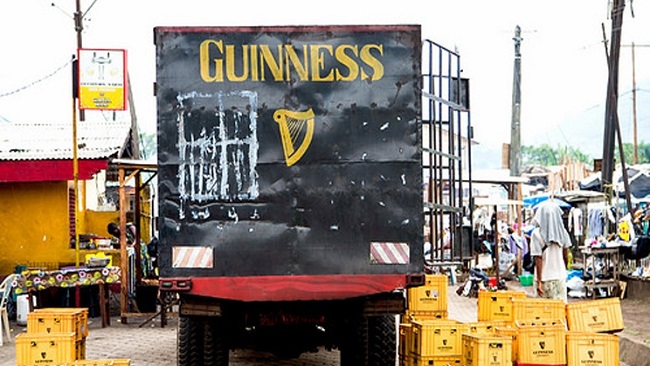
Guinness Cameroon posted a net loss of CFA1.26 billion (€1.927 million) in 2025, its final full-year results ahead of a planned merger into SABC that will combine the two major Cameroon subsidiaries controlled by Brasseries et Glacières Internationales (BGI), the parent company of the Castel Group.
The brewer generated CFA90.7 billion (€138.202 million) in revenue during the year, according to subsidiary data attached to BGI’s 2025 annual financial statements. The loss was equivalent to about 1.4% of revenue.
The BGI document does not provide Guinness Cameroon’s detailed income statement, however, so it does not establish which expenses or events caused the company to fall into the red. Among the African subsidiaries listed in the table, Guinness Cameroon was one of only two companies to report a loss in 2025. Société des Brasseries de l’Ouest Africain (Soboa) in Senegal recorded a CFA1.5 billion (€2.326 million) loss.
Guinness Cameroon’s performance contrasts sharply with SABC, BGI’s other major subsidiary in Cameroon. Société Anonyme des Boissons du Cameroun reported CFA50.6 billion (€77.072 million) in net profit on CFA483.2 billion (€736.664 million) in revenue in 2025. BGI’s accounts also show Guinness Cameroon with CFA20.5 billion (€31.237 million) in share capital and CFA13.6 billion (€20.787 million) in shareholders’ equity. Equity was therefore about CFA6.9 billion below share capital. The figures disclosed by BGI do not, on their own, establish the reason for the difference.
BGI owns 100% of Guinness Cameroon. Its stake is carried in BGI’s accounts at a gross book value of CFA301.4 billion (€459.494 million). After accounting impairments, the net book value stands at nearly CFA270.1 billion (€411.696 million).
Those figures represent the accounting value of BGI’s stake in Guinness Cameroon, not financial investments owned by Guinness Cameroon itself.
CFA271.8 Billion in Net Assets to Transfer to SABC
The results come as Guinness Cameroon proceeds with a merger into SABC. Under the proposed transaction, all of Guinness Cameroon’s assets, rights, receivables and liabilities will transfer to SABC, and Guinness Cameroon will cease to exist as a separate legal entity once the deal is completed.
Figures disclosed for the merger show that the assets to be transferred total about CFA329 billion, while liabilities amount to nearly CFA57 billion. The resulting net assets contributed to SABC are valued at CFA271.762 billion.
In exchange, SABC plans to issue 1,811,106 new shares with a nominal value of CFA10,000 each. Its share capital would increase by CFA18.111 billion, from CFA57.363 billion to CFA75.475 billion. The total number of SABC shares would rise from 5,736,363 to 7,547,469. The new shares issued for the merger would therefore represent about 24% of SABC’s post-merger capital.
The CFA18.1 billion capital increase does not represent the full value of the net assets transferred. The roughly CFA253.65 billion difference between the CFA271.762 billion net asset contribution and the nominal value of the new shares is to be recorded as a merger premium.
The transaction will bring operations currently conducted separately by SABC and Guinness Cameroon under a single company. It remains subject to the required legal procedures and approvals before completion.
Acquisition Announced at £389 Million
The merger represents one of the final stages of the restructuring that followed Castel Group’s acquisition of Guinness Cameroon. On July 14, 2022, British drinks group Diageo announced the sale of its Cameroon subsidiary to Castel for £389 million, equivalent to nearly CFA300 billion at the exchange rate at the time.
The agreement also provided for Castel to continue producing and marketing Guinness in Cameroon under a licensing agreement with Diageo. Competition authorities approved the acquisition on March 28, 2023, subject to commitments that must be fulfilled over five years. These cover areas including industrial investment, local production, distribution and employment.
Around that time, the group announced a CFA200 billion five-year investment program in Cameroon. The plan included new production lines at its Yaoundé, Garoua and Bafoussam facilities and an expansion of Socaver, its glass-bottle manufacturing subsidiary.
Three years after the acquisition was approved, competition authorities continue to monitor those commitments. A third annual assessment was conducted on July 21, 2026, including visits to the Ndokoti industrial site in Douala and Socaver facilities.
Following the assessment, Léopold Noël Boumsong, president of the National Competition Commission, said the group was “ahead of its entire roadmap, even exceeding the initial requirements.”
That assessment was not accompanied by a detailed quantitative report. The statement released after the review did not disclose cumulative investment since the acquisition, the number of jobs created or maintained, or the additional production capacity commissioned relative to the original targets. The merger will also change how Guinness Cameroon’s former operations are tracked. Once completed, its assets, liabilities and operations will become part of SABC.
Castel’s commitments made when it acquired Guinness Cameroon will, however, remain subject to oversight by the regional competition authorities until the end of the agreed monitoring period.
Source: Business in Cameroon






















24, September 2026
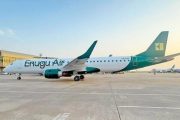
Enugu Air launches first international route with 2 weekly Enugu-Douala flights 0
Nigerian carrier Enugu Air launched its first international service on September 23, 2026, with a direct route between Enugu and Douala that gives Cameroon a new air connection to southeast Nigeria.
The airline, which is owned by Enugu State, will operate two flights a week, on Mondays and Wednesdays, with a 76-seat Embraer E170. Douala becomes its first international destination.
The inaugural aircraft departed Akanu Ibiam International Airport and landed at Douala International Airport, where officials held a welcoming ceremony, before it returned to Enugu. The flight confirmed the start of a route announced a few days earlier.
Flights from Enugu are scheduled to depart at 12:45 p.m. and arrive in Douala at 1:45 p.m. Return flights will leave Douala at 2:30 p.m. and reach Enugu at 3:30 p.m.
Ugonna Agubuokwu, director of operations, said the schedule was designed in part to provide connections with Lagos and Abuja. Enugu Air already serves Port Harcourt, Kano, Owerri, Asaba, Benin City and Warri within Nigeria.
“Today, we take our first major step beyond Nigeria. Enugu to Douala. Nigeria to Cameroon. The Southeast to Central Africa. And this is only the beginning,” Enugu Air Managing Director Tolu Ita said at the launch.
A New Gateway to Southeast Nigeria
Enugu Air is not the first airline to offer direct flights between Nigeria and Cameroon. Air Peace already operates the Lagos-Douala route and still showed availability for subsequent weeks in September 2026.
The difference is the location of the new connection. Enugu Air links Douala directly with southeast Nigeria, which means air travelers no longer necessarily have to pass through Lagos to reach Enugu. The airline also offers connections to Douala through Enugu for passengers from Lagos and Abuja. The flight complements an existing land corridor centered on Enugu. The city forms the Nigerian end of the roughly 438-kilometer Yaoundé-Bamenda-Enugu corridor. On the Cameroon side, another 35 kilometers of the Babadjou-Bamenda section opened in September 2025.
The Ekok-Mfum bridge over the Cross River also forms part of the Bamenda-Mamfe-Abakaliki-Enugu route. The new service therefore adds an air connection to cross-border links that have largely relied on roads.
Trade Estimated at CFA414.12 Billion
The route also connects two countries with significant merchandise trade, much of which takes place outside formal customs channels. According to Cameroon’s National Institute of Statistics (INS), the country officially imported CFA149.83 billion worth of Nigerian goods in 2024 and exported CFA22.85 billion worth of goods to Nigeria.
The INS also estimated unrecorded imports from Nigeria at CFA176.58 billion and Cameroon’s exports outside formal channels at CFA64.86 billion. Combined, merchandise trade between the two countries would therefore have reached CFA414.12 billion in 2024. On the import side, informal trade accounted for 54.1% of the estimated CFA326.41 billion in goods that entered Cameroon from Nigeria.
The Enugu State government has highlighted these commercial ties as part of the case for the route. Sam Ogbu-Nwobodo, commissioner for Trade, Investment and Industry, said traders and manufacturers in southeast Nigeria previously had to use more complex routes to reach Central African markets. He said the Douala connection should shorten those journeys.
Two Weekly Flights, but No Traffic Forecast Yet
The key question is how much demand Enugu Air will find on the route. Neither the airline nor the Enugu State government has disclosed an annual passenger forecast, the inaugural flight’s load factor or a commercial target for the service.
Before the launch, the booking system reviewed by ch-aviation showed two weekly flights through October 28, 2026. That date reflected the booking horizon available at the time and does not mean the service will end after October.
Bookings beyond October, whether Enugu Air maintains its twice-weekly schedule and any future increase in frequency will provide the first indications of whether the route can establish itself over the longer term.
Source: Business in Cameroon