15, February 2026
Catholic University in Cameroon expands cooperation with Europe 0
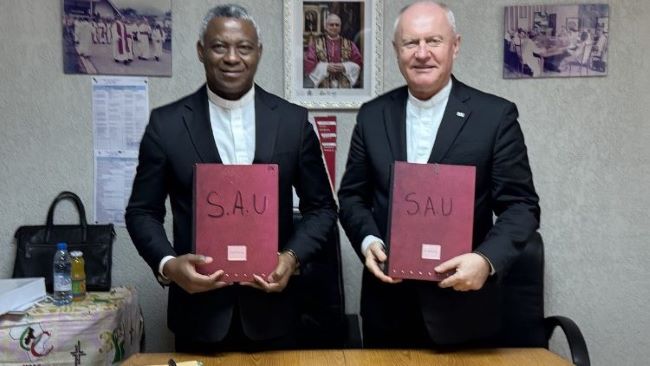
The exchange of experience in the scientific, cultural, and social fields between two important Catholic academic centers is the result of an agreement signed in February between the Catholic University of Central Africa in Cameroon and the John Paul II Catholic University of Lublin in Poland.
The agreement was signed by the rectors: Fr. Prof. Thomas Bienvenu Tchoungui of UCAC and Fr. Prof. Mirosław Kalinowski of KUL.
Due to the academic reach of the Catholic University of Central Africa, the agreement extends beyond Cameroon to include Chad, Gabon, Guinea, Congo, and the Central African Republic.
The Polish Catholic university educates students from Poland and 45 other countries, mainly from Europe—Ukraine, Belarus, and Spain—as well as a large group of students from Central Asian countries and the United States.
Therefore, as Prof. Mirosław Kalinowski emphasizes, cooperation with the university in Yaoundé goes far beyond the borders of Central and Eastern Europe and Central Africa.
“The priority is not only knowledge, but also spiritual formation, which responds to the challenges of the contemporary world,” says the rector of KUL.

From left: Fr. Jean Paul Rene Ondua Omgba, Fr. Prof. Mirosław Kalinowski, Fr. Prof. Thomas Bienvenu Tchoungui
An African existential approach to social challenges
The agreement is the result of a meeting and discussions between the two rectors in the Vatican several months ago.
Both universities see in this pan-continental exchange an opportunity to deepen their own experience and seek common solutions to contemporary challenges. This may be achieved through student and academic staff exchanges.
UCAC is a university with over thirty years of tradition, established by the Conferences of Bishops of Central Africa. For years, it has educated leaders and specialists who serve the Church and society in their respective countries.
Its programs include theology, philosophy, social sciences, law, and health sciences, aligning with local development needs. At the center of its mission is always the human person and human dignity.
UCAC has already been cooperating with universities in Western Europe for many years. This agreement expands that scope to another region of the continent.
The John Paul II Catholic University of Lublin has a rich tradition of more than 100 years, and Karol Wojtyła was among its professors before becoming Pope John Paul II.
The university educates nearly 10,000 students and dynamically develops its research and teaching programs internationally. The partnership with the African university now represents an opportunity for its further growth.
“Above all,” adds Prof. Kalinowski, “it offers integration of European academic experience, especially in the humanities and social sciences, with the African existential approach to understanding reality and responding to concrete social challenges.”
Tools for building community and social change
“KUL’s experience in intercultural dialogue, humanistic ecology, public ethics, and the theory and practice of education can find creative application in the African context of UCAC, where education is also a tool for social change and community building,” the rector of KUL explains.
UCAC also brings to the partnership the experience of its students and lecturers, as well as their perspective on global processes that in Europe are often overlooked—especially where religious and social life intertwine with everyday existential challenges.
Cooperation in migration, ethics, and AI
Furthermore, the cooperation between the universities fits with the Church’s global vision as a community of universities that do not compete so much as support one another in fulfilling the missionary function of education.
“Within the framework of intercontinental dialogue, we can develop and create research and teaching programs related to migration, cultural changes, or devoted to ethical issues in the era of technology and artificial intelligence,” concludes Fr. Prof. Mirosław Kalinowski.
Source: Vatican News













19, February 2026
Should Pope Leo Visit Cameroon? 0
Pope Leo plans to visit Cameroon shortly, although details of the controversial trip have not yet been confirmed by the Vatican. Questions are being raised about whether the Pope’s presence bestows legitimacy on the regime of 93-year-old President Paul Biya. In the nineth year of a vicious civil war, the Central African nation held an election last October which was considered neither free nor fair by respected monitoring groups. Biya remains in power after four decades at the helm of a country considered corrupt by Transparency International and other observers. Meanwhile, Amnesty International points to dozens of political prisoners held in appalling circumstances.
Does the Pope’s visit offer an opportunity for the Church to draw attention to the regime’s shortcomings, urging a change of direction, and a respect for human rights and democracy? PAV asked several Cameroonian civil society leaders for their views. Some names have been omitted to preserve their safety.
According to Maximilienne Ngo Mbe, winner of the International Women of Courage Award in 2021, “The Pope embodies the voice of the voiceless and intercedes with Jesus to end our suffering. That is why we are happy with the arrival of the Pope in Cameroon. His visit must be part of our reconciliation and social justice process. We ask Pope Leo to entrust the Virgin Mary to undo the knots of disagreement, establish mutual forgiveness, and talk to leaders in order to cultivate compromise.”
Madame Ngo Mbe draws attention to the truth and reconciliation process inspired by Pope Francis in the Central African Republic as an example of what can be achieved.
Dr Christopher Fomunyoh, senior associate at the National Democratic Institute in Washington DC agrees. “His Holiness is in a position to know the suffering and misery that Cameroonians have endured under the repressive and kleptocratic regime of a 93 years old autocrat. The world will be watching the Pope’s every step and every word to be sure the biblical downtrodden who constitute the vast majority of the Cameroonian population can find voice and a future while counting on the Holy Father.”
However, Paul (his last name is omitted for his security), who leads a development NGO, asks what the Pope hopes to achieve. “Is it to endorse the current system, encourage looting, the appropriation of resources by the system’s elites, violence, and political grudges? To help Cameroonians mourn the thousands of deaths resulting from conflicts in the Northwest and Southwest or post-electoral crises?”
Like Madame Ngo Mbe, Paul hopes Pope Leo will prompt a process of reconciliation and sustainable peace. “Knowing the regime’s ability to deceive everyone in order to maintain power and preserve its privileges, one fears that the visit might be nothing more than an endorsement, a blessing that the regime is seeking.”
Judith (last name omitted to protect her security), a Cameroonian Diaspora “seeking positive change back home and conflict resolution through dialogue”, urges the Pope not to visit Cameroon “at this fraught moment.” She continues, “If he does come, I pray he will speak with the moral clarity of our social teaching – affirming the dignity of every person, the primacy of the common good, and the duty of authority to serve the people – by urging the regime to respect the will of the electorate.”
Sharing Judith’s concerns is Serge Banyongen, professor of political science at the University of Ottawa. “If Pope Leo XIV visits Cameroon, he will be welcomed by ceremonies and carefully curated images of stability, in which the Yaoundé regime excels. Above all, the Pope must learn the truth about the suffering Church in Cameroon. Priests, religious, and lay faithful have been murdered, some in cold blood. Two bishops, Mgr. Balla and Mgr. Plummey, along with countless priests and nuns, have died in circumstances that were never credibly investigated. Their deaths remain wounds that have yet to heal. When the Catholic Church has spoken prophetically, calling for justice, dialogue, and reform, it has been humiliated, intimidated, and pressured into silence.”
Source: panafricanvisions