
28, September 2020
Biya’s continued stay in power: Repression of protests and attacks against the media must be investigated 0
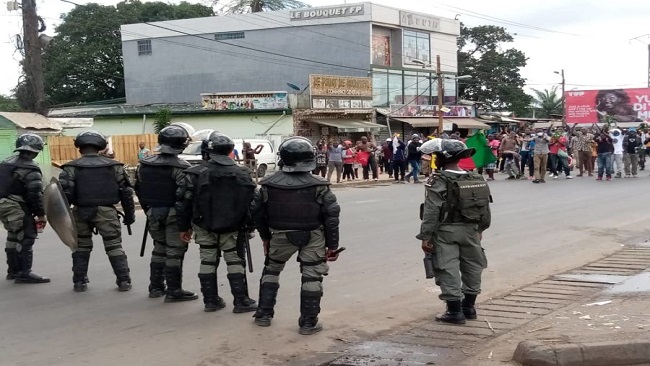
Cameroonian authorities have to investigate the excessive use of force during peaceful protests in Yaounde and other cities in Cameroon on 22 September 2020. They must immediately release all protesters who were arrested solely for expressing their opinion and investigate attacks against journalists ill-treated and arrested for collecting information on the protest. The protests were organised by the Mouvement pour la Renaissance du Cameroun (MRC) to demand the departure of the President of the Republic.
“It is unacceptable that the security forces used lethal force against peaceful protesters, arrested and humiliated people only because they were exercising their right to protest. The authorities must investigate these human rights violations and explain why one of the protesters died and others were injured and illtreated. The authorities must ensure that those suspected to be responsible are brought to justice”, said Fatou Jagne Senghore, Regional Director of ARTICLE 19 West Africa.
“One person was reportedly killed, at least ten wounded and 60 arrested including five media professionals. Some of them were victims of ill-treatments”
The Mouvement pour la Renaissance du Cameroun (MRC) called for a series of peaceful protests across the country to demand the departure of the President of the Republic. On 21 September 2020, Communication Minister and Government spokesman Rene Emmanuel Sadi announced during a press conference the ban on the demonstration, describing it as calls for popular uprising and overthrow of institutions by leaders of a political party, such decision undermines the right to free expression and peaceful protest.
On 22 September, activists responding to the call of the MRC, stormed the streets in different cities of Cameroon to peacefully protest. But the security forces used tear gas and a water cannon to disperse the protesters. According to media reports, one person was reportedly killed, at least ten were wounded and 60 people arrested, including five media professionals. Some of the protesters were ill- treated, and security forces reportedly ordered those arrested to sit on the ground and forced them to sing a chant to glorify the President of Republic.
No one should lose their life, or fear torture or ill-treatment because of exercising their right to protest. The police should have facilitated this peaceful protest, but instead, they used force to disperse the protesters. ARTICLE 19 has reviewed three videos of the protests and all appeared to be peaceful. When attending a protest, the police should be guided by the presumption of peacefulness, rather than assuming there will be violence and resort to using force.
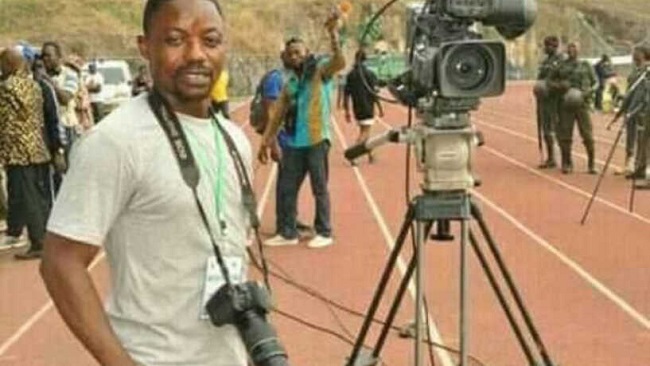
“Five media professionals were arrested. Although Rodrigue Ngassi identified himself to Security forces as Media cameraman, they arrested him and twisted his arm.”
ARTICLE 19 urges the authorities to ensure the protection and safety of journalists, to tolerate media reports on dissident opinions, especially during protests and to unconditionally release all those arrested only for exercising their rights to freedom of expression and association.
The police arrested five media professionals: Tah Jarvis, Tebong Christian Lindovi Ndjio, Rodrigue Ngassi Polycarpe Essomba. The Equinoxe tv channel has in their news broadcast condemned how the security forces treated Rodrigue Ngassi. He identified himself as a cameraman to the security forces, but they arrested him, and twisted his arm and put a foot on his neck. Rodrigue Ngassi was later released and urged the Cameroonian police to respect journalist doing their job.
Polycarpe Essomba, a Radio France International reporter was beaten, while he was covering the demonstration. The police hit him with a truncheon and took him to a police station, released him after two hours. Lindovi Ndjio, Journalist of “Nouvelle Expression”, Tah Jarvis and Tebong Christian respectively Journalist and Cameraman of “ My Media prime” were finally released on the evening of 23 September 2020 in the second day of their arrest.
“The arrest of the journalists, who were just doing their work, is a violation of media freedom. The role of the media is to report and inform the public about anything relevant to them. The authorities shouldn’t intimidate journalists and restrict the right to access to information.”
“Journalism is not a crime. It is not enough to release the arrested journalists. Any charges should be dropped. The Government must shed light on the ill-treatments and the motivation of their arrests against these journalists. Cameroon must end the cycle of impunity for attacks against journalists and brutal repression of protesters” urged Fatou Jagne Senghore.
It is very risky to work as a journalist in Cameroon, and the protection of the media continues to deteriorate. Following attacks on the press, ARTICLE 19 has interviewed the data journalist Paul Joël Kamtchang, Executive Secretary of ADISI Cameroon, who stated: “The protection of journalists in the exercise of their profession is deplorable in Cameroon. The authorities seem to believe they are above the law; they think they can muzzle journalist on duty.”
We call on the African Commission Special Rapporteur on Freedom of Expression and Access to information to urge the government of Cameroon to respect their obligations under the African Charter on Human and Peoples’ Rights and guarantee media freedom.
“We are asking the African Commission Special Rapporteur to monitor the situation and urge the government to investigate these violations and make sure that Cameroon will not continue to prevent, hinder or restrict unduly the right to protest and to attack media.”
The right to protest enables citizens to participate actively in the socio-political life of their country. Cameroon’s 1996 Law on the revision of the Constitution guarantees the freedoms of expression, assembly and association, press freedom and the right to protest. Also, the Constitution prohibits the use of the torture, and other cruel, inhuman and degrading treatment or punishment.
ARTICLE 19 has underlined in its principles of the right to protest that States should not prevent, hinder or restrict the right to protest except to the extent allowed by international human rights law and standards.
By banning and using excessive force to disperse a peaceful protest, Cameroon has violated its international obligations. For example, Article 19 of the International Covenant on Civil and Political Rights (ICCPR) and Article 9 of African Charter on Human and Peoples’ Rights (African Charter) guarantee that everyone should be able to express their opinions without interference. The Guidelines on Freedom of Association and Assembly in Africa underline that protest is a right, for which organisers don’t need prior authorisation.
By using excessive force, the authorities failed to ensure the safety of the public and to safeguard the human rights of all persons during the protest as stated in the African Commission Guidelines for the Policing of Assemblies by Law Enforcement Officials in Africa. Moreover, the excessive use of force doesn’t comply with the requirements of the UN Basic Principles on the Use of Force and Firearms and the UN Code of Conduct for Law Enforcement Officials and the Guidelines on Freedom of Association and Assembly in Africa.
At the UN Human Rights Council, during its last UPR review in 2018, Cameroon received recommendations to ensure that any restrictions on freedom of assembly and demonstration should be in line with international obligations. Unfortunately, the country only noted these, and in practice, Cameroon continues to restrict the freedom to protest. For example, in January 2019 when the authorities banned “marches blanches” following the announcement of the Presidential election results which were contested by the MRC. The security forces used excessive force to disperse the protesters with tear gas and bullets and arrested several demonstrators including the prominent opposition leader Maurice Kamto.
Culled from Sierra Leone Telegraph















28, September 2020
Exiles return to rebuild post-Bashir Sudan 0
After 33 years in exile, El Sadig Mohamed gave up the easy life in Canada to return to help rebuild Sudan as it emerges from three decades of autocratic rule.
“After the revolution… I thought it’s the right time to come back… despite the luxury people enjoy in the West,” said Mohamed, who now heads the Sudanese Mineral Resources Company’s health and environment department.
“It’s my country and I have to do it.”
The SMRC supervises exploration, production and taxation of Sudan’s mining sector, notably its star asset, the gold mines.
Ousted president Omar al-Bashir ruled the country with an iron fist for 30 years until his overthrow in April 2019 after months of youth-led street demonstrations.
“The Bashir regime, for 30 years, destroyed everything,” said the 55-year-old civil engineer and ex-University of Calgary professor, who came home in November, six month’s after Bashir was toppled.
“I believe it is my duty to take part in… building a new Sudan.”
The expert help is needed.
Sudan’s economy is in crisis, laid low by long years of civil war under Bashir’s rule, US sanctions and the 2011 secession of the oil-rich south.
SMRC’s director general, Mubarak Ardol, was in exile for eight years.
His home in Sudan’s southern Nuba Mountains was attacked by government forces, and Ardol had led rebel forces against them.
– ‘Proud’ –
He fled to Uganda in 2011.
“I thought the regime would not last long. We worked with all our might to overthrow the regime,” said 38-year-old Ardol.
“I felt certain I would return home very soon.”
So when Bashir was forced out, Ardol returned from Kampala as quickly as he could.
“I came back immediately,” he said. “I was the head of the first armed group which arrived in Khartoum on May 10, 2019.”
He was appointed by Prime Minister Abdalla Hamdok — a fellow returnee, who has made striking peace with the rebels who fought Bashir a priority.
Ardol aims to boost the revenues of SMRC, the African country’s top moneymaker.
“We far exceeded our targets,” he said.
Among the hundreds of exiles streaming in from around the world since last year, Mohammed Abdulhamid said he is “happy and proud” to have come back to take the reins at the state news agency SUNA.
“We knew it was a big challenge… I’m back home because I wanted to return, because I feel I can be a part of what is happening,” said the 64-year-old journalist, in the agency’s Khartoum offices.
– ‘Very diplomatic’ –
Abdulhamid lived in Yemen before moving to the Netherlands where he launched Arabic-language radio and television broadcasts.
“It was not a matter of money… I used to earn around $3,000 a month… Now I earn 80,000 Sudanese pounds, which is $180,” he said.
“I am proud of what I am doing, and I never regretted my decision.”
But the return of exiles from the US, Britain and the Gulf to fill government posts and succeed figures in Bashir’s Islamist regime at the head of state enterprises has not been universally welcomed.
“They’ve come to reap the rewards of victory, but it was us who suffered,” grumbled Amine Bashir, a 32-year-old entrepreneur and activist.
Adeeb Youssef, a Darfur provincial governor who lived six years in the United States after having served time in jail and escaped assassination, had advice for both sides in the new Sudan.
“This kind of jealousy doesn’t help,” said Youssef. “People who’ve lived abroad can bring this experience and knowledge… they see problems and issues in Sudan better than people who lived here.”
Mohamed said that returnees have to be “very diplomatic”.
“Until now they have welcomed us. But if they see anyone acting arrogant, they take it badly,” he said.
“The challenge for people coming from outside is that they are used to working in a system where everything is organised.”
Source: AFP