

13, September 2019
Cardinal Tumi optimistic about Biya’s planned ‘national dialogue’ 0
An upcoming “major national dialogue” in Cameroon has been hailed as a positive step by the country’s only Catholic cardinal.
In a rare speech on Tuesday, President Paul Biya called for “a major national dialogue that will, in line with our Constitution, enable us to seek ways and means of meeting the high aspirations of the people of the North West and South West Regions, but also of all the other components of our Nation.”
The North West and South West Regions of Cameroon are the English-speaking areas of the French-speaking majority population.
The “Anglophone Crisis” began in 2016, when demonstrations broke out in the two regions after there were demands to use French in their common law courts and English-modeled schools. English speakers make up around 20 percent of the country’s population and have long complained about being marginalized by the French-speaking ruling class.
After Cameroon’s security forces’ heavy-handed response – including using live ammunition on demonstrators – rebel movements arose calling for the independence of Anglophone Cameroon, saying the new country would be called Ambazonia.
According to the UN, the ensuing fighting between the separatists and government forces has led to the deaths of at least 2,000 people, and the displacement of a further 500,000.
Biya said he was launching the dialogue at the end of September to rally Cameroonians “to reflect on values that are dear to us, namely: Peace, security, national unity and progress.”
The dialogue will be chaired by Prime Minister Dion Ngute and bring together a wide range of personalities: Politicians, civil society and business leaders, religious authorities, and members of the security forces.
“It will also focus on issues that can address the concerns of the population of the North West and South West Regions, as well as those of the other regions of our country such as bilingualism, cultural diversity and social cohesion, the reconstruction and development of conflict-affected areas, the return of refugees and displaced persons, the education and judicial system, decentralization and local development, the demobilization and reintegration of ex-combatants, the role of the diaspora in the country’s development,” the president said.
The emeritus Archbishop of Douala, Christian Cardinal Tumi, told Crux he was “satisfied” with Biya’s remarks on Tuesday.
“Even before the speech, I was telling someone that if the president does not convene this national dialogue to resolve mainly the Anglophone problem, he would have said nothing. But I am very happy that he spoke at length about the problem,” Tumi said.
The cardinal had been on the forefront of efforts to bring people together to talk about the problem, but his efforts to organize peace talks have been thwarted by the government.
However, Biya’s latest appeal is not unconditional.
“Those who voluntarily lay down their arms and place themselves at the disposal of the Disarmament, Demobilization and Reintegration (DDR) Centers have nothing to fear,” the president said during his speech.
“Conversely, those who persist in committing criminal acts and violating the laws of the Republic will have to contend with our Defense and Security Forces and will face the full force of those same laws.”
“The same applies to promoters of hate and violence who, comfortably settled in foreign countries with impunity, continue to incite murder and destruction. Let them know that sooner or later they will have to face justice,” he said.
In efforts to resolve the crisis, the government has taken some actions, including the translation of regional corporate law documents into English; the creation of a Common Law Section at the Supreme Court to handle appeals filed against the decisions of lower courts in Common Law matters; the launching of a special recruitment of bilingual teachers in secondary schools; and the establishment of a national Commission for the Promotion of Bilingualism and Multiculturalism.
But these measures have proved unsuccessful in stemming the revolt.
Tumi expressed optimism the upcoming dialogue will lead to a sustainable peace, but told Crux he believes that only a return to a federal system of governance can resolve the Anglophone crisis.
“We are a people called to live with all our differences. In federalism, these differences are respected,” he explained in August.
When the English-ruled part of Cameroon voted to join the new country in 1961, as opposed to a union with neighboring Nigeria, it was as part of a federal government. Federalism was dissolved after a 1972 referendum.
A return to federalism would mean changing the constitutional form of the state – an idea Biya has frequently spoken against. Perhaps, the upcoming national dialogue could be the venue in which he changes his mind.
Crux

















13, September 2019
Ambazonia leader says Biya’s dialogue call a ‘non-event’ 0
The separatist leader of Cameroon’s English-speaking community on Thursday dismissed President Paul Biya’s call for national dialogue to end the country’s anglophone crisis as a “non-starter”.
Biya on Tuesday announced that he intends to open a major “national dialogue” later this month in a bid to solve the conflict between security forces and armed separatists from the anglophone minority in the west.
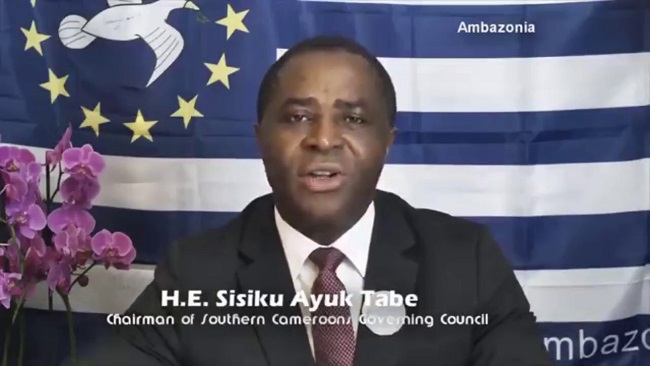
“The speech was a non-event and a non-starter,” separatist leader Julius Sisiku Ayuk Tabe said in a message relayed by his lawyers.
In August Ayuk Tabe was sentenced to life in prison along with nine of his supporters — a move that made the prospect of peace seem even more remote.
Ayuk Tabe is the first self-proclaimed president of “Ambazonia”, a breakaway state declared in October 2017 in two English-speaking regions of the central African country.
Since then the francophone-majority country has been mired in the unrest which has left more than 2,000 people dead as English-speaking separatists demand independence in the Northwest and Southwest regions.
More than 500,000 people have been forced from their homes as a result, according to the Human Rights Watch group.
Ayuk Tabe described Biya’s dialogue initiative as “an awkward and grudging attempt timed to avoid UN sanctions, considering that the UN will be deliberating on the anglophone crisis this September and Mr Biya and his regime has been amply put on notice.”
He added that “President Biya unilaterally declared the ongoing war in the Northwest and Southwest regions. He must unilaterally declare an end to the war that he declared.”
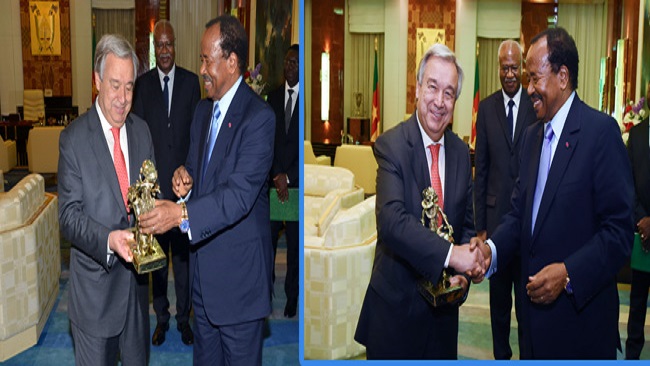
The UN has said that its Secretary General Antonio Guterres “welcomes the announcement” by Biya and “reiterates the readiness of the United Nations to support the dialogue process.”
But many commentators said that if Biya’s overture is genuine, it will have little chance of headway as long as separatist leaders remain behind bars or in exile.
AFP