3, May 2020
Senior Ambazonia commander killed in Bafut 0
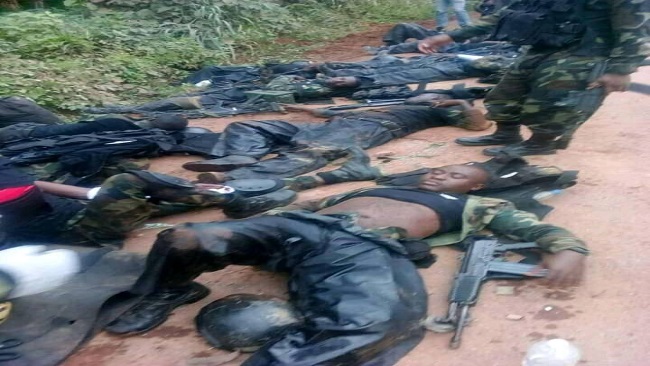
A separatist commander known simply as General Alhaji was among some insurgents who were killed on Friday in Bafut, a locality in Northwest, one of the two troubled Anglophone regions of Cameroon, the Cameroon army said Saturday.
The death of Alhaji was confirmed by Kingsley Ashu, a separatist leader, in a Facebook post.
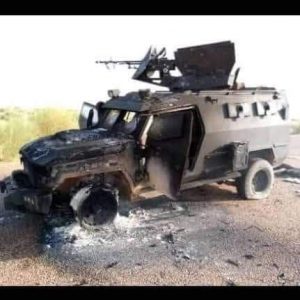
He was killed after a week-long military offensive in the locality that also witnessed the seizure of war weapons and dismantling of several separatist camps, local authorities said.
Alhaji was commanding one of the “largest and fiercest” armed separatist groups known as “Seven Katta Bafut Defence forces” in the region, according to security reports.
He became “notorious” in 2018 after kidnapping over 80 school children and teachers and a driver of a secondary school in Bamenda, Cameroon Anglophone’s largest city, security sources said, adding that his physical elimination could prove a major blow to the rebels in that region.
Since 2017, government forces have been clashing with armed separatist forces who want the two English-speaking regions of Northwest and Southwest to secede from the majority French-speaking nation and form a new country which they call “Ambazonia.”
Source: Xinhuanet


!['I want to ask them: 'You guys, you are fighting for separation, but instead you demand money from your brothers? How will we all live together in a new country when you do this?'.' said Kelly. [Ingebjorg Karstad/NRC]](https://www.aljazeera.com/mritems/Images/2020/4/29/0beafeff0142499ca138ad4cc5e6c6e2_8.jpg)
![Heavily pregnant Alliance went into labour and gave birth to twins during the violence. 'I asked God: How could you give me twins in these times of conflict?' I did not know I could live like this, even for a week,' the 36-year-old said. She was not able to breastfeed at night with the lights on as that would be dangerous as warring parties were fighting outside. [Ingebjorg Karstad/NRC]](https://www.aljazeera.com/mritems/Images/2020/4/29/cf124669dd894d10afb9d4fc63e28269_8.jpg)
!['When we fled I managed to bring with me some mesh and hair extensions. I thought it would be useful so I could work in Bamenda as well. But when we arrived here we had nothing to protect us from the cold concrete floors, so I had to use them for my twins to sleep on. They were damaged by baby pee,' Alliance said. [Ingebjorg Karstad/NRC]](https://www.aljazeera.com/mritems/Images/2020/4/29/311e26a6ed9a489dbc4a8849a7e83b6d_8.jpg)
![The scars of war are deep in Alliance's young children. 'When my children hear gunshots, they start to cry and run inside the house and they wet themselves. I lift them up and I carry them, I tell them it will be over soon,' she said. [Ingebjorg Karstad/NRC]](https://www.aljazeera.com/mritems/Images/2020/4/29/72653b58d83147348128784b3115267a_8.jpg)
![It was May 2018 when 71-year-old Celine escaped her village with her bedridden son, her frail mother, daughter and her three grandchildren. 'On the day we fled, there were heavy clashes and people ran into the bush to hide from the shooting. I could not run with them. My son is bedridden. My mother is nearly 100 years old. I had to stay behind. The army entered our house and asked me: 'Why are you still here?'. I showed them my son and my mother.' [Ingebjorg Karstad/NRC]](https://www.aljazeera.com/mritems/Images/2020/4/29/9d28a6e8f1e044fd83dd6cadfdddb1bc_8.jpg)
![Two years ago, life changed forever for 28-year-old Alpha when the conflict reached her village of Belo and took the life of her husband. 'One day the shooting got really close and our neighbours told us to quickly lock the house and hide. We did, but men in khakis broke in and dragged my husband out of the house and took him away. My kids and I ran for our lives. The next day someone found my husband dead along the roadside and asked us to come and collect him. When we dared to go back to the house, we found it burnt down to the ground. We lost everything. All our ID cards. Everything.' [Ingebjorg Karstad/NRC]](https://www.aljazeera.com/mritems/Images/2020/4/29/6f55dcaff0dc4fe8a342337a231346e6_8.jpg)
![Family members Carine, Happiness and Larissa are making the local speciality 'puff-puffs'. The women will sell these at the local market to get some income for the full family of 15 persons. After being displaced by violence, they all share one room that they rent in Bamenda. 'They killed nine people in the market square that morning we fled. I managed to bring with me a bucket of tomatoes and crayfish that I sold the next morning to get some money. I also brought some clothes, our IDs and my family photos. The military burned down our house and my shop,' Happiness said. [Ingebjorg Karstad/NRC]](https://www.aljazeera.com/mritems/Images/2020/4/29/37470e133fca45739addb4587a405813_8.jpg)
!['Life is not going anywhere,' says Glory, 28. She fled intense fighting in Ndu in January last year with her four children, her younger brother and her husband. With the daily shootings and burning of houses, life was no longer bearable in her village. As far as she knows, their house is still among those standing, but it is too unsafe to go back. So they rent a room in Bamenda with seven family members sharing one mattress. Back in the village, Glory used to roast fish and sell it along the road. Her husband worked as a driver. With barely any income, she finds it difficult to start up a business again. Most of the money they earn goes to rent and food, and most days, they go to bed hungry. School fees are too high to be able to afford them. 'It is really very difficult here,' she said. [Ingebjorg Karstad/NRC]](https://www.aljazeera.com/mritems/Images/2020/4/29/77c83afad92b4133abdd8861c33270ea_8.jpg)
![The road leading from the small airport outside Bamenda into the city has been the site of intense fighting and the area is mostly abandoned. Burned-out cars and destroyed houses are peppered everywhere. In the two English-speaking regions, more than 250 villages have been burned down and are now fully or partially deserted. [Ingebjorg Karstad/NRC]](https://www.aljazeera.com/mritems/Images/2020/4/29/32de70c6a5e34e5eb75cb6588229f524_8.jpg)
![''The boys, sometimes they want money, sometimes they just want to kill those they suspect do not support their cause,' says Reverend Mokake in the Cameroon Baptist Convention in Bamenda. 'It has been a hard year. We lost five pastors the last years as a result of the escalation of the conflict.' [Ingebjorg Karstad/NRC]](https://www.aljazeera.com/mritems/Images/2020/4/29/c001e2e1979847ea819020b1eae6f3c8_8.jpg)


4, May 2020
Yaounde: Journalists Protest Harassment, Abusive Arrests 0
Cameroonian journalists are marking World Press Freedom Day with protests against abuse from the government as well as from rebels fighting for an independent English-speaking state. Reporters Without Borders, in its 2020 World Press Freedom Index, ranks Cameroon 134th out of 180 countries in the World Press Freedom Index. Some Cameroonian journalists have been detained for their reporting or are on the run from the military or separatists.
This message from the Cameroon Association of English Speaking Journalists, that journalism has rules, regulations and professional ethics, is broadcast on television and radio, and shared on social media platforms by journalists in Cameroon as a sign of protest against the abuses they face. The message insists that journalists be allowed freedom to practice.
“We say no to the constant harassment and haphazard arrest of journalists in their line of duties,” the message said.
Journalists did not organize popular celebrations and public protests as in the previous years because of the more than 2,000 cases of COVID-19 in Cameroon.
They said, however, they shared the pain of peers who have been in detention, such as Mancho Bibixy and Tsi Conrad, arrested and charged with insurrection against the state of Cameroon and who have been in detention since 2017, Samuel Wazizi arrested late last year and jailed for alleged collaboration with separatist fighters, and Wawa Jackson, who was arrested in 2019 and accused of propagating the secessionists’ agenda in the English-speaking regions where separatists are fighting to break away from the majority French-speaking country.
Ngah Christian Mbipgo, publisher of Cameroon’s lone English-language daily newspaper, the Guardian Post, said his news organ has been the victim of press abuses while covering the separatist crisis that has killed 3,000 people in Cameroon in the past three years. He said 15 of his reporters, newspaper vendors and their family members have fled from hostile areas in the English-speaking North-West and South-West regions.
“The separatists think that we have not been doing much to project their independence ideology, and that is why our reporters in the field are targeted. I have not gone out of Yaoundé [to the English-speaking North-West and South-West regions] since 2017 that [when] the crisis metamorphosed into an armed conflict because they have openly called to tell me that I am a target. We receive calls from top government officials who say we are a newspaper that is working for the separatists,” he said.
Cameroon’s government did not issue a statement on for World Press Freedom Day, as there were no public ceremonies due to COVID-19. However, the government has always maintained that there is press freedom in Cameroon and journalists are only arrested when they act unprofessionally.
Jude Viban, president of the Cameroon Association of English Speaking Journalists said the government should decriminalize media offenses and make sure abuses against the rights of journalists by government officials and separatist fighters are stopped.
“What we are doing is to inform, and we do so for the interest of the population, so a handful of people should not attack the press. When stories are not told because journalists are under attack, the population would not be informed, which, of course, is their right to be informed in a democracy like ours,” said Viban.
Reporters Without Borders says press freedom continues its long decline in Cameroon, and reporters continue to be subjected to threats, attacks, intimidation and arrests after President Paul Biya’s reelection for a seventh term in October 2018.
Source: VOA