Featured
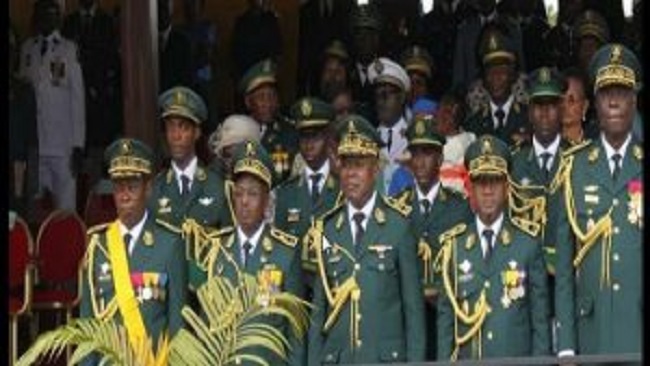 The Cameroonian army must put its conscience to the test
  Who really pushed for the return of the Vice President of the Republic?
  When politics fails a nation, football and the Church become the battleground
  Biya has had his era; Cameroon must now be allowed to enter its next one
 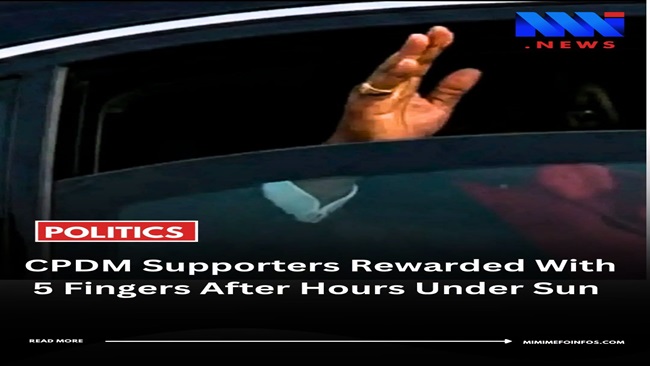 Biya’s hand: a source of glory and shame
Most Commented Posts
 4 Anglophone detainees killed in Yaounde
18 comments Chantal Biya says she will return to Cameroon if General Ivo Yenwo, Martin Belinga Eboutou and Ferdinand Ngoh Ngoh are sacked
13 comments The Anglophone Problem – When Facts don’t Lie
12 comments Anglophone Nationalism: Barrister Eyambe says “hidden plans are at work”
12 comments Largest wave of arrest by BIR in Bamenda
10 comments
Featured
-

Martinez Zogo Trial: questions over missing phone linked to Amougou Belinga
-

Revealed: Colonel Danwe admits ordering Martinez Zogo operation
-
Archbishop Nkea to battle decade of war with new peace Catechism
-

Southern Cameroons Crisis: 7 kidnapped by suspected Amba fighters in Bangourain
-
Southern Cameroons Crisis: 3 killed, 2 injured in bar shooting in Bamenda
-
US military nearing ‘breakdown’ amid sustained Iranian attacks
-
The Cameroonian army must put its conscience to the test
2, April 2026
Pope Leo XIV in Cameroon-The “Ambazonia crisis” in Southern Cameroons 0
Bamenda, the capital of Cameroon’s Northwest Region, which Pope Leo XIV will visit on April 16, is at the heart of the so-called “Anglophone crisis” that has shaken the country since 2016.
The origins of the crisis date back to the colonial era. A former colony of Wilhelmine Germany, Cameroon was divided in two at the end of World War I: one under British mandate and the other under French mandate. The French-speaking part became independent in 1960, while the English-speaking part in 1961. The latter, through a referendum, decided to join French-speaking Cameroon. In 1961, the Federal Republic of Cameroon was proclaimed, uniting territories with different languages and administrative practices. Federalism was abandoned in 1972 in favor of a unitary state. As a result, Cameroon’s English-speaking population felt increasingly marginalized and feared the disappearance of its legal and cultural distinctiveness.
The Anglophone crisis began in 2016 with a strike by lawyers and teachers who opposed the appointment of Francophone judges in Anglophone regions. The demonstrations were repressed by the Cameroonian government and were followed by episodes of violence.
In October 2017, Anglophone separatists proclaimed the Republic of Ambazonia (referring to Ambazonia Bay), thus formalizing their secessionist aspirations.
Since then, a conflict has erupted with a devastating human cost. Both sides in the war are using education as a weapon.
In Cameroon, public education is a prerogative of the state. Therefore, when attacking schools, armed groups are primarily targeting the symbol of a state institution. Schools, in particular, embody the flashpoints of the crisis, especially the language issue. French and English are the two official languages and enjoy equal status. However, French is used far more than English, thus fueling a sense of marginalization among Anglophone Cameroonians. Teaching and educational programs are, in principle, bilingual, even in Anglophone areas, something that is not accepted by the most radical separatists.
Since 2017, more than 700,000 children have been forced to drop out of school. According to the United Nations Office for the Coordination of Humanitarian Affairs (OCHA), more than 1.5 million people are in need of humanitarian assistance in the Anglophone regions. OCHA also estimates that at least 334,098 people have been internally displaced by the violence in the two regions, while more than 76,493 have sought refuge in Nigeria. Both separatists and government forces have perpetrated targeted attacks against health facilities and humanitarian workers, severely reducing access to medical care and forcing several international humanitarian organizations to suspend their operations.
Furthermore, the conflict has degenerated into a veritable criminal industry based primarily on kidnappings for extortion. Under the pretext of financing the independence cause, criminal gangs abduct ordinary people, demanding sums of money from their families in exchange for their release. But the kidnappings also have a political objective: they are abductions aimed at silencing women in particular, since they often play a crucial role in conflict resolution in Cameroon’s traditional and tribal societies.
The latest available data is from 2024, with 450 kidnapping cases recorded. Among those abducted are also priests. It is worth recalling the kidnapping of the late Cardinal Christian Tumi, Archbishop Emeritus of Douala, in 2020 who had expressed his willingness to mediate between the government and the separatists.
Furthermore, the separatists, known as the “Amba Boys,” have imposed a monthly “revolutionary tax” on the local population: 10,000 CFA francs (15 euros) for men and 5,000 CFA francs (7.50 euros) for women.
In this situation, the Church community continues its work of evangelization despite numerous difficulties, and Catholic institutions and representatives are striving to play a mediating role. In a statement sent to Fides, Andrew Nkea Fuanya, Archbishop of Bamenda, affirmed: “The Church has not taken sides with either the separatists or the government precisely so that it can offer its mediation services. Despite the violence, in the Archdiocese of Bamenda I have not closed any parishes nor have I fled. I engage in dialogue with both the government and the separatists in the constant search for the path to peace.”
Source: Agenzia Fides