Featured
 Unity Palace needs a new idea and a new head of state
  Martinez Zogo Affair: Biya must clean house and make way for a new generation
  Ambazonia People’s Liberation Authority explains motives for the new transition
  A year after Biya’s disputed re-election, CPDM remains without a timetable for next year’s polls.
 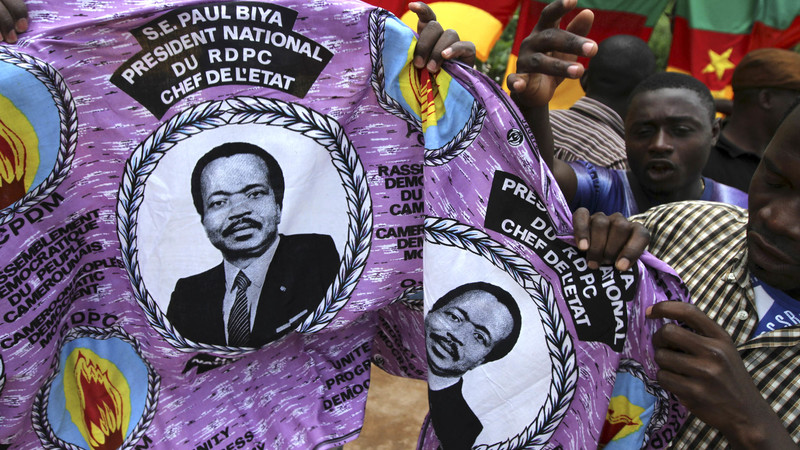 Ruling CPDM Party: When a political message runs out of the road
Most Commented Posts
 4 Anglophone detainees killed in Yaounde
18 comments Chantal Biya says she will return to Cameroon if General Ivo Yenwo, Martin Belinga Eboutou and Ferdinand Ngoh Ngoh are sacked
13 comments The Anglophone Problem – When Facts don’t Lie
12 comments Anglophone Nationalism: Barrister Eyambe says “hidden plans are at work”
12 comments Largest wave of arrest by BIR in Bamenda
10 comments
Featured
-

Unity Palace needs a new idea and a new head of state
-

Trump says US may launch ‘another little Epic Fury’ attack on Iran
-

Formula 1: Hamilton sets sights on racing in African grand prix
-

Yaoundé: anti-corruption agency calls for stronger powers after 20 years of limited progress
-

Martinez Zogo Affair: Biya must clean house and make way for a new generation
-

Biya’s health crisis is starting to alarm investors
-

Cameroon’s Eurobond yields hit record high after Fitch downgrade
26, June 2026
Dion Ngute admin targets power grid expansion 0
Cameroon wants to attract more investment into electricity transmission, marking a new phase in the country’s energy strategy. After years of financing new power plants, particularly large hydropower projects, the government now sees the transmission network as the sector’s biggest priority.
The shift was reaffirmed on June 19 in Yaoundé, where Minister of Water and Energy Gaston Eloundou Essomba met with Italy’s Ambassador to Cameroon, Natalia Sanginiti, and Riccardo Rossi Van Lamsweerde, head of the regional office of Italy’s public financial institution, Cassa Depositi e Prestiti. During the meeting, which focused on investment opportunities in the energy sector, the minister encouraged Italian partners to give greater attention to electricity transmission infrastructure.
“The transmission segment should continue to receive the attention of our partners. They should take an interest in it,” he said. The appeal is part of Cameroon’s National Energy Compact, a roadmap that seeks to mobilize $12.5 billion in additional financing by 2030. The government describes the plan as a roadmap for developing sustainable energy infrastructure that will expand access to clean energy for households and businesses while supporting industrial development and clean cooking.
Among the proposed reforms is a broader opening of the electricity transmission segment to private investors through public-private partnerships. The government hopes this approach will speed up infrastructure development while easing pressure on public finances.
A Grid Under Pressure
The growing focus on transmission comes as Cameroon prepares to significantly expand its electricity generation capacity.
After commissioning the Nachtigal hydropower plant, which increased supply to the Southern Interconnected Grid, the government is advancing several other major projects.
The 500-megawatt Kikot hydropower project remains one of the country’s top priorities. The Minkouma project is also moving forward, while Bini à Warak is approaching another milestone with the expected signing of a development agreement. At the same time, the government, with support from the World Bank, is conducting studies for large-scale solar power plants in the country’s northern regions.
As electricity production increases, expanding the transmission network has become more urgent. Without sufficient investment in high-voltage transmission lines, substations, and evacuation infrastructure, part of the new generating capacity may never reach households, businesses, and industrial zones.
The issue has become even more important as electricity demand grows alongside new industrial, mining, and port projects. In that context, electricity transmission is no longer just a technical component of the power sector. It has become a key factor in industrial competitiveness and in maximizing returns on the country’s investments in power generation.
Sonatrel Faces Major Investment Needs
Created by presidential decree in 2015, the National Electricity Transmission Company (Sonatrel) is responsible for transmitting electricity, managing the national transmission grid, and planning, developing, and building new transmission infrastructure on behalf of the state.
The company, however, faces significant investment needs to modernize and expand a network that remains insufficient for the country’s growing energy ambitions.
According to figures cited by the Ministry of Water and Energy, nearly 30% of the electricity generated in Cameroon is lost before reaching consumers because of weaknesses in the transmission and distribution networks. Reducing those losses is one of the government’s main priorities for improving the technical performance and financial sustainability of the electricity sector.
Opening the transmission segment to new financial partners is therefore viewed as a strategic step. The government hopes it will accelerate the construction of transmission lines, modernize existing infrastructure, and gradually strengthen interconnections between the country’s different power networks. The interest shown by Cassa Depositi e Prestiti in Cameroon’s energy projects could open the door to additional financing.
For the government, the challenge now is to convert growing electricity production into tangible economic gains. That will require a transmission network capable of reliably delivering power to households, industrial sites, and future manufacturing hubs.
After focusing much of its effort on expanding generation capacity, Cameroon now faces the next stage of its energy strategy: building a transmission network that can support economic growth, strengthen energy security, and make full use of the country’s investment in power production.
Source: Business in Cameroon