Featured
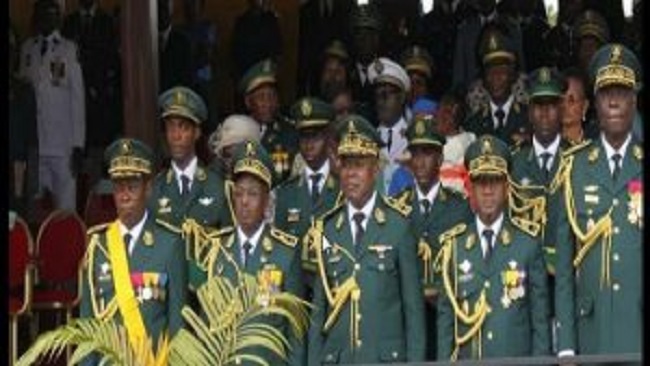 The Cameroonian army must put its conscience to the test
  Who really pushed for the return of the Vice President of the Republic?
  When politics fails a nation, football and the Church become the battleground
  Biya has had his era; Cameroon must now be allowed to enter its next one
  Biya’s hand: a source of glory and shame
Most Commented Posts
 4 Anglophone detainees killed in Yaounde
18 comments Chantal Biya says she will return to Cameroon if General Ivo Yenwo, Martin Belinga Eboutou and Ferdinand Ngoh Ngoh are sacked
13 comments The Anglophone Problem – When Facts don’t Lie
12 comments Anglophone Nationalism: Barrister Eyambe says “hidden plans are at work”
12 comments Largest wave of arrest by BIR in Bamenda
10 comments
Featured
-

Martinez Zogo Trial: questions over missing phone linked to Amougou Belinga
-

Revealed: Colonel Danwe admits ordering Martinez Zogo operation
-
Archbishop Nkea to battle decade of war with new peace Catechism
-

Southern Cameroons Crisis: 7 kidnapped by suspected Amba fighters in Bangourain
-
Southern Cameroons Crisis: 3 killed, 2 injured in bar shooting in Bamenda
-
US military nearing ‘breakdown’ amid sustained Iranian attacks
-

The Cameroonian army must put its conscience to the test
15, July 2026
SNH reports CFA49.3 billion available for transfer to state in Q1 0
Cameroon’s National Hydrocarbons Corporation (SNH) reported a balance of CFA49.253 billion ($about 87 million) available for transfer to the government at the end of the first quarter of 2026.
According to the state-owned company, the amount represents 52.2% of the CFA94.345 billion generated from the sale of the state’s share of oil and gas production and other related income during the quarter.
The remaining CFA45.093 billion, or 47.8% of total revenue, was allocated to expenses and commitments. These included CFA17.406 billion in partnership-related expenses, CFA18.052 billion in gas-sector commitments, and CFA9.635 billion in other commitments.
SNH, however, did not provide a breakdown of those categories or indicate which amounts had already been paid and which remained accounting commitments.
The distinction is important because the published balance is described as “available for transfer” rather than “transferred.” The report shows the amount remaining after expenses and commitments but does not indicate whether the funds had actually been transferred to the Treasury or when such a transfer might occur.
As a result, the figure cannot be treated as government revenue already received. It also differs from the “SNH royalty” reported in Cameroon’s budget accounts.
According to the Ministry of Finance, the Treasury received CFA91.8 billion in SNH royalties by the end of March 2026, compared with a quarterly target of CFA106 billion. The nearly CFA42.5 billion gap between that figure and SNH’s transferable balance may reflect differences in timing, accounting methods, or reporting scope. The available documents do not allow for a detailed reconciliation.
Crude oil remained the government’s main source of hydrocarbon revenue
Crude oil continued to generate the largest share of government hydrocarbon income. Sales of 1.662 million barrels produced CFA64.218 billion, accounting for 68.1% of total gross revenue recorded for the state’s share of production.
The cargoes were sold at an average price of $69.74 per barrel, generating total sales of $115.877 million. Natural gas ranked second, contributing CFA22.112 billion, or 23.4% of quarterly revenue. Gas sales to Gazprom alone generated CFA15.103 billion, ahead of sales to Kribi Power Development Company (KPDC) and Keda.
Sales of liquefied petroleum gas (LPG) to the government and Tradex added CFA3.421 billion, while other revenue totaled CFA4.594 billion. Overall, hydrocarbon sales attributable to the state reached CFA89.751 billion. Including other revenue brought total gross receipts to CFA94.345 billion.
Rio del Rey remained the main oil-producing basin
Total crude oil production allocated to the government and its operating partners reached 4.599 million barrels during the first quarter. The government received 2.691 million barrels, representing 58.5% of the total, while private partners were allocated 1.908 million barrels. Production remained heavily concentrated.
The Rio del Rey basin accounted for about 2.357 million barrels, or 51.3% of total output. Lokele produced 1.053 million barrels and Iroko 335,000 barrels. Other fields contributed a combined 854,000 barrels, or 18.6% of quarterly production.
Natural gas production was even more concentrated. Of the 17.806 billion cubic feet produced during the quarter, the Sanaga South field accounted for 17.529 billion cubic feet, or 98.4% of total output. Logbaba produced only 277 million cubic feet. All 7,282 metric tons of liquefied petroleum gas produced during the period also came from Sanaga South. Production and sales, however, did not necessarily occur during the same period.
The government sold about 1.029 million fewer barrels than were allocated to it during the quarter, while operating partners sold roughly 1.063 million more barrels than their first-quarter production share. These differences likely reflect the timing of production, storage, and cargo liftings, meaning quarterly sales may include oil produced earlier or exclude volumes still in storage.
Partners generated nearly CFA199 billion in hydrocarbon sales
Hydrocarbon sales attributable to private operating partners totaled CFA198.891 billion during the quarter.
Crude oil accounted for CFA147.370 billion, natural gas for CFA50.076 billion, and LPG for CFA1.445 billion. The report shows that partners sold their crude at an average price of $87.17 per barrel, compared with $69.74 per barrel for the state’s share.
That 25% difference should not be interpreted as evidence of stronger commercial performance, however. Without additional information on crude quality, shipment dates, market conditions, and contract terms, the figures are not directly comparable.
Including both the government’s and partners’ shares, total hydrocarbon sales reached CFA288.642 billion during the quarter. Adding other state revenue brought the total commercial value recorded by SNH to CFA293.236 billion. That figure reflects the scale of commercial transactions handled by SNH but does not represent government budget revenue.
Only the balance available after expenses and commitments—CFA49.253 billion—is presented as transferable to the state. Whether that amount ultimately appears in Treasury accounts will depend on when, and if, the transfer is completed.
Source: Business in Cameroon