
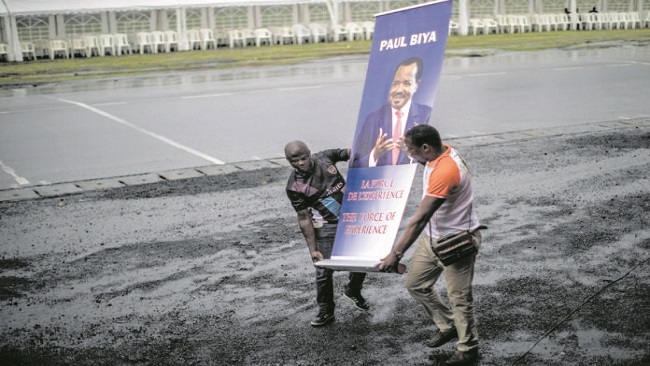
12, August 2021
Biya: The aggressive virus that wrecks everything in its path! 0
Nobody ever imagined that the man the country’s first president, Amadou Ahidjo, handed power to will one day be the most hated person in his own country. This is exactly what is happening in Cameroon as Paul Biya keeps fighting for his dear life in a Geneva Clinic where multiple ailments, including a heart disease, diabetes, high blood pressure and Alzheimer’s disease are robbing him and his family of their happiness.
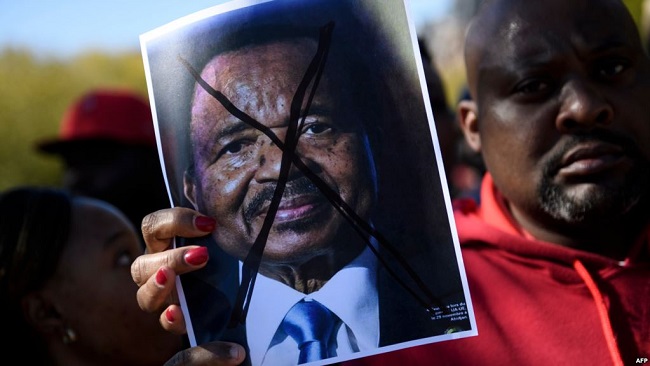
Paul Biya, the man who succeeded Amadou Ahidjo, is now being viewed by his own compatriots as a virus introduced into the system to destroy the entire country and even on his dying bed, Cameroonians think his demise will be good riddance. They hold him responsible for all the issues that are currently assailing the country.
The country’s economy is on its knees due to bad policies and professionally engineered pervasive corruption that will take decades to clean up. Cameroon, a country once known for its strong economy, is today known for its humiliating corruption that is gradually suffocating the economy. While the people loathe the corruption, the country’s president and his corruption love the mess they have created for their country. The people have been pauperized by a Machiavellian government whose objective is to perpetuate its stay in power and this makes it easy for it to lead the people by their noses.
The level of unemployment is mind-blowing. University graduates have simply thrown in the towel. They have been reduced to sorry spectators of events in their own country. They are tired hitting the pavement to look for jobs and many are waving the white flag. Even the low paying civil service jobs have lost their attractiveness as many Cameroonians look outwards for salvation. The Biya government, which was seen in 1982 when Mr. Biya came to power as a “salvation army”, has turned out to be a nightmare that will not be going away anytime soon.
Biya, many Cameroonians say, is like a computer virus that even affects the mind. Though he inflicts pain on many Cameroonians, many still think that at 89, he is the only person who can rule the country, though he has been in power for close to 40 years and has nothing to show for his long stay in power. Many analysts think many Cameroonians have been overwhelmed by the Stockholm syndrome which is an emotional response, and it happens to some abuse and hostage victims when they have positive feelings towards an abuser or captor.
Some of these analysts attribute these helplessness and admiration for a man who has robbed an entire nation of its dignity and promise to the alcohol that flows like a stream throughout the country. But not everybody has lost his minds. Some Cameroonians are clearly out of patience and they want Biya out. They accuse him of all the crimes and sins in this world even when he has nothing to do with personal issues.
The level of frustration has pushed some Cameroonians to even blame their erectile dysfunction on Biya. Some hold him responsible for their premature ejaculation that is tearing their families apart. He is now to blame for even unwanted pregnancies as well as the proliferation of churches in the country.
But such personal issues are not the ones that will tear the country apart. The Southern Cameroons crisis in the country’s two English-speaking regions is what may destroy the country beyond recognition. Southern Cameroonian fighters have stood their ground for more than four years despite the military’s superior weaponry and they are more determined than before. Their military victories have given them more confidence and their use of explosives and other remote-controlled devices is striking fear in the military.
Over the last two months, there has been a swift and inexplicable reversal of fortunes that has put the military in a very tight spot. The Southern Cameroons Defense Forces (SCDF) have proven that they are a force to deal with and they understand the terrain more than the soldiers. The fighters who started off with hunting rifles have struck fear in the minds of many soldiers, with many deserting the military for fear of being killed in a war they hold could have been avoided through peaceful negotiations with the country’s English-speaking minority.
While the tentative death toll stands at some ten thousand dead, sources in the country’s Defense Ministry have hinted that more than three thousand soldiers have been killed and more than four thousand maimed, while up to a thousand have simply melted out of the country. Southern Cameroons is now a nightmare and a graveyard to many of the hastily recruited soldiers from the Center and South regions who have been misled to think that power belongs to them and that Southern Cameroonians are seeking to rob them of what is rightfully theirs.
The Southern Cameroons crisis has also given the country’s economy some deadly blows to the liver, exacerbating the already bad economic situation. Most state-owned corporations in the two English-speaking regions of the country have been seriously affected by the fighting and they are only operating at half capacity. Many of the workers have been laid off and the country has no employment insurance program or alternative retraining programs that can enabled those laid off to find new jobs. The pain is excruciating and the level of criminality in the two regions is just breath-taking.
While the country’s English-speaking minority is creating nightmares for the government in the Southern part of the country, in the North, Boko Haram, the notorious religious sect that started its activities in Nigeria, is spreading death and destruct. Even with support from Western countries, the Yaounde government has not been able to flush Boko Haram fighters from its northern territory. On the country, Boko Haram fighters are gaining new territory every day. Ordinary citizens do not trust the government, as its soldiers are wont to killing children and women with impunity and this is hurting the government’s effort. Civilians prefer to collaborate with Boko Haram fighters instead of with soldiers who always unleash their frustration on the innocent civilian population.
Cameroon is on the brink of a massive implosion. If the armed conflict and terrorist attacks do not bring down the delipidated edifice called Cameroon, the inter-tribal wars that have been in the wings for decades will surely cause the country to go up in pieces. The tribe-based government that has led the country for almost four decades has hurt other Cameroonians and the pent-up anger and frustration may spill over once Mr. Biya exits.
Northerners want to recapture power after more than four decades which have seen many northerners treated like second-class citizens. Northerners have a bone to pick with this regime and they know the Betis will be their target once power falls into their hands. Thousands of northerners were killed in 1984 following a failed coup and they have yet to forget that those summary killings were designed to push the North from the corridors of power for good.
Biya, the dangerous virus, has succeeded to divide Cameroonians. He thought he could only rule for long if he divided a people who had total faith in their national unity. He might have succeeded for close to four decades, but he seems to be running out of luck and those who followed him blindly are now regretting. These days, most Biya supporters seem to be walking on tenterhooks. They are scared of the bad news, but it is bound to happen. The once admired president might only return to his country in an expensive coffin. The odds are against him.
The latest information reaching the Cameroon Concord News Group says that Mr. Biya will not be able to head home next week. Twice his return has been announced and twice it has not taken place. He has now been out of the country for 30 days and in a few days’ time, a vacancy may be announced by the country’s political opposition if Mr. Biya does not cut his treatment short to demonstrate that he can still rule the country.
This is really bad news for his political party and the crooks that are hiding within the party. Cameroonians are bitter and they want to take their pound of flesh for all these years that the regime has oppressed and suppressed them, and they will surely be targeting the flesh that is closest to the heart.
They want to hit the ruling party where it hurts the most. Most ruling party members are indebted to the state or have committed some financial malfeasance that might take them to the country’s maximum-security prisons and the public is looking forward to the day most of them will be dragged through the streets before being thrown in jail.
Many of those crooks and praise-singers are seeking visas to leave the country before the bad news finally makes its way to Yaounde. Biya is in a pretty mess! His health has failed him badly. From every indication, he will not be making it before a vacancy is announced. The “virus” has been infected by many dangerous and powerful viruses. Nature is talking! Biya is gradually understanding that he is not indispensable. He also knows that death can also be his potion and the arrogance with which he ruled Cameroon was uncalled for.
If the worst were to happen, many things will fall apart for some of the criminals who have been using the ruling party to rob the country blind. Many regime insiders are worried, and some have already started talking like magpies. They know Biya has messed up the country, and they know there is no justification for their joyful participation in the destruction of a country that has been considered for many years as an oasis of peace in a desert of chaos and the economic engine of the Central African region.
The days ahead are critical for Cameroon. The dying Biya is still hanging on. He has beaten many illnesses and cheated death on many occasions. Will he be able to stage a spectacular come-back this time around? Time and age are not on his side. He has ruined a once beautiful and prosperous country. However, there is some time for him to deliver his mea culpa. Cameroonians will surely forgive. They want to move on. But will they ever forget this dark chapter in their country’s history?
Biya the virus is no longer dangerous, and he might not have another opportunity to hurt Cameroonians. He has already ruined a lot. The country has hit rock bottom. There is not much he can do again. He is on his way out and Cameroonians have only one prayer point for him. May his soul rest in peace when and if that news gets made public.
By Soter Tarh Agbaw-Ebai










12, August 2021
French football hails Messi’s PSG move, but will the beleaguered Ligue 1 benefit? 0
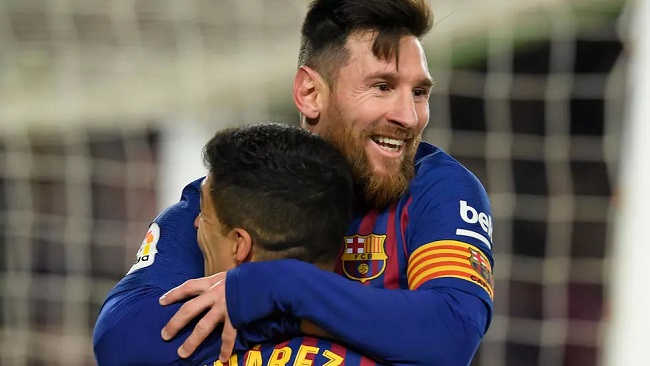
Paris Saint-Germain’s surprise signing of Lionel Messi has been hailed as a shot in the arm for France’s cash-strapped football league, but experts warn that the Argentine superstar’s arrival is not all good news for an increasingly unbalanced Ligue 1.
Call it the revenge of the “farmers’ league”.
As the least prestigious of Europe’s major football leagues, France’s Ligue 1 is well-accustomed to the derogatory moniker, the “farmers’ league”. But now that the world’s most famous footballer has joined the farm, it’s time for a little payback.
On Tuesday night, hours after Lionel Messi signed a two-year deal with Paris Saint-Germain, the league’s Twitter account posted an image of a goat leaning on a farm’s fence with the shirts of Ligue 1’s top players hanging on either side. The caption read, “The farmers have a new goat” – a reference to Messi’s unofficial standing as football’s “GOAT” (Greatest of all time).
Capping a decade of sensational signings by Qatar-owned PSG, the Argentine’s surprise move to Paris has been met with a mix of shock and delight in France, where few pundits had openly entertained the idea that Messi would one day play Ligue 1 football. In terms of prestige, it dwarves even the club’s record €220 million purchase of Neymar in 2017.
In unusual comments praising a club’s transfer dealings, Ligue 1 chief Vincent Labrune – a former president of PSG’s arch-rivals Marseille – celebrated Messi’s signing as a big win for French football in a statement on Wednesday.
“Messi’s arrival will bolster the attractiveness and visibility of our championship across continents,” Labrune said, thanking the club’s owners for creating what he called one of sport’s biggest global franchises.PSG fans hail ‘start of a new legacy for Paris’
Instead of lamenting the widening gulf between the free-spending Parisians and the rest of the pack, PSG’s domestic rivals have also hailed the arrival of Argentina’s six-time Ballon d’Or winner.
“Can you imagine Messi coming to town?” asked Saint-Etienne coach Claude Puel, celebrating a “huge boost” for the French league.
His Brest counterpart Michel Der Zakarian struggled to contain his enthusiasm, telling reporters: “We say that we have a shit league, but if we manage to bring in a player like that, it would be exceptional. I’m not going to be polite here – but he gives me a hard-on.”
Is he the Messiah?
In normal times, PSG’s rivals may well have frowned at the Parisians’ latest move to catch another star. But these are no ordinary times for clubs whose revenues have been hollowed out by the coronavirus pandemic, leaving many teetering on the edge of a cliff. Indeed, it’s no surprise French football sees a saviour in the Argentinian superstar, whose name is pronounced the same way as the French word for Messiah (“Messie”).
According to economist Christophe Lepetit, a member of French football’s DNCG auditing body, Paris Saint-Germain’s lavish spending has helped raise Ligue 1’s profile by luring the world’s top players to France.
“In recent years, the club’s high-profile signings have countered the notion that the Ligue 1 is a ‘farmers’ league’, and Messi’s arrival will further debunk the myth,” he says.
PSG’s star transfers – which in recent years has included the likes of Zlatan Ibrahimovic, Edinson Cavani, David Beckham and Kylian Mbappé – have also helped to qualify another criticism levelled at Ligue 1: that it is merely a “feeder league”, nurturing young talent that is then sold off to the highest bidder. Instead, Lepetit says, “PSG prove that French football can also attract and hold on to the biggest stars in the game.”
The challenge for Ligue 1 officials is now to ensure the league’s heightened star power translates into an increased global audience – and thus greater revenue.
“Talent scouts are already very familiar with the French league, but many in the wider public may discover it now, thanks to Messi,” says Lepetit. “And by watching PSG’s league games, they may discover new players and clubs they want to follow.”
Boosting Ligue 1’s global audience is crucial to French hopes of improving the rotten deal they get from television broadcasters when compared with Europe’s “big four” leagues: England’s Premier League, Spain’s La Liga, Italy’s Serie A and Germany’s Bundesliga.
Three years ago, Neymar’s signing helped push the value of Ligue 1’s international broadcasting rights from €25 million up to €80 million. But that is still only a fraction of what the Premier League and La Liga earn, and less than half the money fetched by the Italian and German leagues.
With legions of fans scattered across the globe, Messi should be an even greater pull than Neymar. Unfortunately for the French league, however, news of his arrival comes just days after it signed off on a new three-year broadcast deal following months of bitter wrangling – meaning the Argentine will be aged 37 by the time that deal expires.
A dead rubber?
Until a more lucrative deal is signed with the broadcasters, and the dividends are spread out across the board, there is little evidence to suggest that other French clubs will benefit from PSG’s most prestigious signing yet.
Amid the euphoria prompted by Messi’s arrival, some have likened his move away from his boyhood club Barcelona to that of another illustrious Argentine, the late Diego Maradona, more than three decades ago. But Maradona’s bold 1984 switch to Italy was precisely what Messi’s transfer is not: a transformative move that singlehandedly put southern minnows Napoli – then the butt of rival Italian fans’ racist jokes – on the football map, breaking the richer northern clubs’ stranglehold on Serie A.
Instead, analysts warn that Messi’s move to PSG will only widen the chasm between the phenomenally wealthy Qatar-owned club and its domestic rivals – a divide that arguably does more harm to the French league’s global standing than the actual quality of the football produced.
“What we’re seeing is the further strengthening of the one club that already outstrips all others, at least in terms of the stars at its disposal,” says sports economist Jean-Pascal Gayant at the University of Le Mans.
“If Messi had signed for another French club, rather than the one that already dominates all others, then yes, that would certainly have heightened interest in the French league,” he says. “But it’s the opposite that’s happening.”’Messi makes football magic,’ says PSG president
According to Gayant, PSG’s signing of an umpteenth superstar is both good and bad news for French football, adding to the pool of talent on display but also increasing the competitive imbalance between clubs.
“Two factors determine a sport’s attractiveness: the amount of talent on display and the level of competitiveness, without which there is no suspense,” he explains. “In this case, an increase in the first factor will almost certainly be offset by a further decline in the second.”
More worryingly for Ligue 1 officials, and indeed their European peers, Messi’s move threatens to widen the disconnect between Europe’s heavyweight clubs, like PSG, and smaller outfits. In this respect, Gayant argues, it increases the likelihood of a future split between a continental “Superleague” and second-tier domestic leagues.
Culled from France 24