
22, September 2020
Heightened Crackdown on French Cameroun Opposition with no AK47s 0
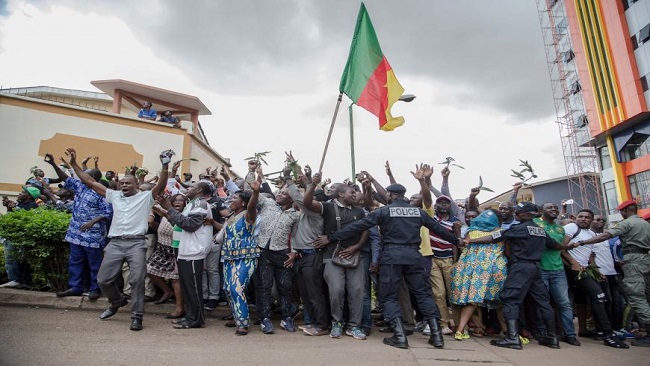
Cameroon authorities banned demonstrations after the opposition party Cameroon Renaissance Movement (Mouvement pour la renaissance du Cameroun, MRC) encouraged people to take to the streets over the government’s decision to call regional elections.
On September 11, 2020, the governors of the Littoral and Centre regions banned public meetings and demonstrations indefinitely. Three days later, Territorial Administration Minister Paul Atanga Nji, in a letter to the two governors and the governor of the West region, warned that law enforcement forces would break up unauthorized demonstrations. He said that the governors should arrest anyone organizing or leading demonstrations, claiming that protests would endanger lives during the Covid-19 pandemic. On September 15, the communication minister warned political parties that protests could be considered “insurrection” and that illegal demonstrations across the country would be punished under the anti-terror law.
“These steps are a thinly veiled attempt by the Cameroonian government to use the Covid-19 pandemic and the draconian anti-terror law as a pretext to quell the right to assemble,” said Lewis Mudge, Central Africa director at Human Rights Watch. “Cameroon’s authorities should protect and facilitate the right to assemble, not seek to curb it.”
These measures came after President Paul Biya announced on September 7 that Cameroon’s first regional elections would be in December. On September 8, Maurice Kamto, the MRC leader, called for peaceful protests on September 22 against holding the elections. Seven other opposition parties and civil society organizations have joined Kamto’s call for peaceful demonstrations. Opposition parties have multiple concerns that they cannot be conducted freely and fairly without reforming the electoral code and addressing the lack of security in the Anglophone regions.
Human Rights Watch conducted phone interviews between mid-August and early September with 15 leaders and members of opposition parties, as well as 5 representatives from civil society and human rights groups.
The Cameroonian government started lifting Covid-19 restrictions in May, allowing bars, restaurants, and nightclubs to reopen. In June, it allowed schools and other training centers to reopen, as well as churches and mosques. The efforts to target the opposition-led demonstrations over Covid-19 appear to be arbitrary, Human Rights Watch said. On September 16, the MRC issued a note providing guidance to all members and supporters who are planning to participate on September 22 on how to ensure peaceful demonstrations and curb the spread of Covid-19 by wearing a face mask.
Other opposition-led meetings and demonstrations have been banned in Cameroon in the last 18 months. In April 2019, the authorities banned a week of demonstrations planned by the MRC across the country. Local authorities recently prohibited two private meetings planned by the party in Maroua, Far North region, on August 9, and in Nkongsamba, Littoral region, on August 15, citing concerns around Covid-19 and general public order.
The Nkongsamba meeting was to be a private meeting at the party headquarters and should not have been subject to a public order ban. In Maroua, where the meeting was to be held in a hotel, the local authorities prohibited the meeting ostensibly on health grounds, although party leaders said they were taking preventive measures to avoid the spread of the Covid-19, including respecting the limit of 50 participants, as required by law. Party leaders told Human Rights Watch that authorities have allowed similar meetings in both cities by the governing Cameroon People’s Democratic Movement.
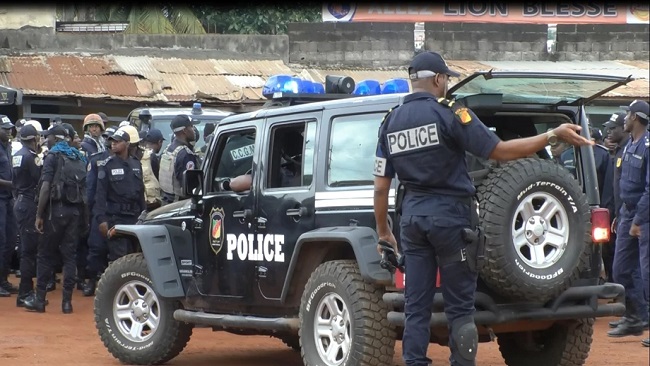
On September 19, the headquarters of the opposition party Cameroon People’s Party (CPP) in Yaoundé was surrounded by over 30 policemen and gendarmes. “The Yaoundé District Officer claimed that the CPP was holding a public meeting without declaration, but we informed him that we were holding our regular weekly meeting whose participation is limited to our members,” Edith Kahbang Walla, known as “Kah Walla,” CPP president said in a statement published the same day. “This is an umpteenth violation of the law and attempt to intimidate us.” After a standoff of about one hour, CPP members were allowed to leave.
Human Rights Watch has previously documented that Cameroon’s government has used the pandemic as a pretext to settle scores and punish the opposition. In May, the authorities arrested several volunteers from the Survival Initiative, Kamto’s fundraising initiative to respond to the health emergency, as they handed out protective masks and sanitizing gel in Yaoundé, the capital. They were charged with rebellion, then released on May 15.
MRC spokesperson Biboun Nissack told Human Rights Watch that the government’s recent ban on demonstrations “threatens to force our party underground.”
Cameroon’s constitution guarantees freedom of assembly. Cameroonian law requires organizers to notify local authorities seven days before a demonstration. While freedom of assembly is not absolute, and restrictions including those aimed at protecting public health are permissible, any such measures must not only have a legal basis but be strictly necessary and proportionate to achieve the objective and not discriminate against particular groups.
Broad, blanket bans such as that invoked by the Cameroon government, in particular in response to political organizing by opposition parties, do not meet these criteria. On March 16, United Nations human rights experts warned that “Emergency declarations based on the Covid-19 outbreak should not function as a cover for repressive action under the guise of protecting health, and should not be used simply to quash dissent.”
The anti-terror law, promulgated in December 2014 as Cameroon struggled to address the escalating threat posed by the Islamist armed group Boko Haram, has been widely criticized, including by Cameroonian and international rights groups and opposition parties, for its overbroad definition of terrorism, the provision of the death penalty, and for being used to silence the opposition, civil society, and the media.
This recent crackdown on freedom of assembly also follows a well-documented pattern of politically motivated arrests and prosecutions of opposition party members and activists, including MRC vice president, Mamadou Mota.
“When government authorities threaten to treat exercise of the right to peaceful protest as an act of insurrection, they are attacking the fundamentals of a society based on human rights and the rule of law,” Mudge said. “Basic freedoms and rights – guaranteed not only under Cameroon’s international obligations, but also in its constitution – are at risk, and if this crackdown leads to wider protests, the excessive use of force and ill-treatment could dramatically escalate.”
Culled from Human Rights Watch















22, September 2020
Cameroon is a ship without a captain 0
Cameroon is bleeding. The people are exasperated and exhausted. The dictatorial, increasingly repressive regime of Paul Biya — one of the longest-ruling leaders in all of Africa — seems not to care about this predicament. Daily, the situation in our beleaguered country grows worse. Cameroon is adrift and crumbling, like a ship without a captain, sailing listlessly amid the ever-cascading waves that collectively batter us.
It is for these reasons that this week — the third anniversary of the outbreak of mass violence in our Anglophone regions — Cameroonians will take to the streets to once again chase our destiny by means of peaceful demonstrations. As a collective voice for change and reform, Cameroonians will again demand that Biya and his corrupt ruling cabal step down from the offices they no longer respect or deserve.
The people believe that demanding political change in Cameroon is the ultimate act of sacrifice and patriotism. They are prioritising the future of our country, something that the ruling regime has failed to do for several decades.
For Cameroon to meet the long-subdued aspirations of its people, a bold reform agenda must be advanced; a viable path for change, regardless of the present dangers. The situation demands leadership and it is evident that the regime is unwilling or unable to exercise the necessary courage.
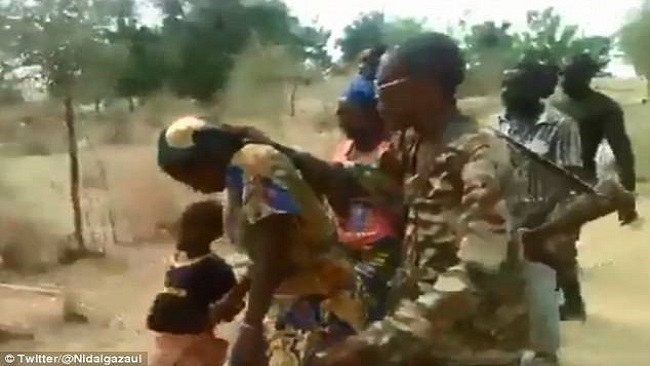
As Cameroonians prepare for peaceful protests, they are concerned about the potential for state violence. In the past, our placards and chants have been met with gunfire, beatings, burnt villages, torture and extrajudicial executions, as well as rape as a weapon of war against our female colleagues.
The freedom to demonstrate and free speech are protected by Cameroon’s Constitution — and duly recognised in regional and international conventions to which our country is part of — yet these basic rights are not respected in practice. My patriotic colleagues and like-minded Cameroonian citizens are law-abiding people who reject all forms of violence. Cameroonians will maintain this stance regardless of the atrocities committed against us. But our plight and demands need to be heard by the international community. Too often, and for too long, our cries for freedom have been met with silence.
The awakening of the Cameroonian spirit, and our peoples’ reclamation of its freedom, are not very different from similar battles that were fought elsewhere such as the apartheid regime in South Africa and in segregationist America. Nor is it dissimilar from the pro-democracy struggles against dictatorships that once stood and still stand in parts of Latin America, Eastern Europe and across the African continent.
No banning or outlawing of any movement has ever prevented a committed people from demanding or attaining their freedom. This is especially so in a context, like Cameroon, where avenues for political change have been systematically nullified through shambolic elections and equally sham persecutions of regime critics.
Today in Cameroon, the nexus between the unending civil war in our Anglophone regions and the imperative of new leadership in our capital city is clear. The Anglophone crisis is part of a deeper cancer in metastasis. The humanitarian disaster is a symptom, a horrific one, of a deeper problem of governance. And until that deeper problem is addressed by Cameroonians and international allies, then the longer the Anglophone crisis will linger. It will simmer and it will continue to kill.
Because I have encouraged people to exercise their democratic rights, I know I may be targeted and arrested by authorities, *as has become the norm. Now, more than ever, the people must speak up against injustice.
But the people of Cameroon need international support. Their struggle needs the attention that a humanitarian crisis of this magnitude deserves. As of this writing, for example, the United Nations conservatively estimates that the ongoing conflicts in our country have killed more than 3 000 people and displaced nearly 700 000 more in the Anglophone regions — this represents about 20% of Cameroon’s total population.
The situation facing our country is dire, but it is not beyond repair. Our people understand that the time to act is now. It is incumbent upon them to both exercise their rights peacefully and to demand change, fearlessly and with bold conviction. Only with change at the top can they, as concerned citizens, begin to heal our country’s deep scars and once again place faith in their future as a united people. Inspired by the words of the great Nelson Mandela, our people are saying: “Never again shall it be that our beautiful land of Cameroon will again experience the oppression of one by another. Let freedom reign. And God bless Cameroon.”
Source: Mail/Guardian