

31, January 2020
Cameroonian employers and tax authorities are at daggers drawn 0
The representatives of Cameroon’s top employers are calling for the sacking of Cameroon’s tax chief, a sign of deteriorating relationships across the business and government sectors as the economy underperforms.
The president of the Groupement Inter-Patronal du Cameroun (GICAM), Célestin Tawamba, in a letter dated 16 January and addressed to President Paul Biya, complained about the attitude of the current head of the Direction Générale des Impôts (DGI), Modeste Mopa Fatoing.
An observer of the country’s economic environment, summed up the letter, saying it was “an indictment and, above all, an explicit demand for [Fatoing’s] dismissal”.
In what was obviously a deliberate leak, the letter made the front page of the economic newspapers. One headline dated 22 January, stated: “Consummate breakdown of relations between the Directeur Général des Impôts and companies”, and carried substantial extracts from the letter. Naturally, this ignited activity on social media.
Gicam’s tax reform in question
According to a copy of the letter, seen by Jeune Afrique, the bosses’ boss openly criticised the DGI boss for, among other things, “his inability to engage in dialogue and to deal with contradiction, the refusal to issue administrative documents which has led to considerable delays in making investments, his inability to devise a short- and medium-term fiscal policy likely to boost growth while ensuring an appreciable level of revenue for the state, his lack of knowledge of the reality for companies”.
For Tawamba, it seems, the straw that broke the camel’s back was Fatoing’s “hostility to a GICAM tax reform proposal in which he [Fatoing] thought he perceived an attempt by the private sector to replace the state, despite instructions from his superiors”.
The cornerstone of GICAM’s 300-page tax reform proposal, submitted in 2018, was to reduce the minimum collection rate on turnover from 2.2% to 1.1%. This would provide companies with a tax break worth 51bn CFA francs ($8.7bn). Tawamba, who is also the founder of the Cadyst Invest Group, has continually advocated abandoning taxation based on activity in favour of a tax based on profit.
Cameroon and the IMF
DGI Fatoing dismissed the complaints. “The DGI is not opposed to anything,” he said.
A tax administration official said: “Arbitrations in budgetary and fiscal matters are made by the presidency” and pointed out that 71% of GICAM’s proposals were validated by a steering committee set up in 2018 by finance minister Louis Paul Motaze, most of which are gradually being implemented.
“The remaining 29% of the proposals, which include the issue of minimum collection, require in-depth studies of their impact, all this while Cameroon is under a programme with the IMF. Moreover, the minister of finance had made this known to employers on 3 November 2018, in Douala,” said our source.
Recipient of the letter, President Paul Biya, has remained silent.
Culled from The Africa Report




















31, January 2020
Ambazonia Fighters Attack Reporters, Torch Media Offices 0
Journalists in Cameroon’s troubled English-speaking regions say separatists are attacking them because of critical reporting and refusal to broadcast rebel propaganda. Media organizations say separatist intimidation is intensifying as Cameroon prepares for local and parliamentary elections, which the rebels have vowed to stop.
Community radio station Stone FM, in Cameroon’s northwestern town of Ndop, stopped broadcasting Monday.
Manager and presenter Mbuotna Zacks Anabi says armed men stormed the station late Sunday night, firing shots into the air before setting the building on fire.
Speaking via a messaging application, he said the suspected separatists left nothing.
“Before burning, they first of all looted radio equipment. Then on the 27th of January 2020, they burned the radio house [station] as well as my own personal house – maybe because I have been against broadcasting their messages. I have been campaigning for schools to go back [reopen],” Anabi said.
Cameroon’s separatists consider the French-speaking majority’s state schools and teachers to be legitimate targets in the English-speaking west and attack those that refuse to close.
Anabi said after the attack, he fled to the English-speaking town of Bamenda, 60 kilometers away, and the station staff in 13 villages went into hiding.
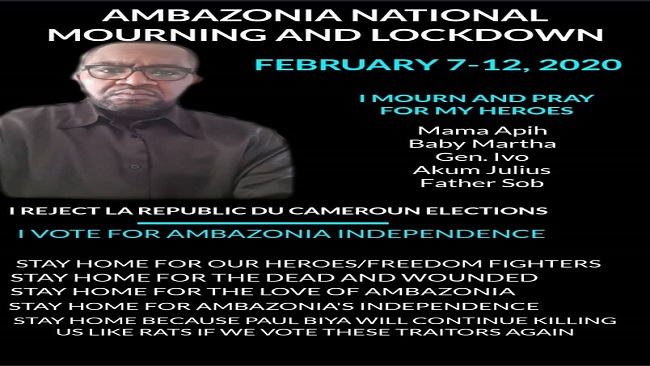
Rebels have not claimed responsibility for the attack. However, on social media, they have threatened anyone supporting Feb. 9 elections in Cameroon’s English-speaking regions.
The separatists are fighting for an independent English-speaking state, and have vowed to stop any elections held by Cameroon’s French-majority authorities.
Twenty-four-year-old teacher Antoinette Melo, a Ndop resident, says without Stone FM, people in the town have little access to news and information.
“That was the only radio station that informed us and for the past days we have not been having any information. It is difficult because we are preparing for elections and we want to hear what candidates are saying,” Melo said.
‘Attack on democracy’
Jude Viban, president of the Cameroon Association of English-Speaking Journalists, notes that Stone FM is not the first station targeted by the rebels.
He said separatists have been attacking reporters and media in the English-speaking regions for refusing to broadcast their propaganda.
“We are calling on the authorities of the country to make sure that they investigate and bring the culprits to book and we also want to let those who are attacking journalists as well as those who are attacking media houses to know that it is sad for our democracy. One of the core values of democracy is press freedom and each time a journalist or a media house is attacked, it is an attack on democracy,” he said.
Viban said journalists are reporting separatist intimidation for simply asking people to vote in the elections.
The government has repeated that it will protect all of citizens and is calling on the population to report any suspected rebels.
Stone FM is the third radio station to be attacked in Cameroon’s restive English-speaking regions in recent weeks.
The others were community radio stations in the northwestern town of Oku and the southwestern town of Kumba.
Since the separatist conflict broke out in 2017, journalists in Cameroon have complained of abuses from both rebels and state security. Close to 30 Cameroonian journalists say they have been detained or threatened while reporting on the conflict. Several were charged with terrorism before the charges were later dropped.
Journalist Macmillan Ambe was abducted by separatist fighters in the city of Bamenda in February 2019 after he criticized their call for families to keep their children out of school. He was released a day later unharmed.
Police last March detained the president of the Cameroon Community Media Network, Geraldine Fobang, for leading a peaceful protest for press freedom. She said police intimidated her before she was released after a few hours.
Military police arrested TV journalist Mimi Mefo in 2018 and charged her with publishing false information and terrorism. The charges were dropped only after Cameroonian President Paul Biya intervened.
Former Guardian Post reporter Amos Fofung fled to the United States in 2017 after he was arrested with three other journalists for allegedly supporting the rebels. He remains in the U.S.
The Reporters Without Borders 2019 World Press Freedom Index ranked Cameroon 131st globally, a two-position drop since 2018.
Source: VOA