
6, June 2019
French and Southern Cameroons Crisis: Full-blown war can still be averted 0
As Cameroon tops a list of the most neglected crises, the world must help those in need and demand an end to attacks on civilians
Mary hands me two tattered photos. In the first, family members stand proudly outside their modest home in Buea, South-West Cameroon. In the second, an empty plot remains, their wooden hut burned to the ground.
Mary and the 14 family members who lived in the house fled to the bush last December. They are still waiting for help to rebuild their home and their lives.
Conflict has uprooted half a million people in South-West and North-West Cameroon. Hundreds of villages like Mary’s have been razed. Hospitals have been attacked. Health workers fear being abducted or killed. Over 780,000 children are out of school, and their teachers are attacked and abused if they try to restart classes.
When brutal fighting displaces hundreds of thousands of civilians, it usually sets international alarm bells ringing. But Cameroon’s fast-deteriorating crisis has resulted in no mediation efforts, no large relief programme, little media interest and too little pressure on the parties to stop attacking civilians.
The silence is chilling.
This is why Cameroon tops this year’s global list of the most neglected displacement crises, according to NRC’s annual tracking system.
Cameroon’s crisis has roots in the country’s troubled colonial history. After World War One, the former German colony was split between a French and British mandate. When the French part became independent in 1960, people in the English speaking regions had to merge with either Nigeria- or French-speaking Cameroon. What was then known as Southern Cameroons ended up with the latter, creating a country with French and English as official languages. However, communities in the English-speaking part of the country have felt increasingly marginalized since.
In 2016, people took to the streets in peaceful demonstrations. A heavy crackdown by security forces ensued, leading to widespread violence and the formation of armed opposition groups.
A year later, non-state armed groups in the region officially declared a symbolic independence from Cameroon, followed by clashes between the national army and secessionist groups. Both sides have been accused of horrific human rights violations. The UN human rights chief, Michelle Bachelet, described the situation as spiraling completely out of control, after visiting in May.
Unbiased information is scarce. Social media is swamped by photos of apparent atrocities. But independent journalists are absent or restricted, and the crisis rarely makes international headlines.
The lack of public attention to the crisis is followed closely by a lack of financial support. Despite being one of the smallest UN’s aid appeals, Cameroon is among the least funded. The consequences of this can been seen immediately.
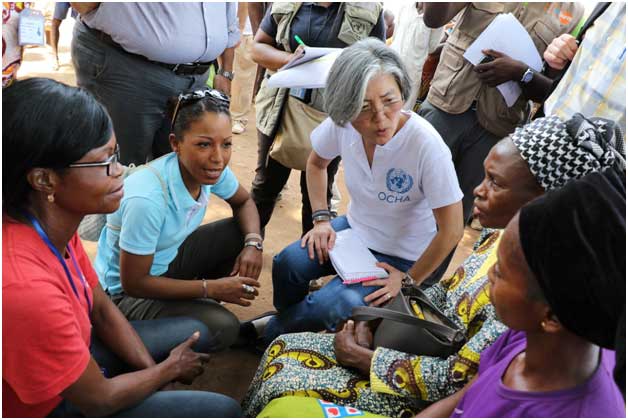
When I visited Cameroon in April, only a splattering of poorly-resourced international relief organisations were visible on the ground. Too few reach beyond the provincial capitals, so many families receive no assistance, even though it is possible to negotiate access with the parties on the ground. Communities ration and share the little assistance they receive, often travelling long distances themselves to deliver aid to those still hiding in the bush.
The women I spoke with in Buea said they feel abandoned by the international community. They asked me, ‘where is the international solidarity? Where is Europe?’
Europe is dragging its heels. Cameroon’s colonial history should be an argument for positive engagement today, and not disengagement. Furthermore, Cameroon is seen as an important ally for many countries in the fight against Boko Haram in the country’s north. The attention to problems there is no excuse for political inaction.
Countries with influence in the region must demand conflict parties stop attacks on civilians and allow schools to reopen.
When I addressed an informal session of the United Nations Security Council in May, my message on Cameroon was clear. More aid is needed, but it is only a temporary solution. Coherent conflict resolution efforts towards a political solution are the only thing that will end the violence and the suffering. Regional and international bodies, like the African Union, the European Union and the UN Security Council can and should play a more important role.
There is still time to avert a full-blown war.
Source: Reuters


















6, June 2019
Rights monitors sound alarm over ‘neglected’ Southern Cameroons crisis 0
Rights groups have sounded a warning over the escalating crisis in western Cameroon, where separatists and government forces are locked in deadly combat.
“The international community is asleep at the wheel when it comes to the crisis in Cameroon,” the secretary general of the Norwegian Refugee Council (NRC), Jan Egeland, said in a report issued on Tuesday.
“Brutal killings, burned-down villages and massive displacement have been met with deafening silence.”
Two regions in Cameroon are in the grip of an armed campaign by English-speaking militants seeking independence from the francophone-majority country.
On October 1 2017, they declared the creation of the “Republic of Ambazonia,” covering the two English-speaking regions incorporated into post-independence Cameroon in 1961.
The declaration went largely unnoticed outside Cameroon, and “Ambazonia” — named after a bay at the mouth of the Douala River — has been recognised by no-one.
The government responded with a brutal crackdown, and the separatists in turn have mounted a campaign of attacks on state buildings, shooting and kidnappings.
According to the International Crisis Group think tank, 1,850 people have been killed, while more than 530,000 people have been forced from their homes, according to UN figures.
The NRC said the crisis in the Northwest and Southwest Regions topped its annual list of the world’s “most neglected displacement crises”.
There has been no major mediation effort, no large relief programme, minimal media interest and insufficient pressure to stop attacks on civilians, it said.
Second and third on the NRC list were long-running conflicts in the Democratic Republic of Congo and Central African Republic.
Separately, a report by a Cameroon-based rights group in Africa, the CHRDA, and the Canada-based Raoul Wallenberg Centre for Human Rights, accused the armed forces of conducting “a deliberate, violent campaign against civilian populations”.
It acknowledged that local armed groups also bore “much responsibility” for the violence.
“It is sometimes argued that the current crisis is just one more conflict in a series of reciprocal attacks and reprisals between government and secessionist forces,” the report, published on Monday, said.
“However, minimizing the seriousness of the attacks on civilians as part of the ‘normal’ conflict serves to shield serious human rights violations and crimes against humanity and may even enable their continuation.
“Minimizing the conflict also ignores evidence that the violence is spreading, engulfing Francophone regions of the country, becoming a threat to the entire sub-region.”
Around a fifth of Cameroon’s population of 24 million are English-speakers.
Resentment has long festered at perceived discrimination at the hands of the francophone majority in education, law and the economy.
In recent years, growing demands for autonomy or a return to Cameroon’s federal structure were rejected by President Paul Biya, prompting radicals to gain the ascendancy in the anglophone movement.
AFP