24, December 2019
France taking land from La Republique Du Cameroun 0
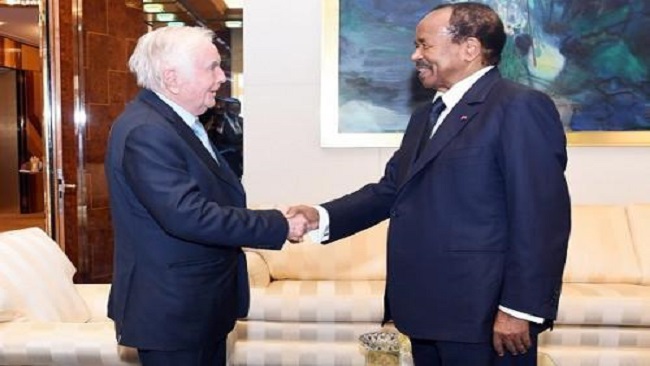
French brewery group Castel is planning investments in the agriculture sector. On December 20, the CEO of the group, Pierre Castel and a delegation including the French ambassador to Cameroon Christophe Guilhou was received by President Paul Biya in Yaoundé. The aim of this audience was for Castel Group to present its investment programme.
“The new investment programme presented by the CEO of Castel group to the Head of State focuses on the development of agriculture in order to reduce the importation of raw materials used to produce brewing products,” the presidency of the republic indicated.
For the time being, Castel indicates that 30% of its inputs are supplied in Cameroon. It currently collaborates with 6,000 local farmers that supply 30,000 tons of sugar and 10,000 tons of corn to the group’s local subsidiary SABC yearly.
Despite these supplies, 70% of SABC’s input needs still remain to be covered. The group’s CEO has not yet revealed the specific details on these new investments but, it can be guessed that the targetted sub-sectors are corn and sugar used in the production of brewery products.
Castel indicates that its yearly investments in Cameroon are estimated at XAF35 billion and it generates 15,000 direct jobs and 35,000 indirect jobs.
Source: Business in Cameroon























28, December 2019
Debate Intensifies Over Future of CFA 0
Debate on the future of the CFA franc in the six-member Central African Economic and Monetary Community (CEMAC) has intensified after it was announced last week that eight West African countries agreed to change the name of their common currency to Eco. They also severed the CFA franc’s links to former colonial ruler France.
The CFA franc used by west and central African states is considered by many as a sign of French interference in its former African colonies, and the main reason for the underdevelopment of CEMAC, which remains the poorest economic bloc in Africa.
Louis Nsonkeng, a researcher and economic lecturer at the University of Bamenda-Cameroon, says when the Eco becomes legal tender, the eight West African states will have their financial freedom from the strong grip of former colonial master France. He says the six central African states that also use the CFA franc should immediately emulate the example of the west Africans.
“In 2017, the International Monetary Fund published the [list of] 10 richest countries in Africa,” Nsonkeng said. “None of the countries was from the CFA zone and most of these countries have their own currencies. If we discover that we don’t have the resources to manage a common currency, then we should dissolve the currency area. We should dissolve it and each country should decide on their own currency.”
Cameroon, Chad, Gabon, Equatorial Guinea, Central African Republic and Congo use the CFA franc. The CEMAC member states have more than 50 percent of their financial reserves kept in the French treasury, following agreements signed in 1948.
Thomas Babissakana, a Cameroon economist and financial expert, says such agreements drain the economies of central African states because France now uses the euro, yet France still controls its currency.
It is unthinkable, he says, that a country will claim it has its independence when its currency, which is an essential instrument for its economic policies, is controlled by a former colonial master.
The CFA franc, created in 1945, is considered by many as a sign of French interference in its former African colonies, even after the countries became independent.
The CFA franc was pegged to the French franc until 1999, when its value was fixed at about 660 CFA francs to one euro.
Daniel Ona Ondo, president of the CEMAC commission, says the six member states’ economic growth rate is estimated at 3 percent in 2019 — up from barely 1 percent in 2018 — and inflation remains under control at less than 3 percent. He says the most demanding issue is to consolidate regional integration before thinking of currency reforms.
Fourteen west and central African countries divided into two monetary unions, ECOWAS and CEMAC, use the CFA franc.
Source: VOA