19, September 2025
Cameroon cocoa challenges deepens amid disease and insecurity 0
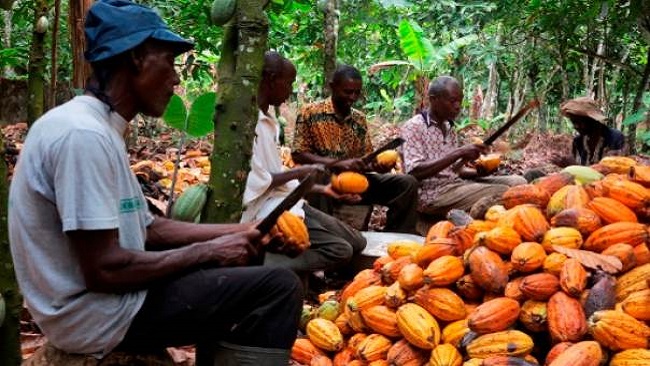
Cameroon’s cocoa industry, the world’s fourth-largest, is facing a compounding crisis that combines disease, insecurity, and corporate pullback. The sector generates over CFA 359 billion (about USD 595 million) from 180,095 tons in the first half of 2024/25 and sustains nearly one million people, but output is under acute pressure. National production, commonly ranging from 250,000 to 290,000 tons, is expected to contract by at least 10% this season, with the South-West region, the supplier of nearly half the crop, being hit hardest.
The first blow is biological. Heavy rains since July 2025, topping 2,200 mm in the South-West, have triggered a surge in black pod disease (Phytophthora megakarya). Infection rates of 65–70% have been reported in key districts such as Muyuka and Kumba. Counterfeit fungicides undermine farmers’ efforts to contain the outbreak, as many are smuggled across the Nigerian border. The result is pod losses ranging from 30% to as high as 90% on some farms, eroding both quality and volume simultaneously.
Layered on top is insecurity. The Anglophone conflict has entrenched “ghost town” lockdowns in the South-West and North-West, enforced by separatist groups. On these days, all economic activity halts, and farmers risk ambush if they attempt to reach plantations. A recent one-month lockdown disrupted government field inspections and fungicide quality checks, worsening the spread of disease. Historically, these ghost towns have cut cocoa sales from the South-West by as much as 40%, and 2025 has seen their persistence alongside sporadic clashes and extortion on rural roads.
Corporate retrenchment adds another dimension. Telcar Cocoa Ltd., which once handled up to 40% of the nation’s beans, suspended processing operations in mid-September, citing a “bean quality crisis.” The move follows Telcar’s earlier split with Cargill and reflects both the deterioration of crop quality and the logistical disruptions caused by ghost towns. By withdrawing, Telcar reduces domestic processing capacity, pushes more beans onto spot markets, and signals growing uncertainty to investors. The suspension also deprives farmers and small grinders of a key buyer, deepening income losses.
The mechanics of the crisis show a classic supply shock in a commodity with inelastic short-term output. Farmers cannot quickly expand acreage or replace diseased trees. With fewer beans being moved to market, prices rise. At the same time, ghost towns and insecurity impose frictional costs: shipments are delayed, storage risks rise, and smuggling surges. For small grinders, the effect is severe — input costs can increase 20–30%, throughput is disrupted, and margins are compressed by as much as 70%. Many risk closure without relief.
Global markets are already feeling the ripples. Futures on ICE were trading at USD 7,364 per ton on September 17, down slightly on the day but vulnerable to upward spikes. Cameroon’s potential 25,000–40,000-ton shortfall alone cannot overturn global supply dynamics dominated by Côte d’Ivoire and Ghana, yet in a context of regional weather shocks and political volatility, it magnifies uncertainty. Price volatility in Q3 has already risen above 7%, and Telcar’s exit will feed risk premiums in forward contracts.
Policy and commercial responses are lagging. Government inspection programs remain hampered by insecurity, while fungicide certification and distribution channels are too porous to prevent the penetration of counterfeit products. Extension services are restricted, and there is no adequate insurance or risk-sharing mechanism for grinders. Without rapid action, production in 2025/26 could contract by 15–25%, resulting in sustained high local prices (4,000–6,000 CFA/kg) and hollowing out processing activity and rural incomes.
The crisis is a test of resilience for Cameroon’s cocoa economy. Farmers require secure corridors to access plantations and reliable fungicide supply chains. Small grinders need cooperative mechanisms and hedging tools to manage volatility. For investors, the message is twofold: the near-term opportunity lies in long positions on West African cocoa, but the long-term risk is systemic — without integrated solutions that tackle both disease and insecurity, Cameroon’s comparative advantage in premium-quality cocoa could erode irreversibly.
Source: Business in Cameroon












19, September 2025
A Critical Rebuff: The International Criminalization of Liberation Movement and the Complicity in the Ambazonian Genocide 0
The recent, coordinated international arrests of key Ambazonian leaders—the illegal detention of our President, Dr. Cho Ayaba, in Norway, and the charges against our compatriots, Benedict NwanaKuah and Pascal Kikishy Wongbi, in the United States—represent a sinister and calculated escalation in the global campaign to annihilate the Ambazonian quest for self-determination. These actions are not isolated judicial events but political acts, designed to decapitate our liberation movement and provide diplomatic cover for the genocidal campaign being waged by the puppet regime of Paul Biya in La République du Cameroun and its master, the French government.
This moment reveals a profound and damning hypocrisy within the international order, drawing direct parallels to other gross injustices, such as the unwavering support of Trump’s USA for the Israeli genocide in Gaza.
1. The Political Persecution of Ambazonian Leadership: A Global Witch-Hunt
The arrest of Dr. Cho Ayaba, the recognised President of the Federal Republic of Ambazonia and leader of our decolonisation struggle, is an egregious violation of international law and the principle of political asylum. As detailed by Fatshimetrie, this detention, likely executed under intense pressure from Yaoundé and Paris, is a blatant attempt to:
• Silence Our Chief Advocate: Dr. Ayaba is the most potent and articulate global voice detailing the genocide against our people. His incarceration is intended to mute our narrative on the world stage.
• Criminalize a Legitimate Struggle: By falsely equating our right to self-defence—a right enshrined in the UN Charter—with terrorism, our oppressors and their international sponsors seek to delegitimize our cause and justify their own ongoing atrocities.
• Demoralize Our People: The message is clear: no Ambazonian leader is safe, even in nations that profess a commitment to human rights. Norway has shamefully become an outsourcing agent for the Biya regime’s political repression.
Similarly, the charges against Benedict NwanaKuah and Pascal Kikishy Wongbi in Minnesota must be viewed with extreme scepticism. While we do not condone attacks on civilians, the timing and nature of these charges reek of a politically motivated setup, orchestrated to corroborate the false narrative of “Ambazonian terrorists” and to provide a pretext for further international crackdowns on our diaspora and funding networks. This is a classic tactic of colonial powers: to provoke a resistance and then use the response to justify overwhelming, brutal retaliation.
2. The Biya Regime and Its French Patron: Architects of the Ambazonian Genocide
As the AGOVC has meticulously documented (agovc.org), the Cameroonian state is not engaged in a “conflict” but is executing a premeditated genocide against the people of Ambazonia. This campaign, supported logistically, militarily, and diplomatically by France, includes:
• Systematic Massacres: The burning of entire villages (e.g., Ngarbuh, Muyenge, Kumba) and the summary execution of civilians.
• Scorched-Earth Tactics: The deliberate destruction of homes, hospitals, schools, and farms to induce famine and force the displacement of our people.
• Torture and Sexual Violence: Widespread use of rape as a weapon of war and horrific torture in clandestine detention centres.
• Economic and Medical Siege: Imposing illegal blockades that restrict access to food, medicine, and humanitarian aid.
France’s role is that of the primary enabler. It arms, trains, and funds the Cameroonian military. At the UN Security Council, it provides diplomatic immunity for the Biya regime, blocking any meaningful intervention or sanctions. France protects its economic interests (managed by corporations like Bolloré and Total) and its neocolonial Françafrique influence at the cost of Ambazonian blood. Paris is not a mediator; it is a co-sponsor of this genocide.
3. International Hypocrisy: The Palestine-Ambazonia Parallel
The world’s silence on Ambazonia is part of a broader pattern of hypocrisy and selective application of international law. The parallel with Palestine is unmistakable:
• The Oppressor’s Playbook: Both the Israeli state and the Cameroonian regime employ the same rhetoric of “counterterrorism” to justify a brutal military occupation and the collective punishment of a civilian population.
• Great Power Complicity: Just as the Trump administration provided unconditional political cover, funding, and weapons for Israel’s crimes in Gaza, the French government provides the identical support package to the Biya regime. The United States and France act as the twin guarantors of impunity for these genocides.
• Media and Institutional Blackout: Both crises are met with a deafening silence from the international media and a cowardly refusal by global institutions to uphold their own laws and conventions.
The message to oppressed peoples is clear: your right to exist and to self-determination is contingent on the geopolitical interests of powerful nations. International law is a weapon used against the weak and a shield for the powerful.
A Call to Action
The arrests of our leaders are a desperate attempt to break the spirit of the Ambazonian people. They will fail. Our resolve, forged in the fires of immense suffering, is unbreakable.
We therefore demand:
1. The Immediate and Unconditional Release of President Dr. Cho Ayaba and the immediate dropping of all politically motivated charges against Benedict NwanaKuah, Pascal Kikishy Wongbi, and all detained Ambazonians.
2. An End to French Complicity: An immediate arms embargo and the cessation of all military and diplomatic support from France to the Biya regime.
3. ICC Investigation: A full, independent investigation into the genocide in Ambazonia by the International Criminal Court, with charges brought against Paul Biya and his military commanders.
4. UN-Supervised Decolonisation: The immediate initiation of a UN-mediated process for the complete and sovereign independence of the Federal Republic of Ambazonia, rectifying the historical crime of the 1961 plebiscite.
The world failed Rwanda. It is failing Palestine. It must not be allowed to complete the genocide in Ambazonia. History is watching.
#FreeAyabaCho #FreeAmbazonia #EndGenocide #FranceStopTheKilling #Cameroon #USAHandsOffAmbazonia
By Dr. Larry AYAMBA, Former Secretary of State for Foreign Affairs of the Ambazonia Governing Council (AGOVC)