17, April 2026
Pope Leo XIV’s Visit to Bamenda: “A Moral Abdication – Generic Platitudes While Ambazonia Bleeds” 0
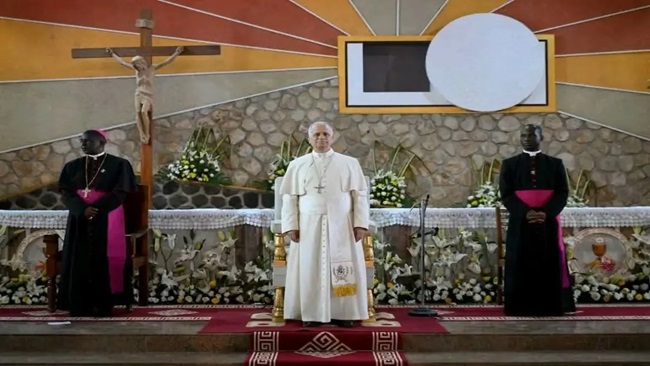
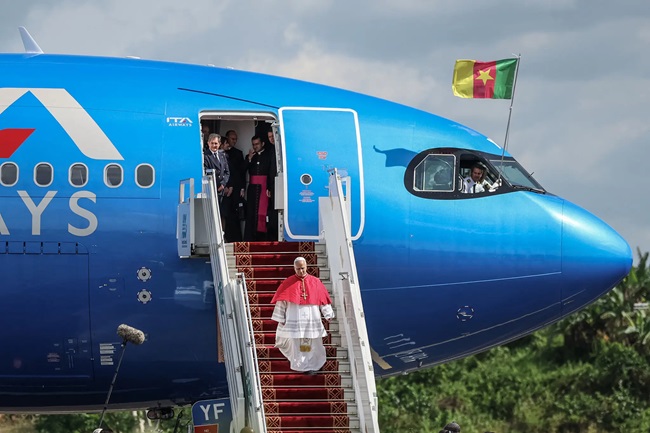
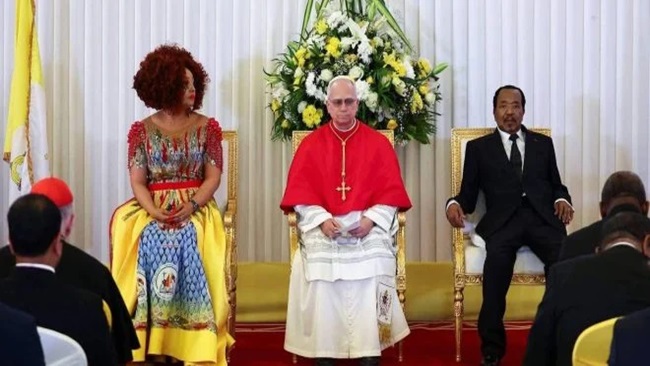
In the shadow of St Joseph’s Cathedral, where the blood of Ambazonian sons and daughters still stains the soil of the Northern Zone, Pope Leo XIV stood before a carefully staged “Meeting for Peace.” Amba forces, in a unilateral gesture of goodwill and restraint, had announced a three-day temporary cessation of hostilities to ensure the Holy Father’s safety and the dignity of his apostolic journey. Yet what the Vatican delivered in return was not prophetic truth to power, but a masterclass in diplomatic evasion – a torrent of lofty abstractions that left the structural genocide against the people of the former UN Trust Territory of British Southern Cameroons (Ambazonia) untouched, unnamed, and unaddressed.
The Pope spoke of “peace,” of “fraternity,” and of the dangers of manipulating religion for “military, economic and political gain.” He lamented the “almost decade-long conflict,” acknowledged dusty feet on bloodstained yet fertile land, and urged conversion and neighbourly love. He praised interfaith efforts and a so-called Movement for Peace. Fine words. Empty ones. In the very epicentre of Yaoundé’s scorched-earth war crimes – where La Republique du Cameroun (BIR) occupation forces have, since 2016, carried out extrajudicial executions, systematic village burnings, mass rape, torture, and enforced disappearances – the Successor of Peter uttered not one syllable about the root cause: the criminal annexation of Ambazonia in defiance of UN General Assembly Resolution 1608 (XV) of 21 April 1961.
He never once named the crisis for what it is: the direct, predictable consequence of failed decolonisation. He never invoked the binding legal instruments – the African Commission on Human and Peoples’ Rights (ACHPR) Banjul Decision on Communication 266/2003, the 2019 Abuja Federal High Court ruling declaring the rendition of Ambazonian leader’s illegal, or the peremptory norm of the right to self-determination enshrined in the UN Charter and the 1966 International Covenants.
Not a word was spoken about the over 580,000 internally displaced Ambazonians, the “world’s most neglected displacement crisis” as declared by the Norwegian Refugee Council. Not a whisper about the Nera 10 and thousands of other political prisoners rotting in Yaoundé’s maximum-security dungeons in open defiance of Nigerian and African Commission rulings. No demand for an immediate, verifiable ceasefire monitored by a neutral AU/UN mission. No call for unfettered humanitarian access. No insistence on direct, unconditional negotiations between Yaoundé and legitimate Ambazonian representatives– in a neutral third country, with the full spectrum of outcomes, including total independence, explicitly on the table.
The 16-Point Peace Plan released by Ambazonian representatives in July 2025 – some concrete, staged, monitorable roadmap endorsed by the very legal instruments the Vatican claims to uphold – received zero mention. Not the immediate ceasefire. Not the unconditional release of all prisoners. Not the restoration of meaningful autonomy or explicit negotiation of independence. Not the independent truth and reconciliation commission. Not demilitarisation and international guarantees. Nothing.
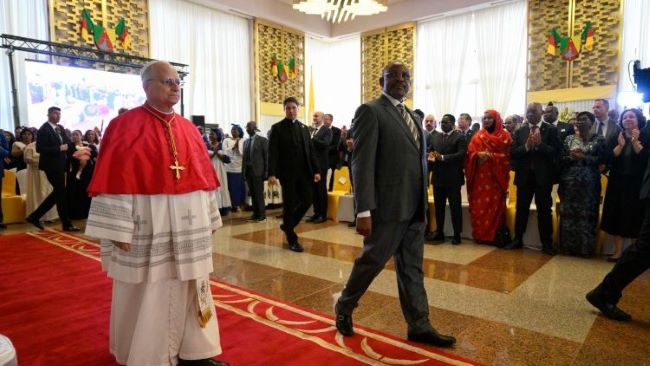
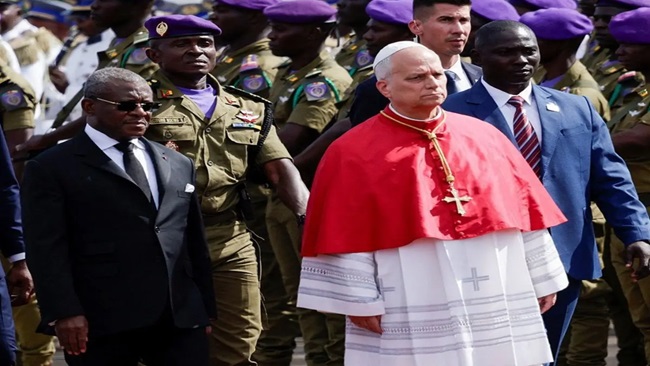
Instead, the Pope offered the same toothless, Yaoundé-friendly mantra of “dialogue” and “national unity” that has enabled nine years of atrocious crimes. In his April 15 address to authorities in Yaoundé, he acknowledged “tensions and violence” in the Northwest and Southwest (Ambazonia) without once assigning responsibility to the Biya regime’s militias and or security forces – the same forces documented by Amnesty International, Human Rights Watch, and the U.S. State Department as perpetrators of summary executions, house-burnings, and the dumping of civilian bodies. He framed the crisis within Cameroon’s “richness of cultures and languages” – a deliberate linguistic sleight-of-hand that erases Ambazonia’s distinct colonial history and legal personality as a former UN Trust Territory.
This was not pastoral caution. This was political cowardice. While villages in the Northern Zone still smoulder and orphaned children crowd refugee camps in Nigeria, the Holy Father chose photo-ops over prophecy. He legitimised a regime that, just twelve days earlier on 4 April 2026, rammed through constitutional amendments restoring the vice-presidency without any guarantee of Anglophone representation – another cynical cheat exposed by The Guardian Post Cameroon as “Anglophones cheated again!”
The Vatican, which once confronted apartheid and mediated Latin American civil wars, has today chosen silence in the face of what the Global Centre for the Responsibility to Protect has warned is an imminent risk of atrocity crimes. A generic appeal for “peace” that refuses to confront the unacceptable marginalisation of Southern Cameroonians, the scorched-earth tactics of the occupation forces, or the legal foundations of Ambazonian statehood is not neutrality – it is complicity.
The people of Ambazonia expected courage. They received platitudes. They expected truth. They received diplomacy. They expected a shepherd. They received a politician in white.
The suffering of burned villages, raped women, orphaned children, and exiled leaders demands more than prayers. It demands prophetic denunciation. Today in Bamenda, that denunciation was absent. History will record this visit not as a triumph of peace, but as a shameful photo-op that allowed a genocidal regime to cloak itself in papal legitimacy while its war machines continue their work of annihilation.
About the Author: Dr Larry Ayamba is a former Secretary of State for Foreign Affairs of the Ambazonia Governing Council (AGovC). He campaigned relentlessly for the decolonisation of the former UN Trust Territory of British Southern Cameroons (Ambazonia), represented the AGovC on the world stage, and authored its successful admission to the UNPO in 2018. Dr AYAMBA frames the crisis as a continuation of colonial annexation and continues to demand genuine dialogue – or the explicit restoration of total Ambazonian independence – as the only path to justice.
The views expressed in this article are author’s own and do not necessarily reflect those of Cameroon Concord News Group











18, April 2026
Douala: Pope urges Christians to reject violence at Mass that draws 120,000 people 0
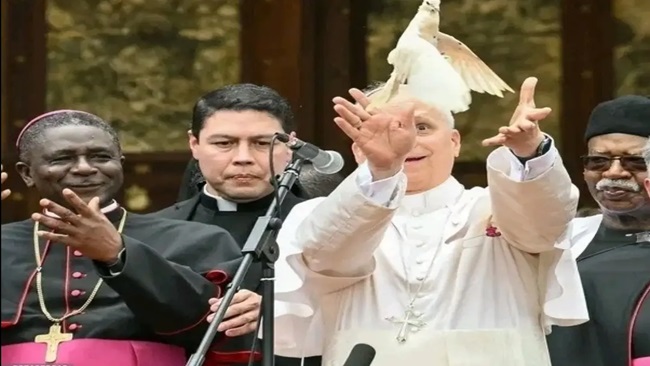
Pope Leo called on Cameroonians on Friday to reject violence and be generous with their neighbours during an event billed as the biggest of his four-nation Africa tour, with roughly 120,000 people flocking to a Mass he led in the port city of Douala.
Amid heavy security, some believers had made their way on Thursday to the city’s Japoma Stadium, venue of the Mass, and slept overnight outside on mats to hear Friday’s address from the pontiff, who has become outspoken on war and inequality and has drawn the ire of U.S. President Donald Trump.
By Friday morning, streets near the stadium were lined with crowds singing, dancing and holding umbrellas to shield themselves from the heat.
After arriving in Douala, Cameroon’s largest city and economic hub, by plane from the capital Yaoundé, Leo told the crowd that many in the country are suffering from “material and spiritual poverty” but he urged believers to reject violence as a means to get ahead, regardless of the hardships they face.
“Do not give in to distrust and discouragement,” the pope said, in an appeal made in English during a speech that was otherwise mostly in French.
“Reject every form of abuse or violence, which deceives by promising easy gains but hardens the heart and makes it insensitive.”
FORCEFUL REMARKS ON AFRICA TOUR
Leo, the first U.S. pope, has debuted a new, forceful speaking style on his Africa tour. In Yaoundé on Thursday, he said the world was “being ravaged by a handful of tyrants”, without naming anybody.
He has also this week decried violations of international law by “neocolonial” world powers and said “the whims of the rich and powerful” threaten peace.
Leo avoided overtly political messages on Friday.
Invoking the miracle of the loaves and fishes recounted in the Gospels, in which Jesus fed thousands with meagre resources, Leo said: “There is bread for everyone if it is given to everyone. There is bread for everyone if it is taken, not with a hand that snatches away, but with a hand that gives.”
Carine Kemmoue, a medical doctor who attended Friday’s homily, said she saw a clear link between Leo’s message and his past statements critical of the war in Iran.
“I was very moved by the Pope’s message. When, I mean, he stands against positions like those of Donald Trump, for example, he is against violence,” Kemmoue said.
“I think that is normal for a man of God, since the Church promotes peace.”
After returning to Yaoundé on Friday afternoon, Leo met with students and professors at the Catholic University of Central Africa, which educates young people from across the region.
During the event, the pope referred to “the darker side of the environmental and social devastation caused by the relentless pursuit of raw materials.”
He drew a loud cheer when he said the continent “must be freed from the scourge of corruption.”
‘MOMENT OF JOY’ FOR CAMEROON’S CATHOLICS
Cameroon, a producer of oil and cocoa, faces grave security challenges, including a simmering Anglophone conflict in which thousands of people have been killed since 2017.
The country has been led for more than four decades by President Paul Biya, the world’s oldest head of state at 93. His re-election last October sparked protests by opponents who say most ordinary Cameroonians have little to show for his rule.
Crowds greeting the pope on his visit to Cameroon have been enthusiastic, lining the streets along his routes and wearing colourful fabrics featuring images of his face.
Bishop Leopold Bayemi Matjei called Leo’s visit “a moment of great joy” and said he hoped it meant God would bless Cameroon.
“Our country needs a lot of blessing, a powerful blessing, so that hope will come to rise again,” said the bishop, who leads the Church in Obala, about an hour north of Yaoundé.
Friday was Leo’s last full day in Cameroon. He is scheduled to travel to Angola on Saturday.
Source: Reuters