24, November 2018
Time for France to give back looted African art 0
African artworks held in French museums – richly carved thrones, doors to a royal kingdom, wooden statues imbued with spiritual meaning – may be heading back home to Africa at last.
French President Emmanuel Macron, trying to turn the page on France’s colonial past , received a report Friday on returning art looted from African lands.
From Senegal to Ethiopia, artists, governments and museums eagerly awaited the report by French art historian Benedicte Savoy and Senegalese economist Felwine Sarr, and commissioned by Macron himself.
It recommends that French museums give back works that were taken without consent, if African countries request them – and could increase pressure on museums elsewhere in Europe to follow suit.
The experts estimate that up to 90 percent of African art is outside the continent, including statues, thrones and manuscripts. Thousands of works are held by just one museum, the Quai Branly Museum in Paris, opened in 2006 to showcase non-European art – much of it from former French colonies. The museum wouldn’t immediately comment on the report.
Among disputed treasures in the Quai Branly are several works from the Dahomey kingdom, in today’s West African country of Benin: the metal-and-wood throne of 19th-century King Ghezo, the doors to the palace of Kign Gele, and imposing, wooden statues.
The head of Ethiopia’s Authority for Research and Conservation of Cultural Heritage, Yonas Desta, said the report shows “a new era of thought” in Europe’s relations with Africa.
Senegal’s culture minister, Abdou Latif Coulibaly, told The Associated Press: “It’s entirely logical that Africans should get back their artworks. … These works were taken in conditions that were perhaps legitimate at the time, but illegitimate today.”
The report is just a first step. Challenges ahead include enforcing the report’s recommendations, especially if museums resist, and determining how objects were obtained and whom to give them to.
The report is part of broader promises by Macron to turn the page on France’s troubled relationship with Africa. In a groundbreaking meeting with students in Burkina Faso last year, Macron stressed the “undeniable crimes of European colonization” and said he wants pieces of African cultural heritage to return to Africa “temporarily or definitively.”
“I cannot accept that a large part of African heritage is in France,” he said at the time.
The French report could have broader repercussions. In Cameroon, professor Verkijika Fanso, historian at the University of Yaounde One, said: “France is feeling the heat of what others will face. Let their decision to bring back what is ours motivate others.”
Germany has worked to return art seized by the Nazis, and in May the organization that coordinates that effort, the German Lost Art Foundation, said it was starting a program to research the provenance of cultural objects collected during the country’s colonial past.
Britain is also under pressure to return art taken from its former colonies. In recent months, Ethiopian officials have increased efforts to secure the return of looted artifacts and manuscripts from museums, personal collections and government institutions across Britain, including valuable items taken in the 1860s after battles in northern Ethiopia, Yonas said.
In Nigeria, a group of bronze casters over the years has strongly supported calls for the return of artifacts taken from the Palace of the Oba of Benin in 1897 when the British raided it. The group still uses their forefathers’ centuries-old skills to produce bronze works in Igun Street, a UNESCO World Heritage Site.
Eric Osamudiamen Ogbemudia, secretary of the Igun Bronze Casters Union in Benin City, said: “It was never the intention of our fathers to give these works to the British. It is important that we get them back so as to see what our ancestors left behind.”
Ogbemudia warned the new French report should not remain just a “recommendation merely to make Africans to calm down.
“Let us see the action.”
Source: AP
















24, November 2018
Southern Cameroons leader, 9 others charged with terrorism!! Trial to begin Dec.6 0
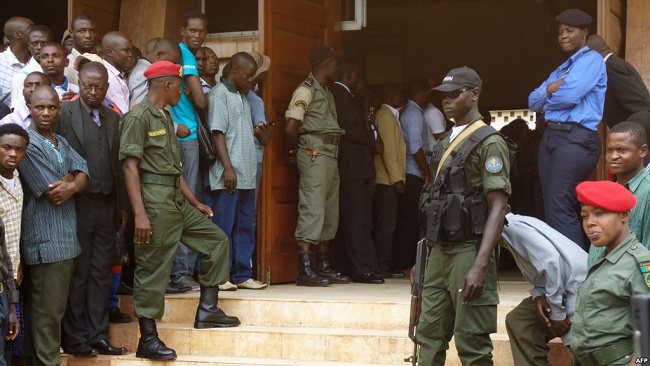
A pro Biya Francophone Attorney General on Thursday November the 22nd charged the leader of the Ambazonian republic and nine others with terrorism. The Yaoundé Military Tribunal held a secret hearing with what is now known as the Nera 10 in the absence of the abductees’ lawyers and the Southern Cameroons leaders were transferred afterwards to the Yaoundé Principal Prison, in Kondengui.
The Southern Cameroons Interim Government’s spokesman, Hon. Chris Anu reported that eyewitnesses saw nine of them as they went through protocol at the Kondengui high security prison. Chris Anu added that “If anything, the event is a clear indication that Yaoundé has no intentions to release the leaders of our revolution in spite of the calls for their immediate and unconditional release.”
The French Cameroun judge who earlier met with the 85 year old Biya privately at the Unity Palace leveled the charge against President Sisiku Ayuk Tabe the interim head of state of the Federal Republic of Ambazonia including nine of his top aides. Cameroon Intelligence Report understands that several detained Ambazonian activists are facing the same charge. A well-placed source in Yaoundé hinted this reporter that President Biya has ordered another Francophone judge to begin the trial on December the 6th.
No human rights activist or legal representations were allowed outside or inside the Yaoundé Military Tribunal where the so-called preliminary hearing took place. The International Crisis Group including many humanitarian organizations has criticized the abduction and illegal extradition of the Southern Cameroons leaders from Abuja, Nigeria.
The Southern Cameroons Acting President Dr Samuel Ikome Sako has also been quoted as saying that President Sisiku Ayuk Tabe is not a terrorist but a great leader who has fought for years against French Cameroun colonial rule in the Federal Republic of Ambazonia.
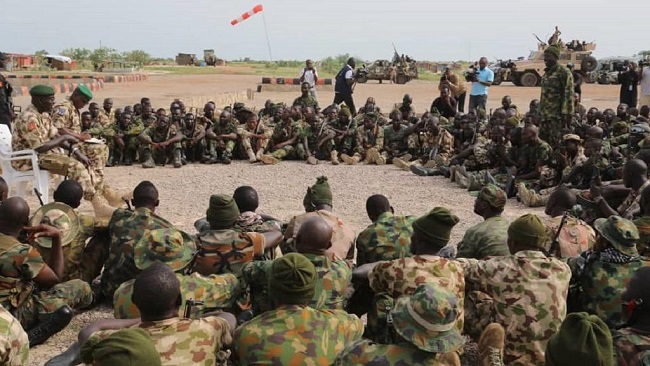
Elsewhere, Cameroon military said on Friday that it has killed at least 43 armed Ambazonia separatists’ fighters. The Biya regime army spokesperson also observed that troops destroyed at least three camps in several operations since Thursday in Bali village in the Mezam administrative area and Abu village in the Fundong administrative area in the North West region. The military reportedly seized a huge consignment of guns, ammunition, machetes, motorcycles and drugs.
The military added that they found the separatist hideouts after tracking one of the gunmen suspected of kidnapping 79 students and three staff members from a school on Nov. 4. La Republique du Cameroun and Southern Cameroons are both experiencing deadliest-ever socio-political crisis and the worst since the war to crush the UPC uprising, when the two territories were governed by the late President Ahmadou Ahidjo. More than 4000 Southern Cameroonian civilians have died in the ongoing violence including some 1600 Cameroon government army soldiers. The Southern Cameroons war has also claimed the lives of a sea of foreign and local missionaries.
The protests against French Cameroun dominance were triggered by a proposed system overhaul by Anglophone teachers and lawyers. Recently, former United States Assistant Secretary of State for Africa Affairs, Herman Jay Cohen again noted that the ongoing war for territorial control between French Cameroun and the Federal Republic of Ambazonia is unwinnable by either side, and therefore recommended that the protagonists should approach the current Assistant Secretary of State for Africa Affairs, Ambassador Tibor Nagy, to begin a mediation process to end the imbroglio. The former diplomat and scholar who brokered a peace deal to end the Eritrean versus Ethiopia war in 1991, among others, made the statement in a recent tweet on his official Twitter handle @CohenOnAfrica.
By Soter Tarh Agbaw-Ebai with files