29, May 2025
Sidi Ould Tah elected president of African Development Bank 0
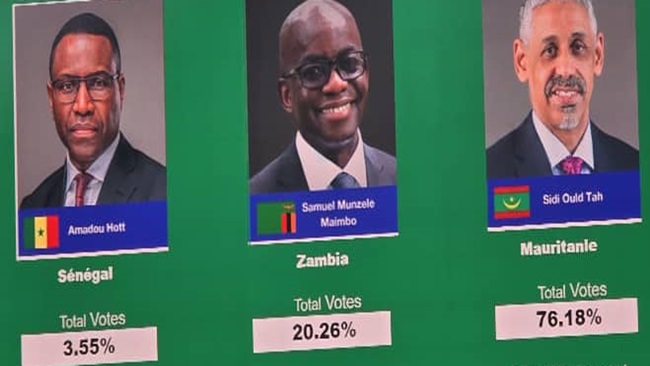
Sidi Ould Tah of Mauritania was today elected President of the African Development Bank Group at the Bank’s Annual Meetings held in Abidjan, Côte d’Ivoire.
Tah was elected by the Bank’s Board of Governors, comprising Finance and Economy Ministers or Central Bank Governors of the Bank Group’s 81 regional and non-regional member countries. The board is the highest decision-making authority for the Bank Group.
The results were announced by Niale Kaba, Minister of Planning and Development for Côte d’Ivoire, and Chairman of the Board of Governors of the Bank Group.
The winning candidate is required to obtain at least 50.01% of both the regional and non-regional votes.
A Mauritanian national, Tah brings over 35 years of experience in African and international finance. He served as president of the Arab Bank for Economic Development in Africa (BADEA) for 10 years from 2015, where he led a full transformation that quadrupled the Bank’s balance sheet, secured a AAA rating, and positioned it among the top-rated development banks focused on Africa.
A former Minister of Economic Affairs and Finance of Mauritania, Tah has held senior roles in multilateral institutions and has led crisis response, financial reform, and innovative resource mobilization for Africa, including the establishment of BADEA’s $1 billion callable capital program for African MDBs.
The Board of Governors Steering Committee received and approved a total of five candidates by the closing date of 31 January 2025. The list of candidates was officially announced on 21 February 2025.
The other candidates in the election were:
- Amadou Hott (Senegal)
- Samuel Maimbo (Zambia)
- Mahamat Abbas Tolli (Chad)
- Bajabulile Swazi Tshabalala (South Africa)
Tah will assume office on 1 September 2025, for a five-year term, following the end of the second mandate of current President, Dr. Akinwumi Adesina.
The African Development Bank’s past heads since its inception in 1964 are:
- Mamoun Beheiry (Sudan), 1964-1970
- Abdelwahab Labidi (Tunisia), 1970-1976
- Kwame Donkor Fordwor (Ghana), 1976-1980
- Willa Mung’Omba (Zambia), 1980-1985
- Babacar N’diaye (Senegal), 1985-1995
- Omar Kabbaj (Morocco), 1995-2005
- Donald Kaberuka (Rwanda), 2005-2015
- Dr. Akinwumi Adesina (Nigeria), 2015-2025.
The election of a new president comes at a crucial time in the Bank Group’s six decades of existence. Africa has remained resilient despite climate shocks, economic disruption, and a shifting geopolitical landscape, but needs to move faster or risk falling behind on delivering on the African Union’s Agenda 2063 and the Sustainable Development Goals, summed up in the Bank Group’s High 5’s.
The 2025 Annual Meetings of the African Development Bank Group are taking place from May 26 to 30 in Abidjan, Côte d’Ivoire under the theme “Making Africa’s Capital Work Better for Africa’s Development.”
The African Development Bank Group comprises three entities: the African Development Bank, the African Development Fund and the Nigeria Trust Fund. Its shareholder countries include 54 African countries or regional member countries, and 27 non-African countries or non-regional member countries.
Source: CNBC News













30, May 2025
Liberia: Plane carrying president involved in landing scare 0
Flights were temporarily disrupted at Liberia main airport on Thursday night after a private jet carrying President Joseph Boakai almost crashed while landing.
Part of the presidential jet’s landing gear malfunctioned while approaching the runway, causing a rough landing, airport authorities said.
The incident, which sparked panic at the airport, forced the cancellation of all scheduled flights for the night, local media reported.
President Boakai, who was returning from a trip in Nigeria with his entourage, was safely evacuated unharmed, as authorities announced an investigation.
Photos of the stalled jet at the Roberts International Airport (RIA) circulated on social media, triggering concerns about the president’s safety.
Local media, citing airport authorities, said one of the plane’s tyres had burst upon landing leaving it stranded on the runway.
In a statement, the Liberia Airport Authority (LAA) confirmed the “unfortunate near-accident situation” involving the presidential jet.
The authority dismissed reports suggesting that the incident was caused by poor runway conditions.
“The runway infrastructure remains fully compliant with international aviation safety standards,” the LAA said.
The aircraft has since been removed from the runway and normal operations have resumed at the airport, the authorities said.
“At this stage, investigation to establish the actual cause of the incident is ongoing, and the airport authority will keep the public informed,” the LAA said.
The Liberian presidency is yet to comment on the incident but it shared photos of Boakai arriving at the airport, where he briefly spoke to journalists without mentioning the plane scare.
He had gone to Nigeria to attend the 50th anniversary of the regional Economic Community of West African States (Ecowas).
Source: BBC