
7, January 2021
World leaders react with shock to Trump mob storming US Capitol 0
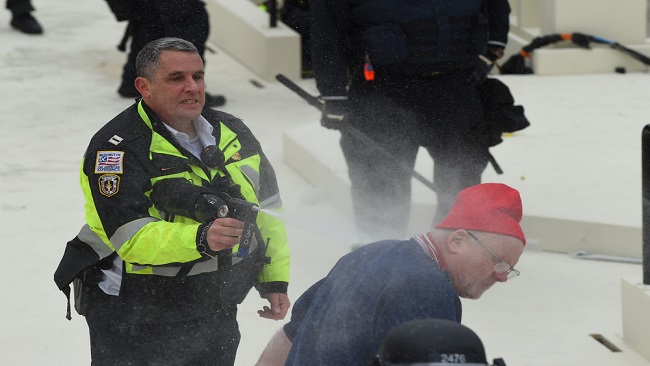
World leaders reacted with shock to the storming of the US Capitol building by enraged supporters of US President Donald Trump who are unable or unwilling to accept that he lost the November 3 election to Democrat Joe Biden. The Congress was in the process of certifying Biden’s win, with some objections from Republicans, when the siege began.
Leaders around the world condemned the storming of the US Capitol building by supporters of President Donald Trump on Wednesday, expressing shock at the chaos unfolding in a country long known for its peaceful transfers of power.
“Disgraceful scenes in US Congress,” tweeted Prime Minister Boris Johnson of Britain, a staunch ally of the United States over generations. “The United States stands for democracy around the world and it is now vital that there should be a peaceful and orderly transfer of power.”
President of the European Parliament David Sassoli, who leads one of the largest legislatures in the world, also denounced the scenes at the Capitol. The European Union has spent four cantankerous years dealing with the Trump administration and its top officials have repeatedly said they are looking forward to a better relationship under President-elect Joe Biden.
“This is insurrection. Nothing less. In Washington,” tweeted Carl Bildt, a former prime minister of Sweden.
‘The looting of democracy’
French President Emmanuel Macron published a video on Twitter, criticising the violence in while reiterating his faith in the US democratic process.
Macron ended the video with a brief statement in English, which carried the hashtag “#WeAreOne.”
“I just wanted to express our friendship and our faith in the United States,” he said. “What happened today in Washington DC is not America. Definitely. We believe in the strength of our democracies. We believe in the strength of American democracy.”
Macron: ‘What happened today in Washington, DC, is not America’
Other allies were similarly appalled at what they described as an attack on American democracy, though many said they believed US democratic institutions would withstand the turmoil.
Several leaders blamed Trump directly for the violence, with some warning: “It won’t end today.”
“This is the widely anticipated outcome of Trumpism,” tweeted a retired Italian centre-left politician, Pierluigi Castagnetti. “And unfortunately it won’t end today. When politics is replaced by deception and fanaticism of the people the drift is inevitable.”
Many Italians watched with shock as the events unfolded in a country that helped Italy after its fascist era during World War II.
Turkey, a NATO ally that has sometimes been at odds with the Trump administration, expressed concern over the images of angry Trump supporters trying to thwart the certification of Biden as the new president. A foreign ministry statement urged all parties in the United States to use “moderation and common sense”.
“We believe that the United States will overcome this domestic political crisis with maturity,” the ministry said.
“Trump and his supporters should finally accept the decision of the American voters and stop trampling on democracy,” German Foreign Minister Heiko Maas wrote on Twitter. “From inflammatory words come violent deeds.”
He added that, “contempt for democratic institutions has disastrous effects”.
Canadian Prime Minister Justin Trudeau said his country was “deeply disturbed and saddened” by the events in the US, Canada’s closest ally and neighbor.
“Violence will never succeed in overruling the will of the people. Democracy in the US must be upheld – and it will be,” Trudeau tweeted.
Other reactions were not so supportive.
Venezuela, which remains under US sanctions, said events in Washington show that the US “is suffering what it has generated in other countries with its politics of aggression”. President Nicolas Maduro has survived US-backed opposition efforts to oust him despite accusations of human rights abuses and a humanitarian crisis that has seen much of its population descend into poverty and forced millions to flee the oil-rich country.
As his supporters stormed the Capitol, Trump issued a lukewarm call for them to “stay peaceful” but did not immediately ask them to disperse. Hours later he urged them to go home but added, “We love you” and called them “very special” people.
(FRANCE 24 with AP)

















7, January 2021
Ambazonians at Ikom rally demand UN-sponsored referendum in Southern Cameroons 0
Southern Cameroons activists at a rally in Ikom bordering Ekok in Nigeria have called on the United Nations (UN) to ensure the Federal Republic of Ambazonia’s right to self-determination by organizing a referendum in Ground Zero.
The Ambazonians at the rally in the outskirts of Ikom on Tuesday demanded the UN to support British Southern Cameroons push for the realization of the UN multilateral treaty obligation towards the Southern Cameroons on 1 October 1961 which Great Britain by some strange happenstance handed the articles of sovereignty over the territory to French vassal state of French Cameroun and France’s proxy army of occupation in the night of 30 September 1961.
The Southern Cameroonians chanted pro-independence slogans and urged the European Union and the US President-elect Joe Biden to take notice of the French Cameroun human rights violations in the English speaking-minority region.
Thousands of British Southern Cameroonians have died since a French Cameroun war erupted four years ago and more than a quarter of the population have fled their homes. Of these, 75,000 are refugees in neighbouring Nigeria.
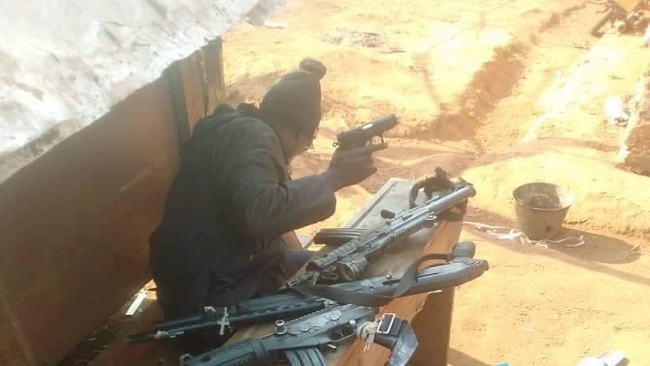
Even though bloodshed has receded in intensity over the last two months, violence remains chronic. Ambazonia Restoration Forces hold sways over two-thirds of the territory. At least four people were killed on Wednesday January 6 2021 following an explosion of a home-made bomb in the Northern Zone of Southern Cameroons.
The Biya Francophone regime in Yaoundé confirmed that the convoy of the prefect of Momo came under attack from Ambazonia Restoration Forces.
At the heart of the crisis, which started in 2016, was a strike by teachers and lawyers, in the English-speaking regions of Cameroon. The professionals, supported by citizens of their areas, protested the unfair use of the French language and unjustified appointments of French speakers in their territories. Cameroon was passing for a bilingual country. By 2017, the situation had spiralled out of control and developed into a fully-fledged separatist war. Both government forces and separatists are now bogged down in a conflict that observers say, can only be resolved through dialogue.
By Kingsley Betek in Ekok