29, January 2022
Biden announces small troop deployment to eastern Europe amid Ukraine diplomacy push 0
US President Joe Biden on Friday sought to maintain pressure on Russian leader Vladimir Putin over Ukraine, announcing a small troop deployment to eastern Europe even as top Pentagon officials backed a renewed push for diplomacy.
As President Volodymyr Zelensky urged Western leaders to avoid stirring “panic” over the massive Russian troop buildup on his country’s borders, Putin and French President Emmanuel Macron agreed on the need for de-escalation.
Neither Putin nor his Western counterparts had until now appeared ready to give ground in the weeks-long crisis, the worst in decades in the region between Russia and Western Europe.
But according to a Macron aide, Putin told the French leader in a call lasting more than an hour that he had “no offensive plans.”
In Washington, Biden nevertheless said he would soon send a small number of US troops – “not too many” – to bolster the NATO presence in eastern Europe as tensions remain heightened.
The United States already has tens of thousands of troops stationed across mostly Western Europe.
At the Pentagon, top officials urged a focus on diplomacy while saying that Russia now had enough troops and equipment in place to threaten the whole of Ukraine.
Any such conflict, warned the top US general, Joint Chiefs Chairman Mark Milley, would be “horrific” for both sides.
“If that was unleashed on Ukraine, it would be significant, very significant, and it would result in a significant amount of casualties,” Milley said.
“It would be horrific, it will be terrible,” he said.
But speaking alongside Milley, Defense Secretary Lloyd Austin said war in Ukraine could still be avoided.
“Conflict is not inevitable. There is still time and space for diplomacy,” said Austin.
“Mr Putin can do the right thing as well,” said Austin. “There is no reason that this situation has to devolve into conflict. He can choose to de-escalate. He can order his troops away.”
During his talks with Macron, Putin “expressed no offensive plans and said he wanted to continue the talks with France and our allies,” the aide to the French president said.
Their conversation “enabled us to agree on the need for a de-escalation,” the aide told journalists. Putin “said very clearly that he did not want confrontation.”
Complex threat
Since October, Russia has amassed more than 100,000 combat troops and equipment, as well as support forces, along its frontier with Ukraine and more recently in Belarus, which borders Ukraine on the north.
Western officials say Russia has also mustered more air and sea assets in the region, creating a complex threat like none seen since the Cold War.
Moscow has demanded wide-ranging security guarantees from the West, including that Ukraine never be allowed to join NATO.
Those demands have been the subject of intensive negotiations, with the West warning of far-reaching consequences if diplomacy fails and Russia attacks.
“We don’t need this panic,” Zelensky told a news conference with foreign media, insisting he wanted to avoid hurting his country’s already battered economy.
“There are signals even from respected leaders of states, they just say that tomorrow there will be war. This is panic – how much does it cost for our state?” he asked.
In talks with Macron, the Ukrainian leader called for more meetings and talks “while a propitious climate for dialogue exists.”
Russia’s concerns not addressed
Putin also made clear to Macron that the written responses from the West to his demands this week had fallen short of Russia’s expectations, the Kremlin said.
“The US and NATO responses did not take into account Russia’s fundamental concerns including preventing NATO’s expansion,” Putin said, according to the Kremlin’s readout of the call.
He added that the West had ignored the “key question,” that no country should strengthen its security at the expense of others, adding Russia would “carefully study” the responses, “after which it will decide on further actions.”
Russia has also demanded a pullback of NATO forces deployed to eastern European and ex-Soviet countries that joined the alliance after the Cold War.
In a sign of continued tensions, Russia announced Friday evening it had added several EU officials to a list of people banned from entering the country, saying they were responsible for “anti-Russian policies.”
Threat to key pipeline
The Putin-Macron phone call followed talks in Paris this week between Russia and Ukraine, with France and Germany alongside, which produced a joint statement to preserve a ceasefire in eastern Ukraine between government forces and pro-Moscow separatists.
They also agreed to hold new talks in Berlin in February.
“Taking into account the results of the meeting” in Paris, the Kremlin said, “the mood for further work of Russia and France in this format was confirmed.”
In tandem with the diplomacy, the West has upped its threats of a tough response to an invasion.
Washington and Berlin warned that the Nord Stream 2 pipeline, designed to double supplies of Russian natural gas to Germany, was at stake.
Milley said Russia itself would be hurt by war.
“If Russia chooses to invade Ukraine, it will not be cost-free, in terms of casualties or other significant effects,” he said.
Source: AFP


30, January 2022
N. Korea conducts largest missile test 0
North Korea conducted its largest missile test since 2017 on Sunday, sending a suspected intermediate-range ballistic missile soaring into space, seen as taking the nuclear-armed country a step closer to resuming long-range testing.
South Korea’s Joint Chiefs of Staff reported that a projectile believed to be a single ballistic missile was launched about 7:52 a.m. (2252 GMT) from North Korea’s Jagang Province toward the ocean off its east coast.
South Korea’s National Security Council (NSC), which convened a rare emergency meeting presided over by President Moon Jae-in, said the test appeared to involve an intermediate-range ballistic missile (IRBM), which North Korea has not tested since 2017.
The launch takes North Korea a step closer to fully scrapping a self-imposed moratorium on testing its longest-range intercontinental ballistic missiles (ICBMs), Moon said.
He noted that this month’s flurry of missile tests was reminiscent of the heightened tensions in 2017, when North Korea conducted multiple nuclear tests and launched its largest missiles, including some that flew over Japan.
North Korean leader Kim Jong Un has said he is no longer bound by that moratorium, which included a stop to nuclear weapons tests and was announced in 2018 amid a flurry of diplomacy and summits with then-U.S. President Donald Trump.
North Korea’s rulers suggested this month they could restart those testing activities because the United States and its allies had shown no sign of dropping their “hostile policies.”
“The United States condemns these actions and calls on (North Korea) to refrain from further destabilizing acts,” the U.S. military’s Indo-Pacific Command said in a statement after Sunday’s launch.
A U.S. State Department spokesperson said the launch demonstrates the threat posed by North Korea’s unlawful weapons of mass destruction and ballistic missile programmes, and called on Pyongyang to engage in “sustained and substantive” dialogue.
Bigger missiles
It is unclear if IRBMs were included in Kim’s moratorium, but those, too, have not been tested since 2017.
South Korea’s JCS and Japanese Chief Cabinet Secretary Hirokazu Matsuno separately said the missile is estimated to have reached an altitude of 2,000km and flown for 30 minutes to a distance of 800km. IRBMs typically have ranges of 600 to 3,500 miles, while ICBMs have ranges exceeding 3,500 miles.
Missile experts said the data could indicate a test of an IRBM such as the Hwasong-12, which was last tested in 2017, or a new type.
“Regardless of whether it’s a IRBM or ICBM, this is a strategic missile of some sort and clearly not the same as the prior tests in the January 2022 test series to date,” George William Herbert, an adjunct professor at the Center for Nonproliferation Studies and a missile consultant, said on Twitter.
The launch could make January the busiest ever for North Korea’s missile programme, which analysts say is expanding and developing new capabilities despite strict sanctions and United Nations Security Council resolutions that ban the country’s ballistic missile tests.
Its latest launches included a test of two short-range ballistic missiles and their warheads on Thursday, and an updated long-range cruise missile system tested on Tuesday.
‘Ramping up tests’
The test comes less than a week before the opening of the Winter Olympics in Beijing, which is North Korea’s main political and economic partner. Pyongyang has said it would be skipping the Games because of the COVID-19 pandemic and “hostile forces.”
“Kim seems to be ramping up tests in bid to pressure both Washington and Beijing over sanctions just ahead of the Olympics,” said Uk Yang, research fellow at Center for Foreign Policy and National Security.
The tests would also appear to be the final nail in the coffin for Moon’s last-ditch push for a peace deal with North Korea before he leaves office in May, Uk added.
“It’s clear that North Korea is saying inter-Korean relations will need to start from scratch,” he said.
In an address ahead of the New Year, Kim Jong Un called for bolstering the military with cutting-edge technology at a time when talks with South Korea and the United States have stalled.
Since then, North Korea has tested a dizzying array of weapon types, launch locations, and increasing sophistication as denuclearisation talks remain stalled.
Jagang Province was the site of two launches this month of what North Korea said was a “hypersonic missile,” which could reach high speeds while flying and maneuvering at relatively low altitudes, but the ranges reported on Sunday were higher and farther than those earlier tests.
“The ballistic missile launch and the ones before it are a threat to our country, the region and the international community,” Matsuno said. “This series of launches violate U.N. resolutions and we strongly protest this action by North Korea.”
South Korea’s NSC condemned the launch as a violation of the resolutions and a challenge to international peace efforts, using stronger language than previous tests, when it typically expressed “strong regret.”
The tests appear aimed at modernizing North Korea’s military, bolstering national pride ahead of several major North Korean holidays, and sending a message of strength as the country grapples with economic crises caused by sanctions and COVID-19 lockdowns, said Leif-Eric Easley, a professor of international studies at Ewha University in Seoul.
“The Kim regime hears external discussions of its domestic weaknesses and sees South Korea’s growing strength,” he said.
“So it wants to remind Washington and Seoul that trying to topple it would be too costly.”
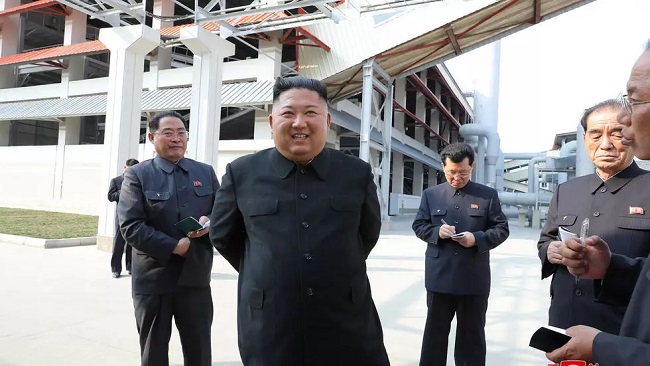
Kim visited a munitions factory last week, where he called for “an all-out drive” to produce “powerful cutting-edge arms,” and its workers touted his devotion to “smashing … the challenges of the U.S. imperialists and their vassal forces” seeking to violate their right to self-defence.
Source: REUTERS