21, July 2019
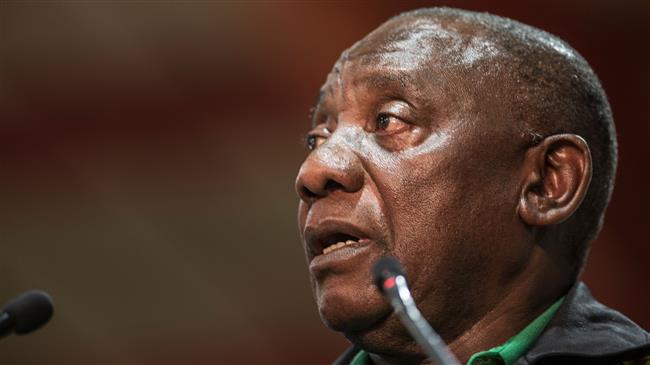
South Africa: President Ramaphosa accused of misleading Parliament 0
A South African watchdog on Friday said President Cyril Ramaphosa “deliberately misled” Parliament about a campaign contribution, a setback for a leader who has vowed to address sprawling graft allegations that forced his predecessor from office.
The report was released as that former president, Jacob Zuma, abandoned his testimony to a high-profile state commission probing wide-ranging allegations of graft in government and state-owned companies. Zuma, who denies the allegations against him, asserted he was being treated unfairly. But a deal was quickly reached for him to return at some point in the future.
The outcry over years of alleged corruption during Zuma’s stay in office has shaken both the economy of South Africa, the most developed in sub-Saharan Africa, and public support for the ruling African National Congress. The party has been in power since the end of the harsh system of racial segregation known as apartheid 25 years ago.
Now the ANC faces an internal struggle between allies of Ramaphosa and Zuma, who led South Africa from 2009 to 2018 when he resigned under party pressure and was replaced by former deputy Ramaphosa.
The current president has repeatedly vowed to fight corruption and win back public confidence.
Friday’s report by South Africa’s public protector, a constitutionally created office that probes alleged misconduct in state affairs, said Ramaphosa “deliberately misled” lawmakers late last year about a 500,000-rand ($34,000) campaign contribution from the CEO of a local company, Africa Global Operations, formerly Bosasa. The report called on the national director of public prosecutions to investigate further.
In response, a statement posted by Ramaphosa’s office asserted that he was not guilty of the accusations and calls on the public protector to allow the president a hearing.
A political analyst and researcher at the University of the Western Cape, Ralph Mathekga, said Ramaphosa should be careful about how he handles the watchdog’s report, saying it might hurt the president further if he loses at court.
“This report gives a lot of ammunition not only to his detractors within the ANC but to the Economic Freedom Fighters as well, as they will exploit it to take him on,” Mathekga said, referring to a populist opposition party that along with the leading opposition Democratic Alliance had filed complaints alleging wrongdoing.
Separately on Friday, Zuma abruptly cut short his appearance at the state inquiry and his lawyers said the former president would no longer participate. But soon afterward the commission chair, deputy chief justice Raymond Zondo, said an agreement had been reached to allow Zuma to return at a later stage.
The commission has no power to prosecute but other authorities could follow up on its findings.
Zuma began his nationally televised testimony this week by calling the graft allegations part of an international intelligence conspiracy that began more than 25 years ago to assassinate his character. On Friday he threatened to expose “spies” if the pressure on him went too far.
Zuma has been questioned about his close relationship with the wealthy Gupta family and allegations that they exerted influence over cabinet appointments and the awarding of lucrative state contracts.
A defiant Zuma told supporters on Friday that he had been the target of many assassination attempts because he has a lot of information about spies who infiltrated the ANC during apartheid. He was once the ANC’s intelligence chief.
“I know a lot about spies, that was my job,” he said. “I have never played around with that information. But if people now want me to uproot them, I will.”
(AP)
















2, August 2019
Benin Republic: Court bans presidential rival from elections 0
A court in Benin on Friday handed a top opposition politician a suspended six-month jail term over campaign breaches and banned him from standing for elections for five years, in the latest case targeting rivals of President Patrice Talon.
Former prime minister Lionel Zinsou, who lives in France, was found guilty of using false documents and “exceeding” spending limits in his 2016 bid for the West African nation’s presidency, judicial sources told AFP.
Critics say the latest ruling is part of a concerted crackdown by former business magnate Talon that has driven key opponents into exile.
Multi-millionaire Sebastien Ajavon, who has voiced his ambitions for the top job, was sentenced in absentia to 20 years for drug trafficking in October.
Former president Thomas Boni Yayi left Benin in June, ostensibly for medical treatment, after being kept under de-facto house arrest after he criticised one-sided parliamentary elections that sparked bloody street protests.
– ‘Repression’ –
Talon, who made his fortune in cotton, came to power in 2016 on a modernising platform as he vowed to stamp out corruption and mismanagement in a country that has a reputation as one of the region’s most stable democracies.
Zinsou, who also holds French citizenship, came second to Talon in the 2016 presidential race but has remained in Paris in the face of his legal problems.
Protests rocked Benin following the parliamentary vote in April that saw parties allied to Talon win all the seats as opposition groups were effectively banned.
Amnesty International said post-election “repression reached disturbing levels” after four people were killed during the demonstrations.
In late July the ministry of justice released a list of “wanted” suspects, including a string of political figures it accused of evading justice in the country.
The minister signed a decree stopping authorities from issuing identification documents for anyone who did not answer police summons, in a move seen as targeting Talon’s opponents abroad.
Vincent Foly, the editor-in-chief of La Nouvelle Tribune that was shut down last year, said it was a sign that Talon was looking to tighten his grip over the country.
“He makes decisions that are seemingly unimportant but actually target opponents,” Foly told AFP.
Foly said the hardening stance had come as a surprise as initially Talon advocated to reduce the presidential mandate to a maximum of one term.
But now he said there “is no longer a shadow of a doubt” that the head of state wants to stand for re-election in 2021.
“He has realised that five years is not enough,” said Foly.
AFP