
30, May 2024
Spain’s parliament approves amnesty law for Catalan separatists 0
Spain’s Parliament voted Thursday to give final approval to a controversial amnesty law for hundreds of Catalan separatists involved in the illegal and unsuccessful 2017 secession bid.
The legislation was backed by Spain’s left-wing coalition government, two Catalan separatist parties, and other smaller parties. It passed by a vote of 177-172 in the lower house with the conservative Popular Party and far-right Vox opposing it.
The amnesty could benefit former Catalan regional president Carles Puigdemont, who is a fugitive from Spanish law in Belgium after fleeing his country following the failed Oct. 2017 breakaway bid that he led. It should also help out hundreds more, including former government officials in Barcelona, average citizens who participated in the secession attempt or protests, and some police officers involved in the crackdown on an illegal independence referendum held by Puigdemont’s government.
The passing of the amnesty law, however, does not immediately clear up the legal mess of the separatists.
The law is likely to face legal challenges and will be reviewed by higher courts. It also must be applied by courts on a case-by-case basis. There are experts who question its constitutionality since they say it would create inequality between Spanish citizens by favoring some over others.
Since taking power in 2018, Spanish Prime Minister Pedro Sánchez has focused on reducing tensions in northeast Catalonia and he argues that the amnesty is key to culminating that process.
But the amnesty was also a political necessity for Sánchez, who agreed to the act of pardon when he needed the support of the separatist lawmakers in Madrid to form a new national government in November. It was initially approved by the Parliament’s lower house in March. The Senate, where right-wing parties hold a majority, vetoed it earlier this month, but the lower house pushed it through regardless.
Tensions ran high in the chamber. The vote was by roll call with each lawmaker standing up to vote verbally. An opposition lawmaker shouted “traitor!” at Sánchez after he stood up to vote “yes.”
The Parliament’s session had already taken a nasty turn during the debate when Socialist spokesman Artemi Rallo was interrupted by a lawmaker of Vox, who shouted out several times to call him “sell out” and “corrupt.”
“Europe, Spain and Catalonia have said ‘yes’ to the amnesty, even if you don’t like hearing it,” Rallo shot back. He was referring to the endorsement of the amnesty law by the Council of Europe, a non-European Union institution that promotes human rights.
While the amnesty is popular in Catalonia, even among many unionists, the Popular Party and Vox have led protests against it in Madrid and other cities across the country. There have also been critics of the amnesty within Sánchez’s Socialist party.
Popular Party leader Alberto Núñez Feijóo tried to shame the Socialists for granting the amnesty in exchange for “seven votes” of Puigdemont’s party that it needed to stay in power. He also warned Sánchez that once it is passed, he should expect little favors from the separatists, whose support is key to keep his fragile government in power.
“This is an exchange of power for privileges and impunity,” Feijóo said.
The long legislative road for the amnesty comes to an end during the runup to European Parliament elections on June 6-9 and when the Socialists are trying to form a government in Catalonia after beating the separatists in regional elections earlier this month.
The parliamentary spokespeople for the Catalan separatist parties had no words of gratitude for Sánchez. Instead, they praised their followers and former leaders who spent time in prison before Sánchez pardoned them and those who left the country like Puigdemont.
“Today truly is a historic day. Today there is no forgiveness. Today a battle has been won in a conflict that has existed for centuries between two nations,” said Míriam Nogueras, of Puigdemont’s Together party.
They also insisted that the next goal for the separatists will be to try to force Sánchez to go back on his pledge to never grant them an authorized referendum on independence.
Gabriel Rufían, lawmaker of the Republican Left of Catalonia, told lawmakers, “Next stop: referendum.”
Source: AP


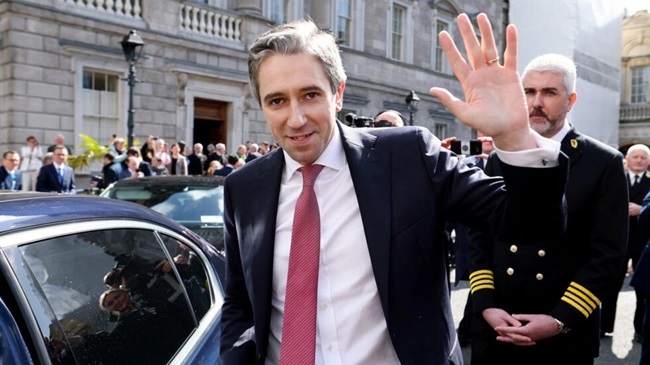
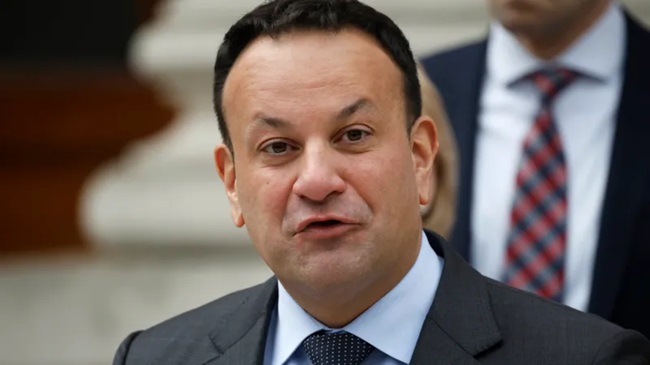
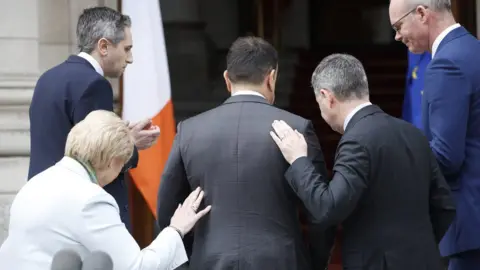
 PA MediaMr Varadkar said he felt he was not the “best person for the job anymore”
 Nick Bradshaw
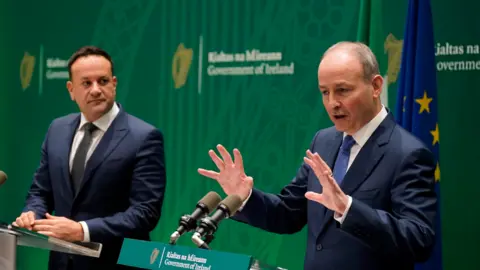 PA MediaMicheál Martin said he was “surprised” when he heard that Mr Varadkar was stepping down
 PA MediaFirst Minister Michelle O’Neill (left) called for a general election in the Republic of Ireland
 Getty ImagesHigher Education Minister Simon Harris is the early favourite with many bookmakers
 Niall CarsonAfter widespread disorder in Dublin last year, Helen McEntee faced down calls to resign from opposition parties















10, June 2024
France: Macron takes huge risk with surprise election 0
President Emmanuel Macron has called snap parliamentary elections later this month in the wake of a big victory for his rival Marine Le Pen’s National Rally in the European Parliament vote.
The far-right party is on course to win 32% of the vote, exit polls say, more than twice that of the president’s Renaissance party.
Announcing the dissolution of parliament, he said the two rounds of voting would take place on 30 June and 7 July, a few weeks before the Paris Olympics.
Mr Macron made the dramatic and surprise decision in a televised address from the Élysée Palace an hour after voting closed and exit polls had been declared in France’s EU elections.
His decision came not long after National Rally’s 28-year-old leader, Jordan Bardella, had openly called on the president to call parliamentary elections.
“I have heard your message,” the president told French voters, “and I will not let it go without a response.”
“France needs a clear majority in serenity and harmony,” he said, adding that he could not resign himself to the far-right’s progress “everywhere in the continent”.
Now barely two years into his second term as president, Mr Macron already lacks a majority in the French parliament, and though this European vote in theory has no bearing on national politics, he clearly decided that continuing his mandate without a new popular consultation would place too much of a strain on the system.
The upcoming parliamentary elections also won’t affect Mr Macron’s own job, as they are separate from the presidential elections and his term as president still runs for three more years.
Ms Le Pen, who has twice been defeated by Mr Macron in presidential elections, immediately reacted, saying her party was “ready to exercise power, ready to put an end to mass immigration”.
Calling a snap election is a huge surprise for the country, and a huge risk for President Macron.
He could have reacted differently. He could have just kept going, explaining the far right’s massive victory as a European aberration which would be corrected at more important elections.
He could have trusted to the impending European football championship in Germany and above all the Paris Olympics to keep people’s minds off politics for a couple of months.
That was certainly how the Paris commentariat thought he would take his party’s rout.
But one can only assume the president had seen this coming, and planned his response in advance.
Source: BBC