Featured
 Ngarbuh massacre trial short on justice
  John Ashu Agboreyong: a man of God counting years and counting impact @60
  Ethnic armies and the democratization process in Cameroon: an impediment to democratic consolidation
 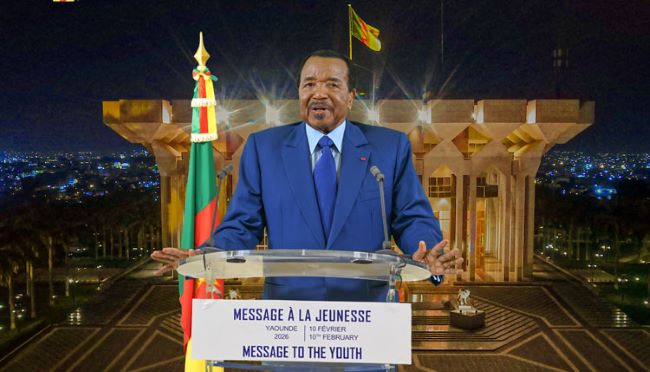 Biya’s message to the Youth on the 60th edition of the National Youth Day
  How Cameroon pays the price for disrespecting contracts
Most Commented Posts
 4 Anglophone detainees killed in Yaounde
18 comments Chantal Biya says she will return to Cameroon if General Ivo Yenwo, Martin Belinga Eboutou and Ferdinand Ngoh Ngoh are sacked
13 comments The Anglophone Problem – When Facts don’t Lie
12 comments Anglophone Nationalism: Barrister Eyambe says “hidden plans are at work”
12 comments Largest wave of arrest by BIR in Bamenda
10 comments
Featured
-

Indomitable Lions: Pagou invites 30 home-based players for training camp
-
Southern Cameroons: 2nd edition of South West Cultural Festival held in Buea
-
Unending attack on medics and healthcare professionals in Cameroon’s separatist war; an unacceptable disgrace
-
Iran says Israeli PM’s fate unclear after ‘surprise’ missile attack on his office
-
Gen. Abdolrahim Mousavi, the martyred Chief of Staff of Iran’s Armed Forces
-

Miss Cameroon 2025 Dismissed
-
Sona Ngoh Appointed to the Board of Ziaur Rahman International Research Centre
Unending attack on medics and healthcare professionals in Cameroon’s separatist war; an unacceptable disgrace 0
In the shadow of nearly nine years of war in Cameroon, the line between professional medical practice and armed conflict has grown dangerously thin. What should be a neutral commitment to saving lives have, for many healthcare workers, become grounds for suspicion, arrest, and abuse. The conflict is pitting the separatist movement of Southern Cameroonians (Ambazonians) against the government of 93-year-old Paul Biya, who has been in power since 1982. The conflict has created an environment in which doctors, nurses and many other health professionals are increasingly forced to choose between their ethical duty and their personal safety.
In July 2020, Cameroon Concord News interviewed Peter Ngute in Kumba and Mary Tata in Bamenda, both practicing medics who had been arrested and detained for five months by Cameroonian security forces. In 2022, we spoke with many healthcare professionals and nurses, among them Enow Arrey Lucy who was harassed by government authorities for doing their jobs. Authorities accused them of aiding and abetting separatist fighters in Kumbo and other parts of the two English parts of the country. All were ultimately released without charge. However, they all allege that during their detention they were subjected to torture and inhumane treatment. Peter said, “were punished not for taking up arms, but for treating wounded individuals who arrived at their facilities. And this cannot be right because we are only doing our jobs”.
Their accounts mirror a broader pattern documented by Amnesty International, which reports longstanding and serious human rights violations committed by government security forces, militias, and armed groups in the Anglophone regions during the ongoing conflict. These violations include unlawful killings, arbitrary arrests, enforced disappearances and torture. Within this climate of repression, healthcare workers have become particularly vulnerable. Both Médecins Sans Frontières and Human Rights Watch have documented cases in which medical personnel were accused of aiding combatants, detained on terrorism-related charges and harassed simply for carrying out their professional duties.
The legal framework protecting them is unambiguous. Cameroon ratified the Geneva Conventions in 1963, along with the First and Second Additional Protocols in 1984 and Protocol III in 2021. Under international humanitarian law, medical professionals must be permitted to treat the wounded and sick without discrimination. Medical neutrality is not optional, it is a binding obligation. Yet multiple testimonies suggest that, in practice, healthcare workers are being criminalised for adhering to that very principle.
Cameroon Concord News has gathered additional disturbing accounts. Dr. Tita Augustine, Susan Ndi, a radiologist, and nurse Adeline Nzouepet Sah are among several healthcare professionals who describe their lives as having been irreversibly altered after being accused of supporting separatist fighters. Arrests, threats, and intimidation have followed allegations that stem solely from the provision of medical care. Their experiences point to a troubling pattern upon which impartial treatment is increasingly equated with complicity.
Despite repeated requests for comment, authorities in Yaoundé have declined to respond to questions from Cameroon Concord News. Security forces have reportedly justified detentions by alleging that certain healthcare providers are supporting terrorism. However, such accusations raise fundamental questions about whether the state is conflating medical duty with political allegiance.
The persistent targeting of medics reflects a broader and deeply troubling reality in a conflict that has claimed more than 9,000 lives. When doctors and nurses are detained, intimidated, or tortured, entire communities lose access to essential and lifesaving care. The erosion of medical neutrality not only violates international law but also deepens civilian suffering.
The cases of Adeline Nzouepet Sah, Dr Tita Augustine and Susan Ndi, among many underscore the urgent need for international scrutiny, credible investigations, and accountability mechanisms. Without meaningful protection for healthcare professionals, the humanitarian cost of the conflict will continue to rise among those who are only stated offence is saving lives.
By Rita Akana in Yaoundé