7, January 2026
Episcopal Conference “not a political party”: Archbishop Nkea cautions against attempts to manipulate the Church 0
The President of the National Episcopal Conference of Cameroon (NECC) has clarified that the Episcopal Conference is neither a political party nor an electoral or constitutional body, urging Cameroonians to assume their civic responsibilities without shifting them onto the Catholic Church.
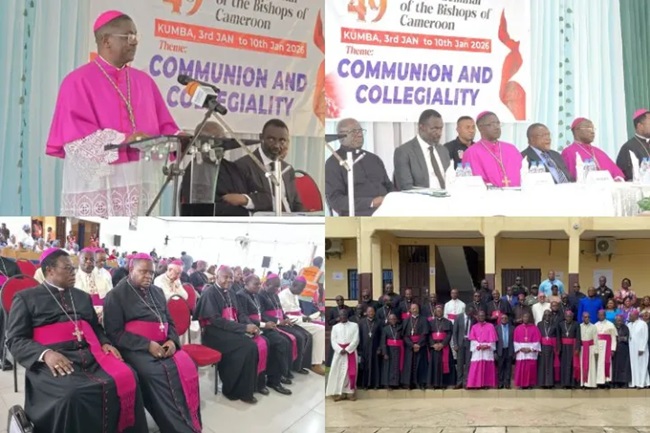
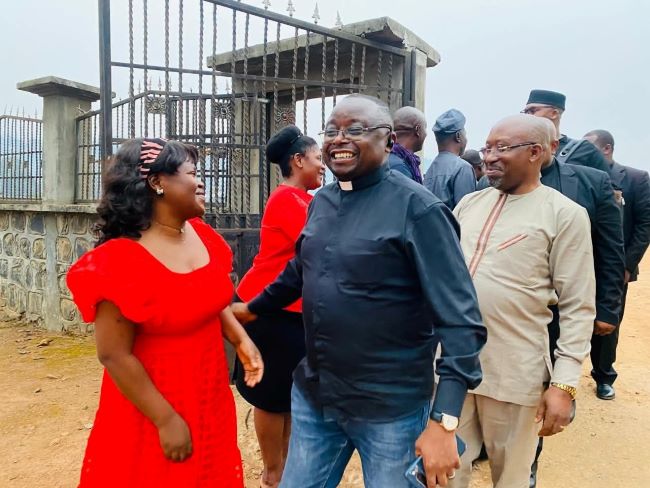
In his speech during opening ceremony of the 49th Annual Seminar of NECC in the Catholic Diocese of Kumba, Archbishop Andrew Nkea Fuanya emphasized that the Bishops’ conference exists to exercise pastoral functions for the good of the faithful and society, in line with Church teaching, and should not be manipulated for political ends.
“Some people don’t understand what the National Episcopal Conference is and its role in this society,” Archbishop Nkea said during the Tuesday, Janaury 6 event that was held at the Immaculate Heart of Mary Pastoral Center in the Diocese of Kumba.
He explained that “a conference of Bishops, a permanent institution, is a group of Bishops of some nation or certain territory who jointly exercise certain pastoral functions for the Christian faithful of their territory in order to promote the greater good which the Church offers to humanity, especially through forms and programs of the apostolate fittingly adapted to the circumstances of time and place according to the norms of the law.”
“Thus, an Episcopal Conference is not a political party nor is it an electoral commission or a constitutional commission to give results of elections in various countries,” the Local Ordinary of Cameroon’s Bamenda Archdiocese clarified.
He added, “I therefore call on Cameroonians of all walks of life to take their responsibilities as political actors and stop hiding behind the Catholic Church and expecting her to do their duty.”
Critics, including politicians, activists, and social media commentators, accused the Catholic Church of a kind of “silence” over electoral fraud in Cameroon’s October 2025 Presidential election despite Bishops being outspoken before, during and after the poll.
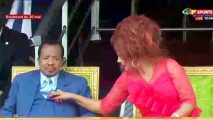
Cameroon’s Constitutional Council confirmed the re-election of President Paul Biya, Africa’s second-longest-serving head of State, rivalled only by President Teodoro Obiang of Equatorial Guinea, following the 12 October 2025 election.
The official results showed Biya winning the election by 53.66 percent of the total votes, against 35.19 percent for opposition leader Issa Tchiroma Bakary.
In his January 6 address, Archbishop Nkea recalled that the Catholic Bishops “clearly” stated in their 2025 pastoral letter that “it is the right and duty of everyone to participate in political life and there is no reason why Christians should fail to take an interest in politics.”
“It is a wake-up call to them not to only denounce the problems but to commit themselves with others to analyzing situations, discerning what is at stake and proposing concrete courses of action,” he added.
Consequently, Archbishop Nkea continued, “the lay faithful are never to relinquish their participation in public life, that is, in the many different economic, social, legislative, administrative and cultural areas which are intended to promote organically and institutionally the common good.”
He said, “For the past couple of years, the Church has been speaking out on the suffering of the people and has been teaching on various social issues in the society.”
“However, we are beginning to notice that some people close their ears to the teachings of the Bishops and when the Bishops do not say what they want to hear, they accuse the Bishops of silent complicity with the powers that be,” the NECC President said.
He emphasized, “The Church will continue her prophetic and evangelization mission and like St. Paul says in the second letter to Timothy 4:2.”
“Therefore, Cameroonian people, take your responsibilities and leave the Bishops to preach their gospel,” Archbishop Nkea said.
On Cameroon’s situation, Archbishop Nkea lamented the persistence of insecurity, corruption, injustice, and social mistrust, situations he said undermine peace and development.
He called for moral renewal, unity, solidarity, and a conversion of hearts as essential foundations for national recovery.
Reflecting on the theme of the January 3-10 seminar, “Communion and Collegiality,” he explained that the Bishops intend to reflect “honestly on their own actions and witness as members of the NECC.”
As Cameroon approaches the conclusion of the Catholic Church’s 2025 Jubilee Year of Hope, Archbishop Nkea reminded the people of God that hope, as a theological virtue, does not end.
He said hope must continue to inspire the Church’s pastoral mission in promoting human dignity, fraternity, and solidarity, beyond all political partisanship.
Source: AciAfrica













7, January 2026
AFCON 2025: Tougher test awaits anxious hosts Morocco 0
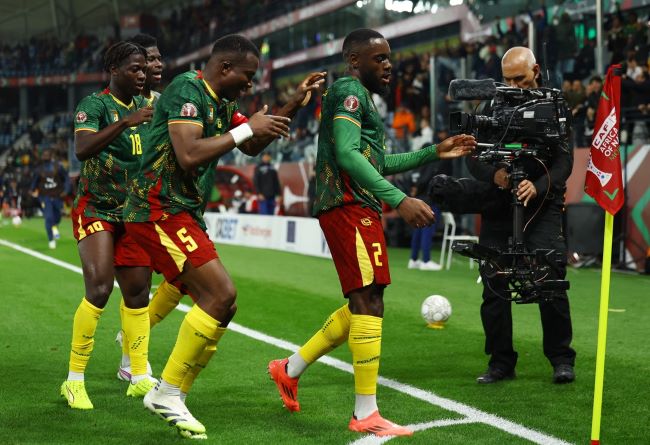
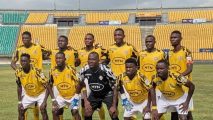
Hosts Morocco can expect the first proper examination of their ability to go on and win the Africa Cup of Nations when they take on a feisty Cameroon in the quarter-finals at the weekend.
The top-ranked Moroccans were not stretched in the group phase of the tournament, where they finished top of the standings, nor in their last-16 clash against Tanzania on Sunday.
Yet they delivered only one convincing performance when they beat Zambia in their last of their group matches and against Cameroon in Rabat on Friday there will need to be a marked improvement if they are to advance towards the target of a first continental title in 50 years.
The home side were heavy pre-tournament favourites but have looked anxious and nervy at times, feeling the intense pressure and will be cautious of the threat that Cameroon pose. “We will try to disrupt them,” said Cameroon coach David Pagou, promising a physical battle.
The game will be one of the highlights of a blockbuster set of last-eight ties, with Algeria meeting Nigeria on Saturday and Egypt’s clash against defending champions Ivory Coast later on the same day also eagerly anticipated.
Only Senegal, who take on Mali in the first quarter-final in Tangier on Friday, are expected to ease through to the semi-finals, up against opponents who have made it to the latter stages of the tournament without winning a game.
Mali have drawn four successive matches in Morocco, advancing on post-match penalties over Tunisia in the last 16 despite being down to 10 men for most of the match. Their fighting spirit is not expected to be enough to hold out against Senegal’s attack, which has scored 10 goals at the tournament.
Algeria and Nigeria are the only teams to have won all four of their matches in Morocco and both have given strong indicators of their ability to take the title.
Ivory Coast were also in impressive form in the last 16 as they brushed aside Burkina Faso 3-0 on Tuesday and are set to reignite a Cup of Nations rivalry with Egypt, who are looking to give talisman Mohamed Salah international success to go along with his numerous achievements at club level with Liverpool.
“We’ll simply try to impose our rhythm (of play) on Egypt,” said Ivorian coach Emerse Fae.
The quarter-final winners advance to the last four to be played in Rabat and Tangier on January 14.
Source: Reuters