
23, May 2025
Football: Modric to leave Real Madrid 0
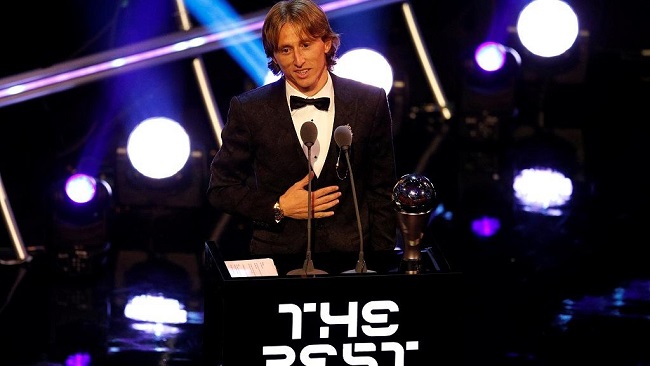
Real Madrid captain Luka Modric has revealed he will leave the Spanish giants after the end of their Fifa Club World Cup campaign this summer.
The 39-year-old Croatia midfielder, the 2018 Ballon d’Or winner, will play his last match at Real’s Bernabeu home when they welcome Real Sociedad on Saturday in their final La Liga game of the season.
“The moment has arrived. The moment I never wanted to come, but that’s football, and in life everything has a beginning and an end,” Modric said on Instagram.
He has won 28 trophies, including six Champions Leagues and four domestic titles, since joining Real from Spurs in 2012.
“I arrived in 2012 with the hope of wearing the jersey of the best team in the world and the ambition to do great things, but I couldn’t have imagined what came next,” he said.
“Playing for Real Madrid changed my life as a footballer and as a person.
“I’m proud to have been part of one of the most successful eras of the best club in history.”
Real will open their Club World Cup campaign against Saudi Arabia’s Al-Hilal on 18 June and will also face Mexico’s Pachuca and RB Salzburg of Austria in the group stage.
Modric bagged two goals and six assists in 34 appearances in the Spanish top flight this season as Real were pipped to the title by Barcelona.
He also featured in every game as Carlo Ancelotti’s side reached the quarter-finals of the Champions League, where they were beaten 5-1 on aggregate by Arsenal.
Modric signed a one-year contract extension last year, which expires at the end of this campaign.
Saturday’s game will also be Ancelotti’s last in charge of Real, with Bayer Leverkusen boss Xabi Alonso reportedly set to succeed the Italian.
‘Modric’s legacy will live on forever’
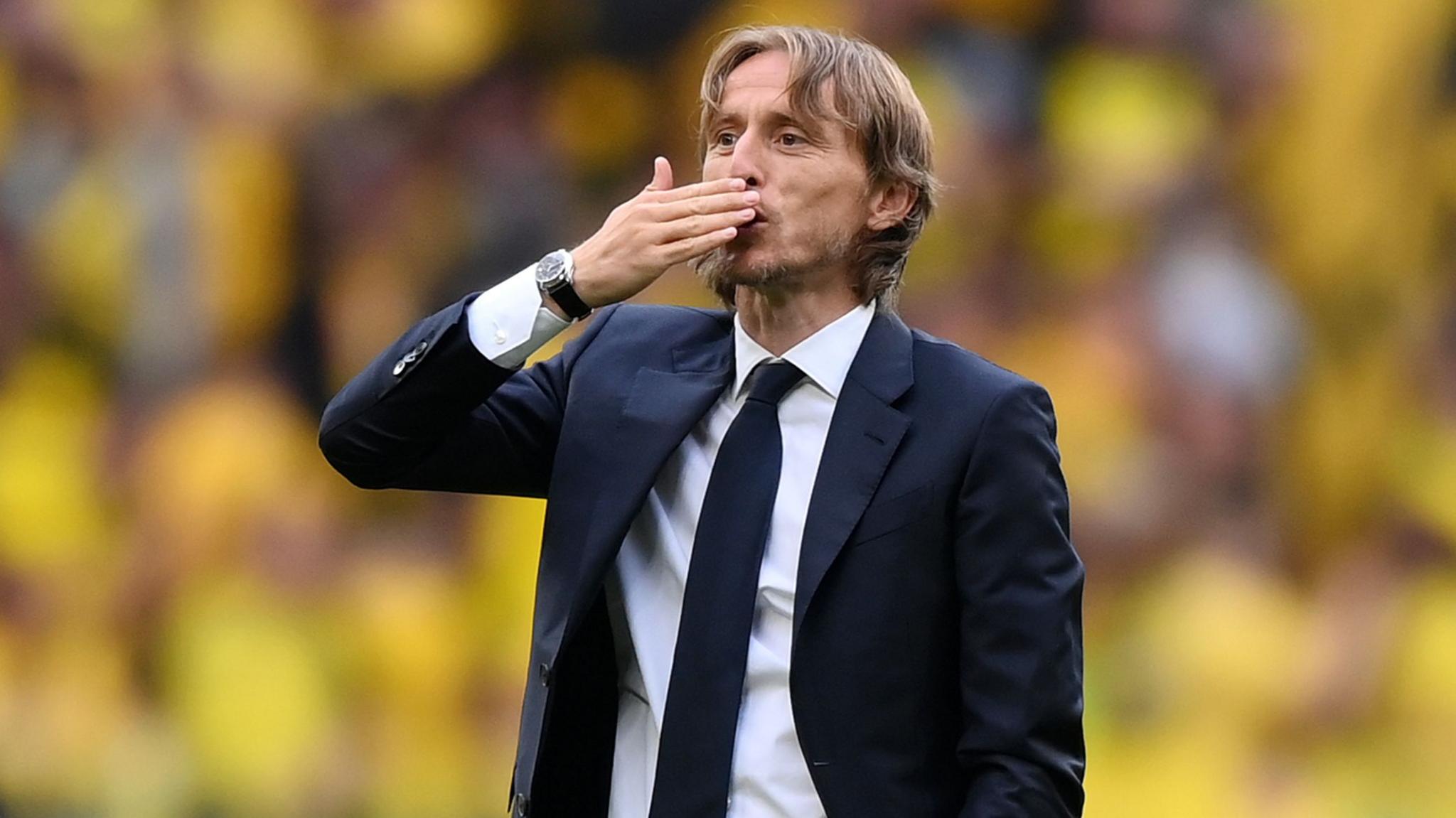
Although he has been largely limited to substitute appearances this season, Modric will leave Real as its most decorated player after 590 appearances, 43 goals and 95 assists.
“Modric will forever remain in the hearts of all Madridistas as a unique and exemplary footballer who has always embodied the values of Real Madrid,” added club president Florentino Perez in a statement.
“His football has captured the imagination of Madridismo and fans all over the world. His legacy will live on forever.”
Modric captained Real to two trophies in his final season to take his haul to 28 titles, overtaking Nacho Fernandez as the club’s most successful player.
His tally includes the six Champions Leagues, six Fifa Club World Cups, five European Super Cups, four La Liga titles, two Copa del Rey triumphs and five Spanish Super Cups during his 13 seasons at Real.
After leading Real to a 2018 Champions League success over Liverpool and then Croatia to the World Cup final in the same year, Modric became the first player since 2007, other than Cristiano Ronaldo and Lionel Messi, to win the Ballon d’Or.
He is also the oldest player to represent Los Blancos in La Liga and their oldest goalscorer, having scored in a 2-1 win over Valencia at the age of 39 years and 116 days, overtaking Ferenc Puskas’ mark.
Modric is also currently the third longest-serving member of a Spanish top-flight side, behind Oscar de Marcos of Athletic Club and Atletico Madrid midfielder Koke.
Last month, the Croatia legend became an “investor and co-owner” with a minority stake in Championship side Swansea City.
‘It feels like the end of an era’
Although Modric has been playing less than he has done for most of his Real Madrid career, he is the kind of player that can affect things because he becomes a magnet for the team.
He may have felt he was being useful at some points, but football is heading in a different direction now – you need to cover a lot of ground for instance. Look at Pedri who is the number one retriever of possession at Barcelona and runs more than anybody else. Modric can’t do that anymore.
He has been the one who has been pushing to stay put but Real had doubts. They listened to the player, the fans, read the room and felt it wasn’t time yet. But everybody was prepared for his departure.
Modric, however, has been an exemplary professional.
Perhaps his most difficult time was when Carlo Ancelotti told him and Toni Kroos that he was going to change things and the club had decided to go for a more physical and dynamic midfield with Aurelien Tchouameni, Fede Valverde and Eduardo Camavinga.
Kroos managed to turn things around and became a very important part of the team, but Modric had a phase on the bench.
During the last couple of years, his situation has left him a bit uneasy. He didn’t know where he stood. He felt he could play 90 minutes more often. It was a nightmare for him but this season, he has understood his role better and has been their leader.
But ultimately, this will have been a decision taken by the club. Xabi Alonso would have agreed to it but it’s a club decision, first of all. The way Alonso’s teams play requires a lot of effort which he cannot ask of Modric.
It also feels like the end of an era.
There is a new culture that has to be set for this team. Ancelotti has struggled with the fractions and egos in the team and by getting Modric out, you can build for new leaders – and that might be Real’s thinking.
Source: BBC























23, May 2025
CPDM Crime Syndicate: ELECAM defends UN partnership amid interference allegations 0
Elections Cameroon (Elecam) rejected calls from the Movement for the Rebirth of Cameroon (MRC) and the United Party for Social Renovation (PURS) to hand over election management to an outside group. Elecam signed a CFA3 billion technical assistance deal with the United Nations but insisted it will keep full control.
Enow Abrams Egbe, Chairman of Elecam’s Electoral Council, said, “It is important to specify that in Cameroon, electoral operations are entirely financed by the public treasury.”
The agreement, signed on May 9 in Yaoundé, aims to tap into the UN’s “proven electoral expertise.” It follows a recent African Union mission in Yaoundé from May 12 to 17 to explore electoral cooperation. Egbe explained that the UN assistance will involve six agencies, including UNDP, UN Women, and UNESCO. The support covers the 2025-2027 electoral cycle, which includes the presidential election, regional council elections, and the legislative and municipal polls.
The MRC and PURS sharply criticized the deal. On May 14, Maurice Kamto’s MRC called the initiative risky and warned of a repeat of the 2010 post-election crisis in Côte d’Ivoire. The party said, “Africans in general, and Cameroonians in particular, still remember the UN’s regrettable interference in the electoral process in Côte d’Ivoire in December 2010, which helped to accelerate one of the worst post-electoral crisis in Africa in the 21st century, resulting in thousands of deaths and the desolation of many Ivorian families.”
The MRC also condemned the secrecy around the agreement, noting, “several days after the signing, neither Elecam nor UN officials deemed it necessary to officially communicate on this event.” The party called the timing “unseemly,” especially as the presidential election campaign period approaches.
PURS, led by Serge Espoir Matomba, echoed the criticism. In a May 16 statement, the party “vigorously denounces the interference of the United Nations in Cameroon’s electoral process.” PURS warned that the move threatens national sovereignty. The party asked, “Why is the United Nations, which has never resolved an electoral crisis, intervening here and now?” It added, “How can we understand that in the 21st century, a sovereign country still accepts such foreign tutelage?” PURS called for “a Cameroonian electoral system that responds to the interests and respects the will of the Cameroonian people.”
Despite the backlash, Egbe stood firm. He signed the agreement alongside Issa Sanogo, the UN resident coordinator in Cameroon. Egbe urged Elecam’s mixed commission members to “become more involved in the implementation of the 2025-2027 electoral cycle.”
Source: Business in Cameroon