
18, March 2026
Changes in the Senate and National Assembly: who becomes next head of state? 0
Cameroon as a nation now stands at a very quiet but consequential crossroads. The recent changes in the leadership of both the Upper and the Lower House have not merely reshuffled the Senate and the National Assembly hierarchies but they have subtly altered the geometry of succession in a Francophone dominated system where constitutional order and political reality do not always move in lockstep.
At the heart of the so called political changes in Yaoundé lies a 60 million dollar question: who becomes the next head of state?
Under Cameroon’s present constitution, the head of the Senate is first in line to assume interim leadership in the event of a vacancy. This provision was designed to guarantee President Biya’s continued stay in power and not to ensure continuity and institutional stability. With new figures now presiding over both the Senate and the National Assembly, the predictability of that succession has become even more complicated. Change is not only needed in both the Senate and the National Assembly but also in the Unity Palace and the Star Building.
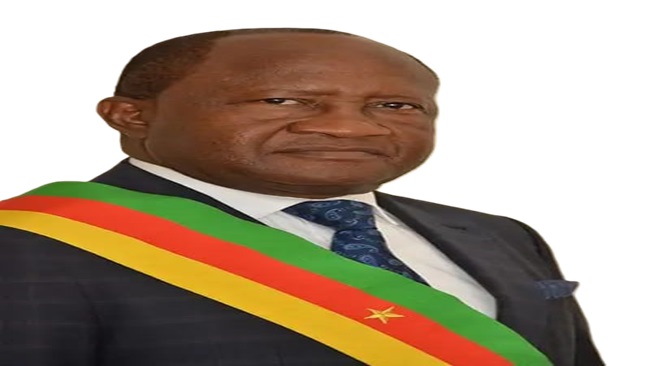
Having a new leadership in the Senate is of course significant. In theory, the President of the Senate is a transitional political figure in a caretaker presidency with limited powers tasked with organizing elections. But in practice, Senator Aboubakary Abdoulaye occupying that seat becomes the face of the nation in a moment of potential uncertainty. Correspondingly, Senator Aboubakary Abdoulaye’s political alliances, administrative competence and perceived neutrality matters far more than the constitution suggest.
The National Assembly’s leadership shift from the 86 year old Cavaye Djibril to Theodore Datoua adds another layer to the puzzle. Though not directly in the line of succession, the National Assembly plays a vital role in shaping the political environment in which any transition unfolds. The Speaker of the National Assembly can influence parliamentary priorities, manage consensus and perhaps most importantly signal where the balance of power truly lies within the ruling CPDM institution.
What has emerged from these two changes in both the Upper and Lower House is not a clear successor, but a more fluid and possibly contested pathway to power. Political power in Cameroon revolves around a strong presidency, with the Senate and the National Assembly including the Central Committee of the ruling CPDM party often seen as supportive rather than autonomous. But as Cameroon approaches its moment of transition, these same establishments can become arenas of political negotiation or even rivalry.
The wahala here is not simply “who” will be the next head of state, but “how” that person will emerge. Will the constitution be followed allowing Senator Aboubakary Abdoulaye to step in smoothly and elections organized without friction? Or will political realities such as CPDM party dynamics, tribal and regional considerations and elite bargaining reshape the process behind the scenes?
Added to this very complicated scenario is also a generational undercurrent. Frankly speaking, recent changes in parliament may reflect a cautious attempt to recalibrate the Cameroon political system for the future. If so, the next president of the republic—whether interim or elected—could mark a departure from entrenched patterns.
For now, Cameroon remains in a state of watchful anticipation. The coming of Senator Aboubakary Abdoulaye and Hon. Theodore Datoua has not answered the succession question; they have instead sharpened it. And in doing so, they remind political commentators that in Cameroon, the formal rules are only part of the story. The rest unfolds in the quieter, less visible spaces where power is negotiated, alliances are forged and futures are decided.
The coming weeks and perhaps months will very much reveal whether these institutional adjustments were merely routine or the early signals of a more significant transition.
By Soter Tarh Agbaw-Ebai















19, March 2026
2025 Africa Cup of Nations: Patrice Motsepe should go and go now! 0
Corruption in all walks of life across Africa is well documented. But even by African standards, the decision by the Confederation of African Football (CAF) to retroactively award the 2025 AFCON title to Morocco, more than 60 days after Senegal won the final 1:0 is not merely controversial, it is absurd. CAF’s statement, invoking Articles 82 and 84, declared Senegal to have forfeited the final, converting a completed match into a 3: 0 victory for Morocco. What makes the decision indefensible is that the match was played to completion, overseen by match officials, and accepted at full-time with CAF and FIFA official presenting the medals and trophy to the players and teams. One cannot have it both ways; a game cannot be fully played and retrospectively forfeited.
AFCON 2025, hosted in Morocco was clouded with controversy. Throughout the competition, particularly in matches involving the host nation, there were persistent complaints about questionable refereeing and inconsistent VAR interventions. Supporters of Cameroon and Nigeria pointed to ignored penalty appeals and un-reviewed fouls by VAR during their games against Morocco in the quarter and semi-finals respectively. Cameroon and Nigeria fans were aggrieved, but accepted the oldest principle in football, that when the referee blows the final whistle, the result stands.
Had Articles 82 and 84 been applied on that day and Morocco declared winner there and then, there would have been outrage, certainly in many parts of the football world, but also closure. Instead, CAF failed to act in real time, only to resurrect its rulebook in a dark committee room weeks later in a move that is incoherent and institutionally damaging. The result is not justice, but confusion and accusations of corruption. This decision has the potential to break CAF up as an organization. There are many in sub-Saharan Africa who already believe that Morocco and the North African nations are using their financial resources to create their own rules in CAF and this is unacceptable.
As explained by Osasu Obayiuwana on Talksport Radio in the UK, rules must be applied prospectively, not retrospectively. If an authority fails to enforce a rule at the relevant moment, it cannot later invoke it to alter an outcome, unless fraud or fundamental illegality is proven. No such finding has been established here. This is not the correction of injustice; it is the creation of it by denying Senegal their victory. If matches completed under a referee’s authority can be rewritten in backrooms, then the referee ceases to be an arbiter. He becomes a temporary facilitator whose decisions are provisional and negotiable.
If Senegal forfeited the match, why was it allowed to continue after the seventeen minutes delay? Even within football circles, the reaction has been scathing. A member of the Cameroon Football Federation (FECAFOOT) described the decision as “unacceptable and disgraceful to African football.” There are the whispers that officials empowered to influence outcomes may have taken their rewards but failed to deliver. This has led to awkward conversations between the parties involved in the scheme. Many say this ruling is less about law and more about settling accounts by the parties. Whether true or not, CAF has once again created the conditions in which such suspicions of corruption thrive.
Senegal’s government has called the ruling as “unprecedented and exceptionally serious,” and called for an independent international investigation into suspected corruption within CAF. They have rightly signaled their intention to appeal to the Court of Arbitration for Sport. There is hope within lovers of African football and justice that the original result will be restored. But even if it is, the damage has already been done. Because in football, the final whistle is supposed to end the argument. In African football, it has just started one.
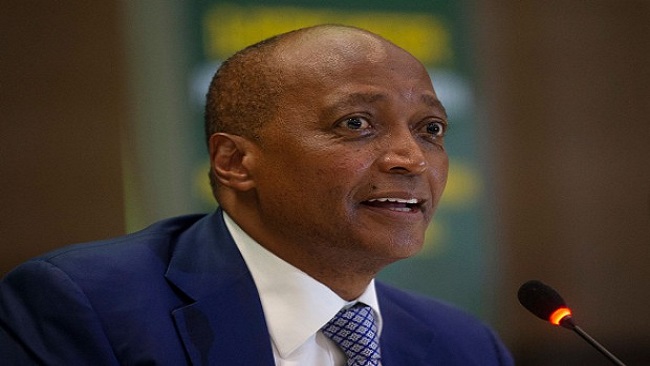
African football has never lacked brilliance. From George Weah to Didier Drogba, from Roger Milla to Samuel Eto’o, the continent has produced generations of extraordinary talent. What it has too often lacked is institutional credibility. Decisions like this erode the very foundations of trust upon which the beautiful game in Africa depends. For the credibility of the game, many now argue that Patrice Motsepe must take responsibility for this mess and resign immediately.
By Isong Asu
Cameroon Concord London Bureau Chief