24, November 2025
Archbishop Nkea attacks Amba fighters targeting priests 0
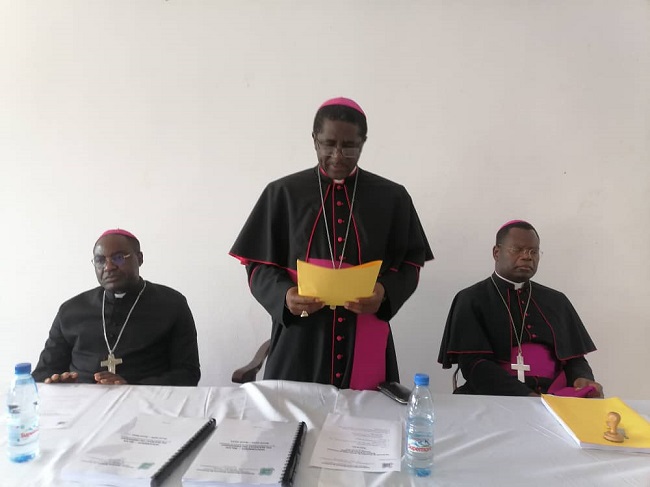
Catholic leaders in Cameroon’s restive North-West region have issued a scathing condemnation of the recent kidnapping of priests, stating that the targeting of religious figures is a clear sign that the separatist struggle has “lost focus” and devolved into pure criminality.
Their remarks follow the abduction of six priests and one member of the laity from the Archdiocese of Bamenda.
According to a release signed by the Archbishop of Bamenda, Archbishop Andrew Nkea Fuanya, gunmen abducted Father John Berinyuy Tatah, the parish priest of Babessi, and his assistant on Nov. 15, as they returned from the Mass inaugurating the PAX University Institute in Ndop.
On Nov. 18, four priests and one lay person went to negotiate with the gunmen for the release of the two priests but were also taken captive. While the group was later released, Tatah remains in captivity, with his captors demanding a ransom.
In a Nov. 23 release, Nkea declared the Church will not pay the ransom, setting a Wednesday deadline for the captors to free the priest. He warned that if the deadline passes, all Catholic institutions in the Ndop Deanery will be closed and religious personnel will withdraw.
“The frequent kidnapping of our priests and mission personnel has pushed us to the wall and we say that this should stop with immediate effect,” he added, noting that many lay Christians have also been tortured or killed.
The recent kidnappings are the latest crimes in the separatist conflict that has rocked Cameroon’s English-speaking North West and South West regions for nine years.
The crisis stems from the 1961 reunification of the former French and British Cameroons, creating a bilingual state where the English-speaking minority has long felt marginalized by the Francophone-dominated central government.
Tensions over the perceived erosion of the common law legal system and English-language education practiced in the English-speaking regions boiled over in 2016, leading to peaceful protests that were met with a harsh security crackdown. This response radicalized many in Cameroon’s English-speaking regions, sparking an armed insurgency for an independent state called “Ambazonia.”
But what began as a genuine fight for identity has degenerated into criminality, Church leaders argue, and the kidnapping of priests is a testament to this decline.
“The focus has been lost because we cannot be fighting the church, a moral institution and its authority,” said Edith Tanyi, National President of the Catholic Women’s Association (CWA), expressing the disgust and frustration felt by many faithful.
Valentine Tameh, an executive member of the Catholic Men Association in the Bamenda archdiocese, questioned the spiritual legitimacy of a movement that attacks men of God.
“We have heard over and over that the struggle is God-ordained. But when such things begin to happen, then you ask, how can it be God-ordained when priests, pastors, bishops are being kidnapped?” he told Crux.
Tameh argued the conflict has shed any pretense of being a political movement.
“These kidnappings tell me that the ongoing struggle is not a rational struggle any longer,” he asserted. “I think I will not hesitate to call this criminality now… what progress has those huge, extorted sums brought to the people? Nothing at all. So, it’s more or less criminality now,” he said.
Pricillia Agendia, Director of Communication for the Archdiocese, highlighted the demoralizing effect on the community, noting that priests are now targeted “on average, weekly.” She warned that such tactics are undermining the separatists’ cause by alienating potential sympathizers.
“The kidnappings are not helping in any way in resolving the crisis because kidnappings are sending the wrong message about a crisis that drew sympathy at the beginning,” she told Crux.
In his release, Nkea also urged the military to be more professional and ethical—a veiled reference to abuses also committed by security forces. He called on all stakeholders “to do everything within their powers to dialogue and bring this crisis to an end.”
“The people of the North West and South West regions have suffered enough and they deserve to have a quiet life,” the archbishop said.
Source: Crux














25, November 2025
Reggae legend Jimmy Cliff dies aged 81 0
Jimmy Cliff, the Jamaican music legend and one of the pioneers of reggae, died due to a seizure followed by pneumonia, his wife said on Monday.
“It’s with profound sadness that I share that my husband, Jimmy Cliff, has crossed over due to a seizure followed by pneumonia,” his wife Latifa Chamber posted in a message on Instagram.
“I am thankful for his family, friends, fellow artists and coworkers who have shared his journey with him. To all his fans around the world, please know that your support was his strength throughout his whole career,” Chamber said.
“Jimmy, my darling, may you rest in peace. I will follow your wishes. I hope you all can respect our privacy during these hard times. Further information will be provided at a later date. See you and we see you Legend,” said the message, which was also signed by their children Lilty and Aken.
Born in Jamaica in 1944 as James Chambers, he began writing songs at a young age before his father took him to the Jamaican capital Kingston, where he would take the stage name Jimmy Cliff.
He was one of just handful of musicians to be awarded the Order of Merit, the highest honour that can be granted by the Jamaican government for achievements in the arts and sciences.
Cliff’s vast repertoire of hits included “Many Rivers to Cross”, “You Can Get It If You Really Want”, “I Can See Clearly Now” and “Wonderful World, Beautiful People”.
‘I still have many rivers to cross’
In the course of a prolific musical career, Cliff recorded more than 30 albums and performed all over the world, including in Paris, in Brazil and at the World’s Fair, an international exhibition held in New York in 1964. The following year, Island Records’ Chris Blackwell, the producer who launched Bob Marley and the Wailers, invited Cliff to work in the UK with him.
Cliff later went into acting, starring in the 1972 classic film “The Harder They Come,” directed by Perry Henzell, which introduced an international audience to reggae music. The movie portrayed the grittier aspects of Jamaican life, redefining the island as more than a tourist playground of cocktails, beaches and waterfalls.
“When I’ve achieved all my ambitions, then I guess that I will have done it and I can just say ‘great’,” he said in a 2019 interview, as he was losing his sight.
“But I’m still hungry. I want it. I’ve still got the burning fire that burns brightly inside of me – like I just said to you. I still have many rivers to cross!”
Known in part for his hit singles as well as for his covers of Johnny Nash’s “I Can See Clearly Now,” which appeared on the soundtrack of the 1993 movie “Cool Runnings,” and Cat Stevens’ “Wild World,” Cliff was a prolific writer who weaved his humanitarian views into his songs.
Bob Dylan said Cliff’s “Vietnam” was the best protest song ever written.
The anti-establishment bent of Cliff’s music gave a voice not only to the hardships faced by Jamaicans, but to the spirit and joy that persevered in spite of poverty and oppression. Over the years, Cliff worked with the Rolling Stones, Elvis Costello, Annie Lennox and Paul Simon.
In 2012, he won a Grammy Award for best reggae album for “Rebirth,” which was produced by punk band Rancid’s Tim Armstrong, and another Grammy in 1984 for “Cliff Hanger.”
Cliff was inducted into the Rock and Roll Hall of Fame in 2010.
Source: Reuters