8, December 2021
Bishops condemn attacks on Southern Cameroons schools as more details emerge on the Ekondo Titi incident 0
Cameroon’s English-speaking bishops have condemned attacks on schools in the country’s conflict-ridden North West and South West Regions.
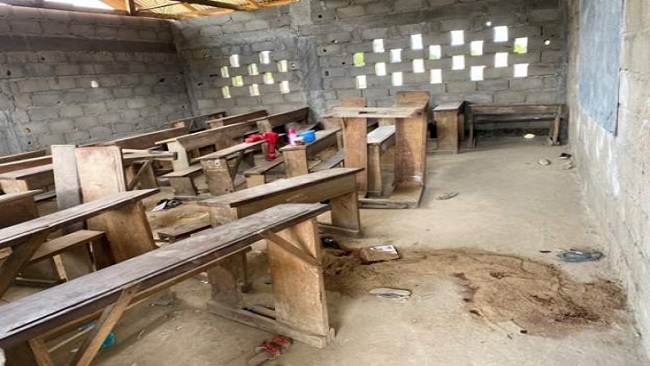
Their latest statement comes after four students and a teacher were killed on Nov. 24 at Government Bilingual High School Ekondo-Titi in the South West region.
Schools have become a battleground as Anglophone separatists fight the majority French-speaking government in the African country. For many years, the separatists imposed a schools’ boycott, which they enforced with violence.
“Our hearts have been pierced again!” said Archbishop Andrew Nkea Fuanya of Bamemda, in a statement he signed on behalf of all the bishops of his ecclesiastical province, which overs the Anglophone regions of Cameroon.
“In recent times, we have painfully witnessed an agonizing drama involving, among other evils, the targeting and killing of pupils, students and teachers … We have hardly recovered from the cruel killing of Enondiale Tchuengia Carolaisse, killed in Molyko-Buea on Thursday, October 14, 2021, and the brutal killing of another pupil, Brandy Tataw, on Friday, November 1, 2021, in Nkwen-Bamenda, then we are confronted again with the killing of four more innocent Cameroonians within the protected area of a school,” said the archbishop.
“These innocent victims are not the cause of the socio-political crisis, and their deaths cannot be the solution. Their murder is totally senseless and unacceptable,” Nkea said.
A local government administrator confirmed the attack, telling Crux that “separatist fighters laid ambush in the school before students arrived. They were dressed like soldiers to give students the feeling that they were actual soldiers guarding the school.”
Timothee Aboloa identified the students as Emmanuel Orume 12, Joyceline Iken 16, and Kum Emmanuel, 17. The teacher, Celestine Song was 58 years old and a mother of four.
“It was quite a frightening scene,” said Henry Agbor, a local resident.
“I heard a loud explosive. I was standing around the Okada beach park ready to take a bike to the beach before the mayhem broke out. Besides the teacher and students who have died, many students are also wounded,” he told Crux.
“We never expected this,” said Father Gaetan Ndongo.
“The attacks are creating fear around the place and the education of our children has been systematically sacrificed,” he told Crux.
The recent attacks are a grim reminder of the price education has had to pay in the separatist war in Cameroon’s English-speaking regions, now in its 5th year.
The darkest date was probably Oct. 24, 2020, when six children were killed by suspected separatists at the Mother Francisca International Bilingual Academy in Kumba.
Several other schools were attacked the following month, leading to the deaths of at least three other students.
Earlier this year, on Oct. 14, a soldier killed Enondiale Carolise, a student on her way to school in Buea. Another girl, Tataw Brandy, was killed by a soldier in Bamenda on Nov. 10.
The United Nations says more than 700,000 children have been forced out of school during the conflict, with 2 out of 3 schools being shut.
Yasmine Sherif, the director of Education Cannot Wait, said the Cameroon crisis is among “the most complex humanitarian crises in the world today.”
“Children and youth are having to flee their homes and schools, are threatened with violence and kidnapping, and being forced into early childhood marriage and recruited into armed groups,” said Sherif.
“We call for urgent support from donors to respond to this forgotten crisis. We call for the respect of human rights and adherence to the principles of international humanitarian law and the Safe Schools Declaration, and for partners to redouble efforts so all children and adolescents can get back to the safety, protection and hope that quality learning environments provide,” she said.
The bishops have condemned violence as a means of problem solving, insisting that life must be protected.
“We, the Bishops of the Ecclesiastical Province of Bamenda, condemn these barbaric acts, which violate all International Laws and Conventions safeguarding the inviolability of schools and the protection of learners (pupils and students), and teachers, offend against the fundamental right to education, and breaks the Fifth Commandment of God,” the statement reads.
“We have been persistent in our call for the respect and defence of human rights, especially the right to life, openness to dialogue, an option for the truth and recourse to peaceful means as the best way to a durable solution,” it continues.
While calling on the government to ensure the security of schools, we make a special appeal, once more, to all perpetrators of violence to allow the genuinely human feelings of love, pardon and benevolence to flow into their hearts so that the safety and security of all may be guaranteed, alongside the right of all young people to life and to an education and a future,” the statement added.
Source: Crux













8, December 2021
Southern Cameroons refugee crisis affecting map of Nigeria 0
The United Nations High Commissioner for Refugees (UNHCR) has called on the international community to urgently support over 70,000 Cameroonian refugees in Nigeria.
The UN agency said that nearly 80 per cent of these people are women and children.
“This is not just a number, these are people behind these numbers, mothers, fathers, brothers and sisters, people just like you and I, that have been forced to flee their homes to seek safety and save their lives,” says UNHCR’s Country Representative Chansa Kapaya. “70,000 refugees are 70,000 daughters and sons.”
Their dreams and plans were disrupted by violence in the North-West and South-West regions of Cameroon where a conflict between secessionist Non-State Armed Groups and the army has been displacing people from their homes since 2017. Recent arrivals and UNHCR’s protection monitoring confirm killings, abductions, forced evictions and other forms of violence, with armed groups attacking schools and hospitals.
Over 8,000 Cameroonian women, men and children have arrived in Nigeria’s Akwa Ibom, Anambra, Benue, Enugu, Cross River and Taraba States in the past 12 months, many in hard- to -reach rural areas. UNHCR, together with the National Commission for Refugees, Migrants and IDPs, registered them. 59 percent found refuge in local communities. The rest live in four settlements which UNHCR helped build on land generously provided by the government.
Nigeria has a progressive open-door approach to refugees, allowing refugee girls and boys to go to school just like nationals and their parents to work where they can. With support from UNHCR, Nigeria provides primary health care to refugees and nationals alike. “UNHCR commends Nigeria because it is on its way to become a champion in implementing the Global Compact on Refugees,” says UNHCR’s Representative Chansa Kapaya, “but Nigeria needs support”. The most pressing needs of Cameroonian refugees are food, shelter, improved health care and education as well as livelihood opportunities.
With rising food prices, the economic hit of COVID-19 and the refugee influx, needs are on the rise with serious risks of gender-based violence and negative copying mechanisms such as begging and survival sex. The amount of support UNHCR can deliver is increasingly falling short. Cash for food, for instance, had to be reduced from 2019 due to insufficient funding.
US$97.7 million is needed to respond to the needs of a total of some 78,000 refugees and asylum-seekers of different nationalities and to IDP needs – protection, camp management/coordination, shelter and non-food items such as blankets and jerry cans.
So far, not even half of this amount (45 per cent, as of 23 November) has been received. UNHCR calls on donors and development agencies not to forget Cameroonian refugees in Nigeria.
Source: Vanguard