
27, August 2020
Mali junta says it has released ousted president Ibrahim Boubacar Keita 0
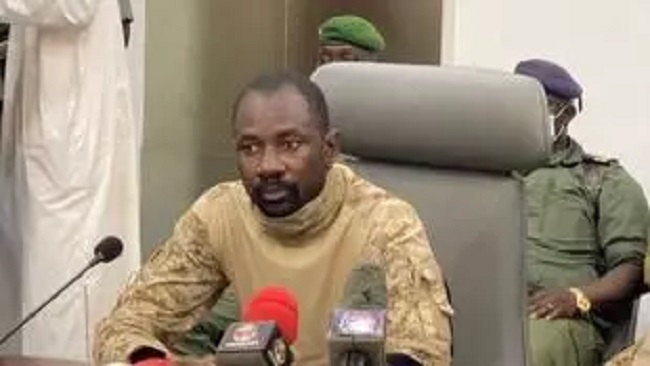
Mali’s new military rulers said Thursday that former president Ibrahim Boubacar Keita, who was detained during the country’s coup on August 18, had been freed.
The announcement came on the eve of a summit by Mali’s neighbours, who are to decide whether to ratchet up pressure on the fledgling junta.
Keita’s ousting by rebel troops sent shockwaves through the region and in France, which sees Mali as a linchpin in its campaign against jihadism in the Sahel, where more than 5,000 French troops are based.
“President IBK is free in his movements, he’s at home,” a spokesman for the junta, Djibrila Maiga, told AFP, referring to Keita by his initials, as many Malians do.
The junta, calling itself the National Committee for the Salvation of the People (CNSP), said on Facebook it was “informing public and international opinion that former president Ibrahim Boubacar Keita has been released and is currently in his residence”.
A Keita relative, speaking on condition of anonymity, said the 75-year-old former leader had returned overnight to his house in the Sebenikoro district of the capital Bamako.
The source did not say whether he was still subject to any restrictions.
Keita, prime minister Boubou Cisse and other senior officials were seized by young officers who mutinied at a base near Bamako.
In the early hours of August 19, Keita appeared on national TV to announce his resignation, saying he had had no other choice, and wanted to avoid “bloodshed”.
His release — and other leaders — is a key demand of Mali’s neighbours, its ally France and international organisations, including the African Union and European Union.
Former Nigerian president Goodluck Jonathan, heading a team from the regional bloc ECOWAS, was given access to Keita last Saturday, and said he seemed “very fine.”
The announcement Thursday came on the eve of a virtual summit by the 15-nation ECOWAS — the Economic Community of West African States — which has imposed sanctions against Mali for the coup.
Those measures include a closure of borders and a ban on trade that threaten to worsen Mali’s already severe social and economic troubles.
Jonathan’s three-day mission to Bamako foundered on the question of the transition to civilian rule.
The junta have promised to enact a political transition and stage elections within a “reasonable time” but not spelt out details.
Discussing progress with Nigeria’s President Muhammadu Buhari, Jonathan said the coup leaders wanted to stay in power for a three-year transition period, an offer rejected by the mediators, according to a statement from the presidency.
“We also told them that what would be acceptable to ECOWAS was an Interim Government, headed by a civilian or retired military officer, to last for six or nine months, and maximum of 12 calendar months,” Jonathan was quoted as saying in the presidency statement late Wednesday.
Jihadist worries
Keita was elected in 2013 as a unifying figure in a fractured country and was returned in 2018 for a second five-year term.
But his popularity plummeted as he failed to counter a bloody jihadist campaign that has claimed thousands of lives and driven hundreds of thousands from their homes, and to reverse the country’s downward economic spiral.
In a visit to the Estonian capital of Tallinn on Thursday, the head of the French armed forces, Francois Lecointre, said, “Our wish is to maintain the Malian army’s commitment in the fight against armed terrorist groups.”
He pointed to a campaign launched earlier this year to regain control over the strategic “three-border” zone, where the frontiers of Mali, Niger and Burkina Faso come together.
“We are going to see if the Malian armed forces are able to maintain the momentum… we have told them that this appears essential to us,” said Lecointre.
“The corps commanders are still there, the area commanders are still there, these aren’t people who took part in the coup, and so we are continuing to cooperate with them,” he said.
(AFP)
















28, August 2020
Cardinal Arinze says cause of beatification of Dr. Bernard Nsokika Fonlon could be introduced 0
UNFORGOTTEN
I hold Dr. Bernard Nsokika FONLON in very high regard.
I first got to know him in Bigard Memorial Seminary, Enugu, Nigeria, in the years 1953 and 1954. He was in second year theology when I entered that Major Seminary in September 1953. When he and his classmates were due to be ordained subdeacons in December 1954, the Seminary authorities and his Bishop decided not to admit him to major orders.
As a seminarian, I saw Bernard as a learned seminarian. I still remember how with lustre he sang “Audi Benigne Conditor” during Vespers in Lent. He took no breakfast. When other seminarians were at breakfast, he was studying, we believed he was at Latin and Greek!
During holidays and in the years after he had to leave Bigard Memorial Seminary, he used to visit one of the Nigerian priests, Monsignor Peter Meze-Idigo who was very kind to him, as he also was to seminarians in general. Once during those visits by Fonlon to Monsignor Meze at Dunukofia, my parish, I took Bernard to visit my parents at Eziowelle and my father, a good wine tapper, gave him good palm wine which he took gladly. I still remember that my mother tried to converse with him in Igbo and was surprised that Fonlon did not know how to speak Igbo. I had to inform my innocent mother that Igbo is not the only language spoken in Africa!
I lost track of Fonlon in the years when he worked for a Doctorate in Ireland and another Doctorate in France. The next time I met him was during the Nigeria-Biafra war, probably in 1968 or 1969. It was a quick meeting because we were both passengers in Air France flying to Paris from Douala. At that time, Dr Fonlon was Minister of Communications in the Camerun and I was Archbishop of Onitsha.
After that Nigerian civil war, I visited Dr Fonlon in Yaounde. It may have been around the year 1972. I first visited Archbishop Paul Verdzekov in Bamenda. Then I flew from Buea to Yaounde. Fonlon met me at the airport. I stayed about two days with him. I then learned that he was no longer Minister in the Government because President Ahidjo called him and explained: Bernad, I regret that we can no longer retain you in the cabinet because you put the rest of us ministers to shame, because you are your own driver and you drive an old car.
My unforgettable memory of my stay with Fonlon in his flat was that one day his sister prepared a fou-fou lunch for both of us. During lunch, Dr. Fonlon was so absorbed in our conversation (which was more me listening to his wisdom) that I finished my lunch; he then put together his fork and knife, put his plate aside and continued his learned discourse. He forgot that he had not eaten anything yet! I have never in my life of 87 years reached that level of detachment from creatures.
Dr Bernard Nsokika Fonlon was a man of high ideals. He prayed. He said the Latin Breviary daily. He loved the Church. He was not bitter that he was not ordained a priest. In my view, it was an administrative mistake of his superiors that he was not ordained. It seems to me that they did not understand enough. He was the type of professional intellectual who may seem not the routine parish priest. As a university priest, he could have answered many needs of the Church. However, as a lay person, he also did much good. The Camerounians are the best placed to make a judgement on this. He lived a celibate life. When I visited him in 1972, I saw that he loved the Breviary.
In my view, the Cause of Beatification of Dr. Bernard Nsokika Fonlon could be introduced. I am happy to be writing these lines on his anniversary of his death.
May he rest in the peace of Christ.
+ Francis Card. Arinze
Vatican City, 26 August, 2020.