
5, September 2019
Ambazonia: Children stay away from school as separatists threaten attacks 0
Hundreds of thousands of children in Cameroon’s English language-speaking region are staying out of school this week, after separatists called for a boycott and threatened attacks on those who attend.
Insurgents have been fighting the West African country’s francophone government in a bid to carve out an independent state they hope will be named Ambazonia.
Though Cameroon’s school year officially began on Monday, Unicef says that 80 per cent of schools have been shut down in the anglophone region, in Cameroon’s northwest and southwest, many for the past three years. About 600,000 children have been affected, and at least 74 schools destroyed, the agency said.
This is “putting the future of an entire generation of children at risk, children who with the right support and opportunities can build a more stable and prosperous future”, said Unicef spokesman Toby Fricker.
Schools were originally closed in 2016, after anglophone teachers and lawyers began to protest an enforced increase in how much French had to be used in courts and schoolrooms. In the fighting that has escalated since, more than half a million people have been displaced and thousands killed.
Embedded
“Schools have been at the heart of the conflict since it began,” Emmanuel Freudenthal, one of the only journalists who has been embedded with Cameroon’s separatist forces, told The Irish Times.
“For both the state of Cameroon and separatists, the schools have become a symbol to demonstrate their control over the two anglophone regions.
“Nevertheless, the separatists are divided on this question, some arguing that schools should be allowed to function, while others say that the education offered is of low quality and that the yet non-existent country of Ambazonia will offer a schooling, which has not materialised.”
Parents who can afford to have sent their children abroad, Mr Freudenthal said.
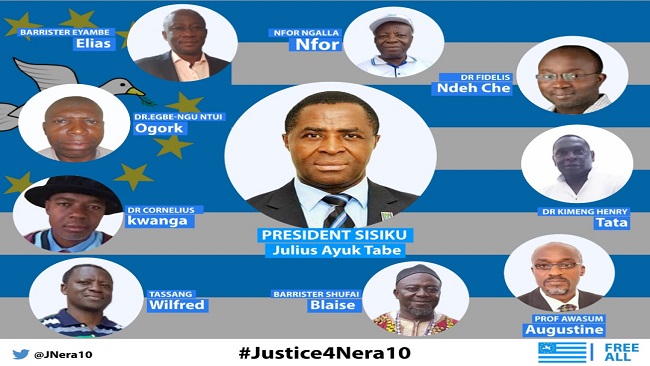
On August 20th, Sisiku Ayuk Tabe, one of the leaders of the separatist movement, was sentenced to life imprisonment in Cameroon, along with nine others.
This process has been plagued by pre-trial abuses and serious allegations of fair-trial breaches
On Monday, New York-headquartered Human Rights Watch announced that the 10 imprisoned men had lodged an appeal against the convictions.
“It appears that the military court handed down a hasty verdict and sentence without giving the accused any meaningful opportunity to defend themselves,” said Lewis Mudge, Human Rights Watch’s central Africa director. “This process has been plagued by pre-trial abuses and serious allegations of fair-trial breaches that warrant independent and impartial judicial review, which we hope will happen under appeal.”
Torture
The men were arrested in Abuja, Nigeria’s capital, in January 2018. According to Human Rights Watch, they were then held without contact for six months, in a Cameroonian detention facility where torture and abuse is believed to be rampant.
The human rights organisation said the evidence used against the men was only shown to them during a 17-hour overnight hearing, which began on August 19th. Defence lawyers said they were not able to challenge it, or even discuss what was presented with their clients, and eventually withdrew from proceedings in protest.
The trial was also carried out in French, according to the organisation, and there was no proper translation for the defendants.
Source: Irish Times
















9, September 2019
French Cameroun: Internally displaced Ambazonia children struggle to continue schooling amid crisis 0
As early as 6:30 am on the day of school reopening, 10-year-old Cameroonian girl Kelsy Shinyuy was already on her way to meet her new teachers and classmates.
“I am very happy because I have not been to school for long. Very happy,” she said.
Shinyuy had to stay at home since 2017 due to a persistent crisis in the Cameroon’s two English-speaking regions of Northwest and Southwest, where separatists have been clashing with government forces in a bid to secede from the French-majority Cameroon and create an independent nation they call “Ambazonia”.
In late August this year, Shinyuy and her family left their home in Kumbo in the Northwest to take refuge in Foumban, chief-town of Noun division in the Francophone part of Cameroon, about 100 km away from Kumbo. She was finally able to restart school at Saint Joseph Bilingual School of Foumban.
Her mother Lidwina Limunyuy was very excited that she managed to resend her child back to school, although for lack of money, the other two younger brothers of Shinyuy have to keep staying at home.
“We went through hardship. In fact we are lucky to be alive,” Limunyuy said.
A UNICEF report released in August estimates that insecurity spreading across Cameroon’s Anglophone regions has left more than 4,400 schools forcibly closed, affecting more than 600,000 children. According to the government, many of these schools were found being used as bases of the armed separatists.
According to UN estimations in July, the conflicts have resulted in about 530,000 internally displaced persons (IDP). Among them, many are children and teenagers struggling to resume schooling with very limited ressources.
“The situation is sad and touching…We have asked all the school authorities to admit all the internally displaced children. We are very focused to make sure they go to school hitch-free,” said Amidou Mbouombouo, divisional delegate of the secondary education ministry in Noun.
Magdaline Abongmbuh, a teacher at Government Bilingual High School of Foumban, said 33 IDP students registered in her class.
“Some of the students came to school without uniforms and books and school fees. When I asked them to go home and dress properly before coming to school, they burst into tears and insisted that they are ready to study in any condition,” said Abongmbuh. “They cried, Madam, we have suffered a lot and we want to go to school.”
Humanitarian agencies like the Red Cross are also taking actions.
Last academic year, the Red Cross helped about 7,000 displaced children register in primary and secondary schools in Noun, where there are currently 38,940 IDPs, according to Ibrahim Pouamoun, divisional secretary of the Red Cross in Noun.
Local elites make their contribution too. Members of Bamoun Kingdom, a major chiefdom in Noun, visited displaced families before school resumption to donate learning equipments.
To provide IDPs with sustainable sources of income, the sultan king Ibrahim Mbombo Njoya has made available 600 hectares of farm land, according to Inoussa Ngoupayou, first deputy to the sultan king.
On this first day of school, Shinyuy was already making new friends. All children have been instructed to be kind to their mates coming from crisis-hit regions, school headmistress Caroline Yaah told Xinhua.
“I will study hard to become a doctor,” Shinyuy said.
Culled from Xinhuanet