18, April 2026
Douala: Pope urges Christians to reject violence at Mass that draws 120,000 people 0
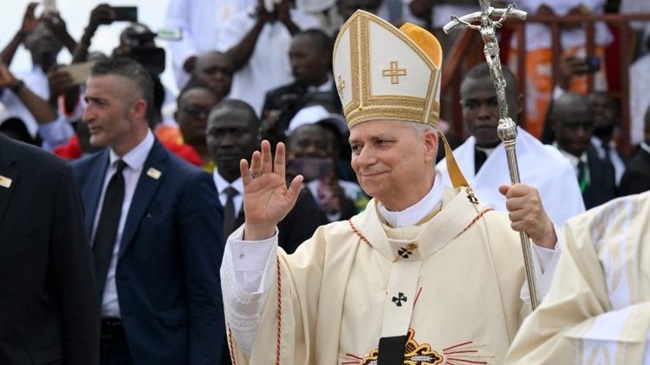
Pope Leo called on Cameroonians on Friday to reject violence and be generous with their neighbours during an event billed as the biggest of his four-nation Africa tour, with roughly 120,000 people flocking to a Mass he led in the port city of Douala.
Amid heavy security, some believers had made their way on Thursday to the city’s Japoma Stadium, venue of the Mass, and slept overnight outside on mats to hear Friday’s address from the pontiff, who has become outspoken on war and inequality and has drawn the ire of U.S. President Donald Trump.
By Friday morning, streets near the stadium were lined with crowds singing, dancing and holding umbrellas to shield themselves from the heat.
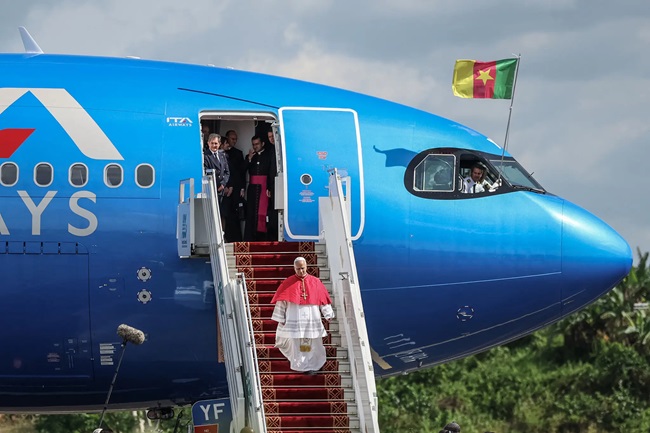
After arriving in Douala, Cameroon’s largest city and economic hub, by plane from the capital Yaoundé, Leo told the crowd that many in the country are suffering from “material and spiritual poverty” but he urged believers to reject violence as a means to get ahead, regardless of the hardships they face.
“Do not give in to distrust and discouragement,” the pope said, in an appeal made in English during a speech that was otherwise mostly in French.
“Reject every form of abuse or violence, which deceives by promising easy gains but hardens the heart and makes it insensitive.”
FORCEFUL REMARKS ON AFRICA TOUR
Leo, the first U.S. pope, has debuted a new, forceful speaking style on his Africa tour. In Yaoundé on Thursday, he said the world was “being ravaged by a handful of tyrants”, without naming anybody.
He has also this week decried violations of international law by “neocolonial” world powers and said “the whims of the rich and powerful” threaten peace.
Leo avoided overtly political messages on Friday.
Invoking the miracle of the loaves and fishes recounted in the Gospels, in which Jesus fed thousands with meagre resources, Leo said: “There is bread for everyone if it is given to everyone. There is bread for everyone if it is taken, not with a hand that snatches away, but with a hand that gives.”
Carine Kemmoue, a medical doctor who attended Friday’s homily, said she saw a clear link between Leo’s message and his past statements critical of the war in Iran.
“I was very moved by the Pope’s message. When, I mean, he stands against positions like those of Donald Trump, for example, he is against violence,” Kemmoue said.
“I think that is normal for a man of God, since the Church promotes peace.”
After returning to Yaoundé on Friday afternoon, Leo met with students and professors at the Catholic University of Central Africa, which educates young people from across the region.
During the event, the pope referred to “the darker side of the environmental and social devastation caused by the relentless pursuit of raw materials.”
He drew a loud cheer when he said the continent “must be freed from the scourge of corruption.”
‘MOMENT OF JOY’ FOR CAMEROON’S CATHOLICS
Cameroon, a producer of oil and cocoa, faces grave security challenges, including a simmering Anglophone conflict in which thousands of people have been killed since 2017.
The country has been led for more than four decades by President Paul Biya, the world’s oldest head of state at 93. His re-election last October sparked protests by opponents who say most ordinary Cameroonians have little to show for his rule.
Crowds greeting the pope on his visit to Cameroon have been enthusiastic, lining the streets along his routes and wearing colourful fabrics featuring images of his face.
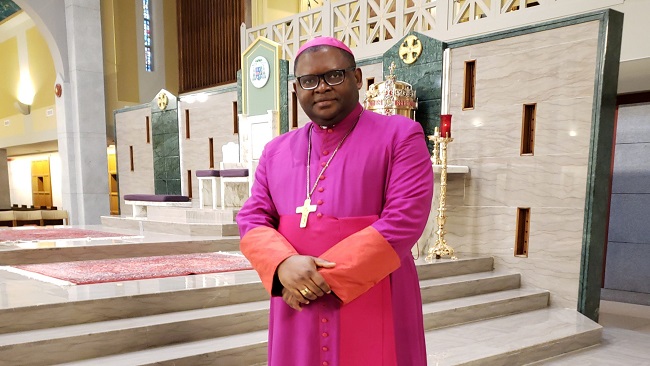
Bishop Leopold Bayemi Matjei called Leo’s visit “a moment of great joy” and said he hoped it meant God would bless Cameroon.
“Our country needs a lot of blessing, a powerful blessing, so that hope will come to rise again,” said the bishop, who leads the Church in Obala, about an hour north of Yaoundé.
Friday was Leo’s last full day in Cameroon. He is scheduled to travel to Angola on Saturday.
Source: Reuters











18, April 2026
Douala: The Holy Father challenges wealth distribution amid rampant corruption 0
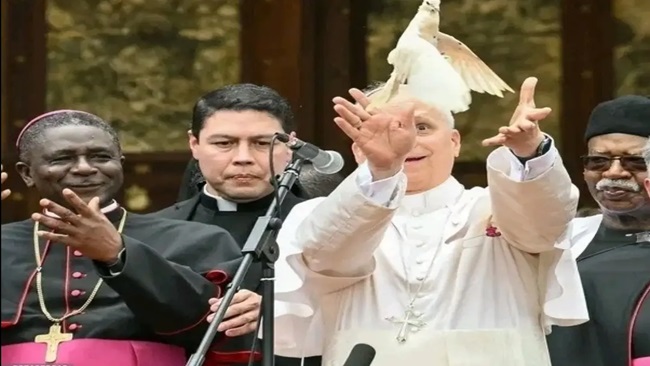
In a half-day visit to the economic capital of Cameroon Friday, Pope Leo offered the local population an extended reflection on the just and equitable distribution of resources in a country notorious for corruption.
In his April 17 homily at Japoma Stadium in Douala, the pope framed his message in the context of the day’s Gospel reading recounting Jesus’s multiplication of the loaves and fish upon discovering there was not enough food to feed the hungry crowd gathered to hear him preach.
Seeing the problem of inadequate resources, he said, “Jesus asks us today, just as he asked his disciples then: How will you solve this problem? Look at all these hungry people, weighed down by fatigue. What will you do?”
“This question is posed to each one of us,” Leo said, saying it applies to families trying to make ends meet, as well as the pastors of the church and to “those who bear social and political responsibility for the people and seek their well-being.”
Every person, strong or weak, rich or poor, has the same hunger, and nourishment is necessary in order to live, he said, asking, “where is God in the face of people’s hunger?”
Jesus offers his own answer to this question when he took the loaves and fish, gave thanks to God, and distributed them among the crowd.
“A serious problem was solved by blessing the little food that was present and sharing it with all who were hungry. The multiplication of the loaves and the fish happened while sharing: that is the miracle,” the pope said, saying, “There is bread for everyone if it is given to everyone.”
There is enough bread for everyone, Pope Leo said, “if it is taken, not with a hand that snatches away, but with a hand that gives.”
He highlighted Jesus’s act of gratitude to God before performing the miracle, saying this is what made the food abundant.
“It was not rationed out of necessity. It was not stolen in strife. It was not wasted by those who gorge themselves in the presence of those who have nothing to eat,” but rather, passing from Jesus, to his disciples, and then to the people, “the food increased for everyone; indeed, it was superabundant.”
When the crowds immediately declaring Jesus to be a prophet, Jesus, Leo said, “did not use those words for personal gain. He did not want to become king, because he had come to serve with love, not to dominate,” but to serve the good of all.
Pope Leo spoke on his third day in Cameroon, which is part of a broader April 13-23 tour of Africa that began in Algeria, and which will also take him to Angola and Equatorial Guinea.
He will celebrate Mass in the capital city of Yaoundé Saturday before flying to the Angolan capital of Luanda.
A consistent appeal
Pope Leo, whose very name and magisterium so far are seeped in issues of social justice, spent over two decades as a missionary in Peru, serving in the country’s most impoverished regions in the north during a massive financial and political crisis, leading to terrorism and widespread social instability.
Throughout the nearly complete first year of his pontificate, Leo has condemned income inequalities and the unjust distribution of wealth, saying in an exclusive interview for this journalist’s biography of his life, Pope Leo XIV: The Biography, set for publication in English later this month, that employers now make around 600 times more than their employees.
In that interview, he questioned extreme wealth concentrated in the hands of a few, noting that last summer Elon Musk was declared the first trillionaire in the world, saying, “What does that mean and what’s that about? And if that is the only thing that has value anymore, then we’re in big trouble. We have to talk about these things.”
Later, in a general audience Dec. 17, he condemned bloated, “out of control” investment portfolios of the extremely wealthy, while vast portions of the global population live in poverty.
“In the heart that true treasure is kept, not in earthly safes, not in large financial investments, which today more than ever before are out of control and unjustly concentrated at the bloody price of millions of human lives and the devastation of God’s creation,” he said on that occasion.
Continuing to drive this point, this time speaking from a continent whose lands are notoriously exploited by foreign powers and extractive industries for resources while their populations live in poverty, indicates this will be a consistent major talking point for the American missionary pontiff.
A message to Cameroon
Pope Leo’s visit to Douala for Mass took him to the economic capital of Cameroon, which is currently afflicted by violent protests and paralysis over President Paul Biya’s disputed re-election last October.
Barricades, looting, and violent clashes with security forces have afflicted the city for the past six months, threatening the national economy and general social stability in a nation already gripped by violence amid the ongoing Anglophone Crisis.
One of central Africa’s largest ports, Douala has been the site of its own spat of violence as authorities resorted to forceful measures to quell protests against Biya’s election, and the population is still reeling.
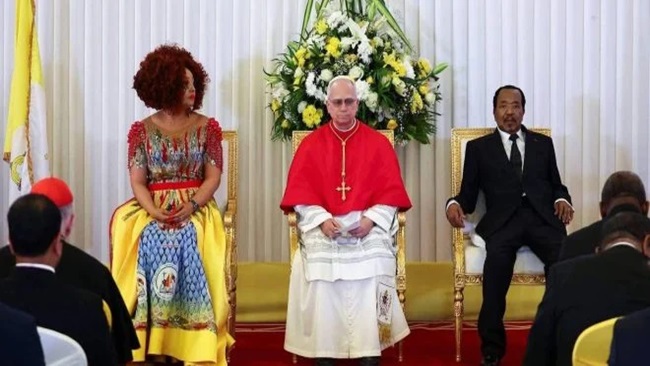
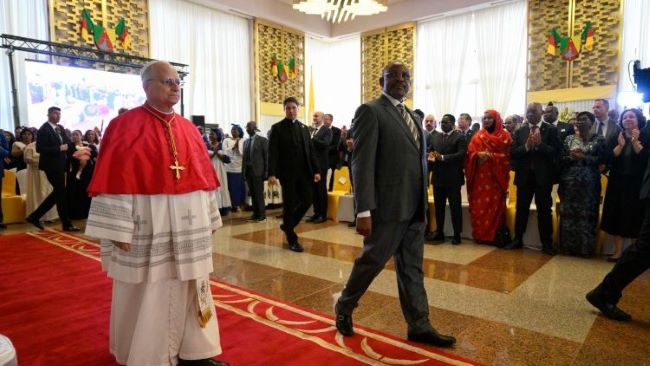
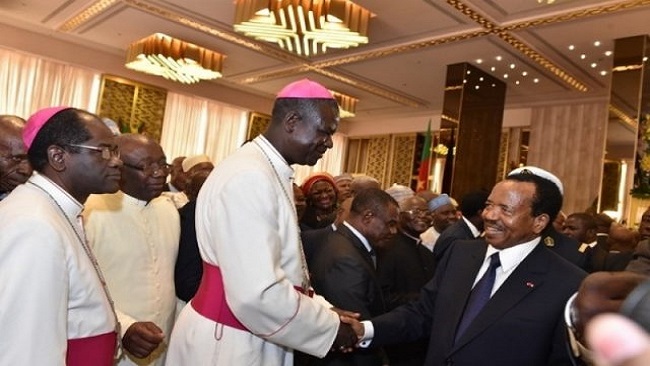
Some Cameroonians feared the papal visit could lend support to Biya, 93, who has ruled since 1982 and is the world’s oldest head of state. Pope Leo met with Biya privately on his first day in Cameroon.
Cameroon, notorious for corrupt practices such as bribery, embezzlement, and nepotism, is rich in natural resources such as oil, timber, cocoa, coffee and minerals, which for decades have been pillaged by both large foreign firms and local elites.
Some 600,000 people were expected to turn out for the pope’s Mass in Douala; however, the crowds were notably smaller, perhaps due to extreme heat and tight security.
Catholics in Cameroon make up around a third of the population of 30 million, and play a fundamental role in the country’s social life. After Mass, the pope is set to visit Saint Paul’s Catholic hospital before returning to Yaoundé, where he will meet with university students and professors.
Equality as rooted in love
In his homily, symbolically delivered in both French and English, the pope said Jesus’s multiplication of the loaves and fish was done primarily as an act of love for the people, which is why it is seen as a foreshadowing of the Eucharist.
“It shows us not only how God provides humanity with the bread of life, but how we can share this sustenance with all men and women who, like ourselves, hunger for peace, freedom and justice,” he said.
Each act of solidarity and forgiveness and every effort to improve one’s circumstances, he said, “becomes a morsel of bread for humanity in need of care.”
“Yet this alone is not enough,” he said, saying it must also be accompanied by acts of charity that feed the soul, forming the conscience and sustaining people “in dark hours of fear and amid the shadows of suffering.”
In this regard, Leo stressed the importance of the sacraments, especially the Eucharist, which he said, “does not merely revive a distant memory; it brings about a ‘companionship’ that transforms us because it sanctifies us.”
The Eucharist, he said, is “a proclamation of hope amid the trials of history and the injustices we see around us.”
“By becoming man to save us, he chose to share in the simplest and most everyday needs of humanity. Hunger thus speaks to us not only of our poverty but, above all, of his love,” he said.
Pope Leo urged attendees to remember this whenever they see someone who lacks life’s basic necessities.
“Through their eyes, the question that Jesus posed to his disciples is repeated: ‘What are you going to do for all these people?’” he said.
He cautioned that being a true witness to Christ and imitating his love for others implies facing certain difficulties and obstacles, “from without and from within us, where pride can corrupt the heart.”
The pope then offered a special message to young people, who make up the majority of the African continent, telling them to be “the first faces and hands that bring the bread of life to your neighbors.”
He told youth to provide others primarily “with the food of wisdom and deliverance from all that does not nourish them but rather obscures good desires and robs them of their dignity.”
In this regard, Leo lamented that despite Cameroon’s wealth of natural resources, “many experience both material and spiritual poverty.”
“Do not give in to distrust and discouragement. Reject every form of abuse or violence, which deceives by promising easy gains but hardens the heart and makes it insensitive,” he said.
Pope Leo likewise told youths not to let themselves “be corrupted by temptations that waste your energies and do not serve the progress of society.”
He noted that Jesus carried out his ministry in spite of threats, persecution and urged them to continue proclaiming the Gospel even amid difficulty, saying, “Christian proclamation changes our lives, transforming minds and hearts.”
“Proclaiming the risen Jesus means leaving signs of justice in a suffering and oppressed land, signs of peace amid rivalry and corruption, signs of faith that free us from superstition and indifference,” he said, closing his remarks.
Source: Crux