6, March 2026
Manyu Solidarity Group supports Mamfe District Hospital 0
In every thriving community, there comes a moment when collective effort begins to produce visible and meaningful results. For the Manyu Solidarity Group, that moment is now. Founded in 2021 by Manyu indigenes in Great Britain and the EU, the group has grown into the largest network of Manyu people and friends of Manyu outside Cameroon. With more than 463 registered and active members, the association’s core purpose is to preserve Manyu culture, support members and their families in times of distress, promote unity within the fast-growing Manyu community in Europe, and proudly display Manyu culture and values abroad while supporting vulnerable families back home.
Through committed leadership, active membership, and a shared vision for progress, Manyu Solidarity has emerged as a shining example of what unity and purpose can achieve. At the heart of this progress is a Board that has shown remarkable dedication in guiding the association forward. With clarity of vision and determination, the Board has worked tirelessly to elevate the profile of Manyu across Europe. Their efforts have united members across 28 countries and positioned Manyu Solidarity as a community capable of meaningful action and positive influence.
In August 2025, the group hosted its first Cultural Festival in the United Kingdom. The hugely successful event attracted more than 500 participants over an entire weekend and offered a vibrant celebration of Manyu culture. The atmosphere, performances, and community spirit left a lasting impression on attendees and their guests. The festival generated a net profit of £2,243. From this amount, the Board resolved to dedicate £1,843.85 to support the Mamfe District Hospital in Manyu Division, Cameroon.
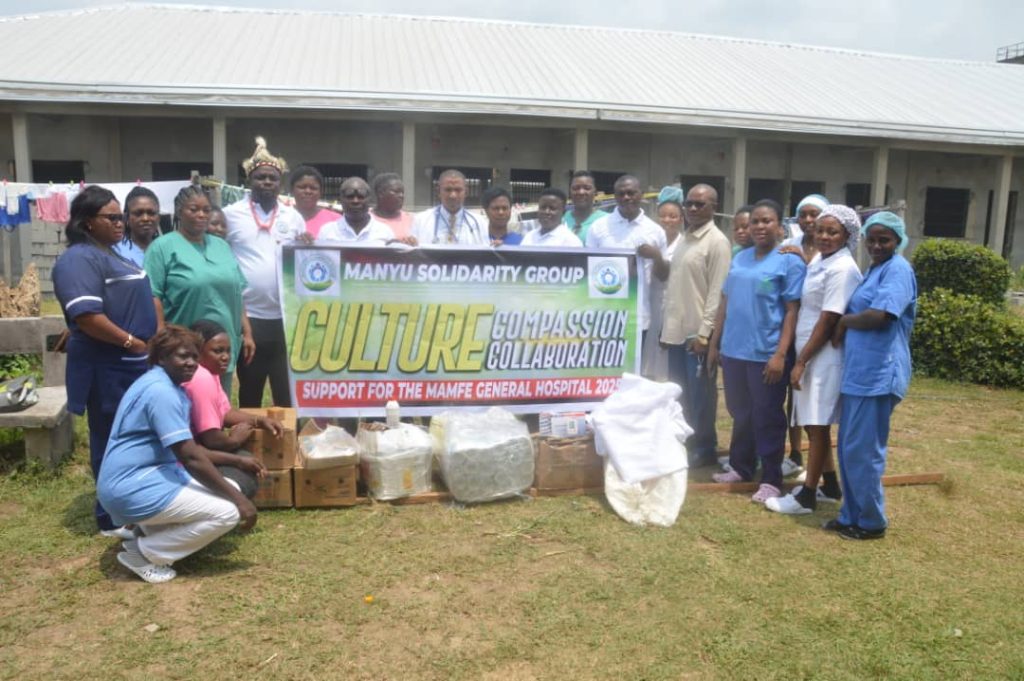
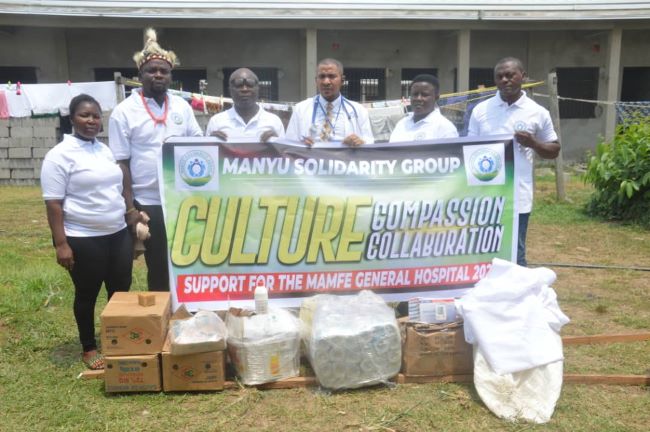
Acting on behalf of the association, the Manyu Solidarity Group coordinator in Cameroon, Mr. Cyprian Tabi, used the funds to procure and deliver essential supplies to the hospital. These included ten blood pressure monitoring machines, two hundred bottles of hand sanitizer, one hundred bed sheets, two hundred toilet rolls, and two hundred bars of washing soap.
Receiving the items on behalf of the hospital, the Mamfe District Hospital Director, Dr. George Akikeng, expressed sincere gratitude for the support. He noted that such assistance is invaluable for healthcare facilities operating with limited resources and thanked the group for remembering the needs of their people at home. Speaking on the initiative, the Group Chairman, Prince Julian Ebai, reflected on the significance of the gesture, “Strong communities are built through leadership, trust, and participation. Manyu Solidarity has demonstrated that when people come together with a clear purpose, they can create real change. Supporting the District Hospital in Mamfe is just one example of the impact we can achieve when we work as one community.”
Though modest in scale, the gesture has been warmly received by members of the association. Ms. Barbara Akoachere, praised the initiative, stating, “The leadership of Manyu Solidarity deserves sincere recognition and appreciation. Their transparency and commitment have built confidence among members. For them to make this gesture to the District Hospital in Mamfe is remarkable. They have shown that leadership is not about position, but about service, and I am so proud of them.”
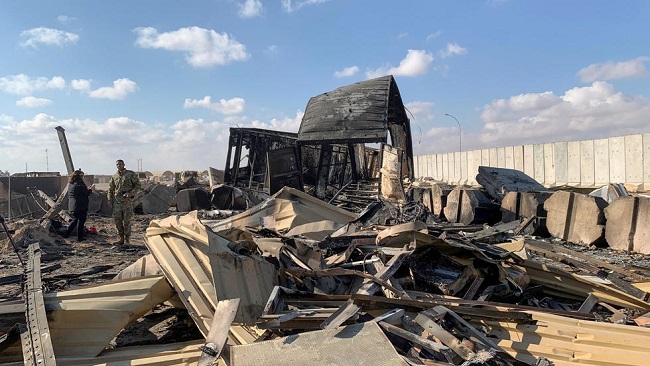
At the height of the political conflict that engulfed Cameroon’s Southwest Region, arsonists burnt Mamfe District Hospital on June 9, 2022. After years of effort and rebuilding, much of it funded by donations from abroad, the hospital finally reopened on the 5th of March 2025. Donations to hospitals in rural Africa often carry enormous impact. Many hospitals in Africa operate with limited resources, outdated equipment, and immense pressure to serve large populations with minimal supplies. Essential items such as blood pressure monitors and basic hygiene supplies are frequently in short supply. For patients and healthcare workers alike, these seemingly simple resources can mean the difference between life and death.
For Manyu Solidarity, this contribution represents far more than a donation. It is an expression of compassion, responsibility, and enduring connection to home. For many families back in Manyu, this support will make a tangible difference at moments when medical care matters most. Mrs. Susan Agbor Ebot, the group’s Financial Secretary, emphasized “This success belongs to all of us. The trust, participation, and belief of our members are what make initiatives like this possible. Strong communities are not built by a few individuals, but by many people working together toward a shared purpose.”
Looking ahead, excitement is already building for the second edition of the Manyu Cultural Festival, scheduled to take place from August 28 to 30, 2026 in the UK. Members are optimistic that the upcoming festival will build on the success of the first and generate even greater support for healthcare initiatives in Manyu. If successful, the next festival will allow the association to expand its impact further, transforming celebration into meaningful assistance for the Mamfe District Hospital and the wider community.
By supporting the Mamfe District Hospital, Manyu Solidarity has demonstrated that the strength of a community lies not only in celebrating its cultural identity, but also in uplifting those who need help the most. Ultimately, Manyu Solidarity is a story of collective action as a community determined to make a difference both at home and abroad. In an increasingly fragmented world, examples like this remind us that strong communities still have the power to change lives.
By Isong Asu
Cameroon Concord London Bureau Chief














7, March 2026
2.9 million people in Cameroon now need aid as crises overlap 0
Cameroon is facing growing humanitarian pressures fueled by three simultaneous crises affecting different parts of the country.
In the Far North region, violence linked to the Lake Chad Basin conflict continues to trigger population displacement and increase protection risks, while insecurity limits access to basic social services.
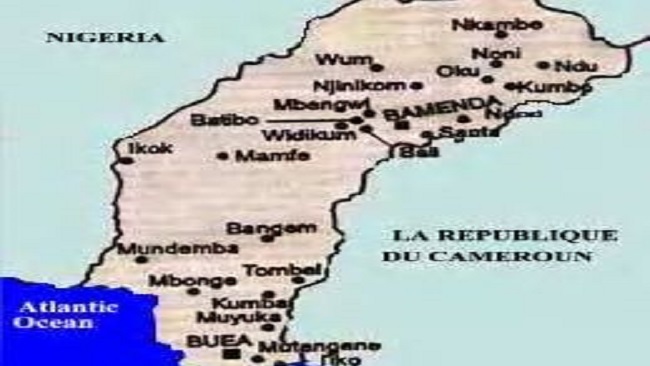
In the Northwest and Southwest regions, persistent violence continues to disrupt daily life and restrict access to markets, schools, and health care.
Meanwhile, the Adamawa, North, and East regions continue to host refugees from the Central African Republic. Many of them have been displaced for years and remain exposed to protection risks, while opportunities for economic self-reliance remain limited.
Against this backdrop, Cameroon remains among the most neglected humanitarian crises in the region. Violence and insecurity, forced displacement, climate shocks, and public health risks are compounding existing structural vulnerabilities.
About 2.9 million people in Cameroon are expected to need humanitarian assistance and protection services in 2026, according to the United Nations Office for the Coordination of Humanitarian Affairs (OCHA). The estimate appears in the report Cameroon: Humanitarian Needs and Response Plan 2026, published March 5.
A Complex Humanitarian Landscape
Behind this figure lies a pattern of long-term vulnerability, according to the United Nations.
Many families have lost their homes and livelihoods, children face repeated interruptions in schooling, and communities continue to experience successive shocks while humanitarian operations remain constrained.
These crises are unfolding in a broader environment marked by structural development gaps and persistent vulnerabilities, which amplify the impact of each new shock.
Climate hazards are further worsening the situation. Floods and droughts repeatedly damage property, disrupt livelihoods, and put additional pressure on already limited public services.
In the Northwest and Southwest regions, insecurity and access restrictions add another layer of operational difficulty for aid organizations.
In 2025, humanitarian actors documented several constraints in affected areas, including movement restrictions, administrative hurdles delaying operations, and security incidents that increased risks for both civilians and aid workers.
Source: Sbbc