28, February 2020
Nigeria braces as coronavirus hits megacity Lagos 0
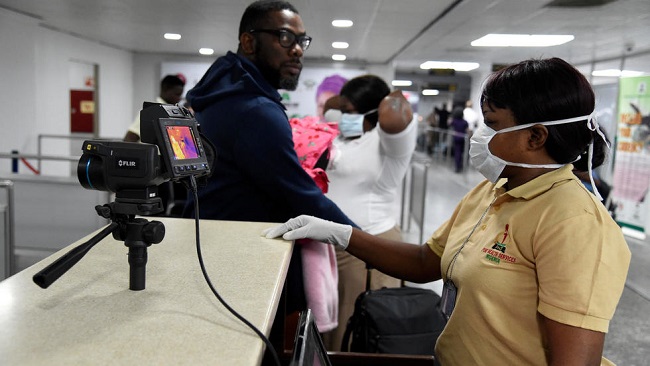
Nigeria’s economic hub Lagos confirmed a case of new coronavirus on Friday, stirring memories of the fears sparked six years ago when West Africa’s Ebola epidemic hit the chaotic megacity of 20 million.
The health minister said the first confirmed case of the virus in sub-Saharan Africa was an Italian citizen who had returned from Milan earlier this week.
“The patient is clinically stable, with no serious symptoms,” Ehanire said, adding that the patient was being treated at a hospital for infectious diseases in Lagos.
The low number of cases so far across Africa, which has close economic ties with China, the epicentre of the deadly outbreak, has puzzled health specialists.
Prior to the case in Nigeria, there had been just two cases on the continent — in Egypt and Algeria.
– Vulnerable country –
Nigeria, Africa’s most populous country with some 190 million people, is viewed as one of the world’s most vulnerable to the spread of the virus given its fragile health system and high population density.
In 2014, the first case of Ebola confirmed in the city from the outbreak that swept West Africa set off alarm bells across the globe and unleashed a wave of panic among residents.
In the end Lagos escaped relatively lightly and only seven people died from a total of 19 infected, a number dwarfed by the overall toll of 11,000 deaths across the region from 2013 to 2016.
The World Health Organization (WHO) hailed the containment of Ebola in Lagos as a major success given the potential for a rapid spread in the city’s closely packed and poorly sanitised neighbourhoods.
The Lagos state health authorities reacted quickly, medical experts from international organisations in the country deployed from the capital Abuja and the disease was confined to the upscale neighbourhoods in the city.
This time around officials insist that the country has made its preparations for a potential coronavirus outbreak.
“I can tell you that in Nigeria we have a costed plans as part of preparedness for this epidemic,” deputy health minister Olorumibe Mamora said earlier this month.
Mamora said quarantine centres had been established in Lagos and Abuja and were being set up in the southern oil hub of Port Harcourt and the biggest northern city of Kano.
“We would do everything we need to do if the situation arises in respect of the safety of our citizens,” the official said.
Nigeria’s Centre for Disease Control says that three laboratories in the country have the capacity to diagnose the virus and that health officials have been meeting daily to share intelligence.
– ‘Lessons from Ebola’ –
The director general of the West African Health Organisation Stanley Okolo has insisted the region had “learnt from the lessons of Ebola”.
He said members of the Economic Community of West African States (ECOWAS) bloc agreed recently to come up with a “regional cost plan” and estimated that up to $50 million was required.
“The devastation of an epidemic affects everybody,” he said.
Situated in a tropical regional not far from the equator, Nigeria has had to face the threat of multiple contagious diseases.
An outbreak of Lassa fever, which is spread mainly through rat faeces and urine, has killed over 100 people across the country since the start of the year.
Experts say the oil-rich economic powerhouse is better prepared to deal with any disease epidemics than some of its poorer neighbours in the region.
But the government is criticised for not spending enough on health and crumbling infrastructure, corruption and the departure of doctors to better paying jobs abroad have eaten away at the sector.
Source: AFP
















2, March 2020
Nigeria: Obasanjo carpets Buhari, says nation may fall into pieces 0
Former President Olusegun Obasanjo has again criticised President Muhammadu Buhari’s leadership of Nigeria. Obasanjo condemned the current state of affairs in his speech on Saturday at the Frederick Fasehun 1st Memorial Lecture. Fasehun was a Yoruba leader and founder of the Oodua People’s Congress (OPC).
Obasanjo stated that Nigeria belongs to all Nigerians on the basis of freedom, equality, equity, justice, fairness, peace, security, cooperation, mutual dignity, respect, shared values and shared prosperity.
“If these factors are removed, Niagara falls to pieces. But for now, we can still make hay while the sun shines”, he warned.
Obasanjo, in his lecture, who pointed out several calls by groups and prominent Nigerians on insecurity in Nigeria, the gave “apologists” of Buhari’s administration six questions to answer.
He quipped: “Are all these people speaking the truth enemies of the government? Are apologists just telling the President what they believe he wants to hear? Do they believe that they are being fair to Nigerians and indeed to President Buhari? Do they remember that there is a day of judgement when they have to render account before God? I know for sure that God has the best in stock for Nigeria. And do they consider the present situation as the best for Nigeria?”
The former leader regretted that President Goodluck Jonathan’s efforts of a National Conference did not even get to the National Assembly.
“Today, the agitation has moved up to restructuring. Thanks to Buhari’s administration and its impunity and all. With the fractional political division, poor management of the economy, the non-protecting security and the politics of uncertainty in the land, we should not allow the restructuring agitation to degenerate to self-determination agitation.
“There is still a window of opportunity for us to nip in the bud a possible and indeed likely agitation for self-determination that will be violent, destructive and all-empowering. We have descended to lack of civility bordering on uncivilisation, indignity, mutual disrespect and crudity in the language of our debate, dialogue, discourse, address, comments and remarks across tribe, section, religion, region, ethnicity and community. If not halted, it will degenerate and poison the atmosphere to the tipping point or point of no return. If the issue becomes conceptualised as an issue of freedom or liberation, there will be no wall or gate to effectively prevail against it. Some well-meaning Nigerians are worried and understandingly so.
“Threats and intimidation do not build a community, they rather destroy. The language of love, knowledge, understanding, appreciation, consideration, compassion, cooperation, forgiveness and accommodation should be the language to build our nation. We should be honest and courageous enough to tell ourselves home truth for self-education and for the edification of our country. If we shirk our duties to our country because we are afraid of threats, intimidation, blackmail or being called names, we are not worthy of being called patriots or nationalists.
“While the unity and integrity of Nigeria will be defended with all that I can muster but surely not at the expense of my liberty, human dignity, freedom of choice, and human rights. I will not relent by exerting effort, ability and capability to make a contribution to the development and progress of my land of birth. If I allowed myself to be enslaved in Nigeria, I would have left a shameful legacy for my children and their succeeding generation forever. May God forbid!
“In that way, my existence in life would amount to naught. “If the hands cannot be swung”, the saying goes, “they are better held above the head perpetually”. My services to my country and to humanity would have ended in total failure as I would have lived not to carry out the divine mission of making better what I found. If I fought racial and tribal injustice and oppression in South Africa, Angola, Mozambique, Namibia and South Sudan tenaciously and successfully, it would be remiss of me to do any less in Nigeria. It is a divine duty and responsibility which must be attended to, if necessary.
“It would appear that the National Assembly is fully aware of the lurking danger and wants to be proactive which is commendable. But the Nigerian Constitution does not give the National Assembly the power to write a new Constitution but the power to amend existing one. What is required is a new Constitution to meet the agitation and aspiration of all Nigerians and to allay all fears.
“The Executive and the Legislature need to work together to establish a Constituent Assembly. The exercise must not be compromised like the present Constitution; it must have full legitimacy of ‘we the people’. Talking of a new Constitution, maybe we should try a hybrid Constitution of President and Prime Minister sharing executive power in a Presidential cum Parliamentary system. And before we descend any further, let me warn, from experience, those who are beating the drums of war and domination from all quarters. I joined late Bisalla, under General Hassan Katsina, to write the appreciation and the operational instruction for the Civil War.
“We estimated that Federal Government would suppress the Biafran rebellion within three months. To make allowances for the unforeseen, we allowed six months. But it took us thirty months, five times what we allowed for, and what is more, we nearly lost the war. And as a Field Commander at the end of the war, I can attest that we fought with all Nigerian tribes including Igbos against Biafra.
“And if after over ten years of fighting Boko Haram, the terrorist group is still waxing strong, let nobody out of self-delusion think that a war of self-determination by one or more geopolitical zones of Nigeria with the present disenchantment would be easily suppressed by the rest of what may remain of the country. Some will fight to the last drop of the blood of their group rather than suffer the indignity of slavery, oppression, domination and atrocious injustice in the land of their birth and the only one that they can call their country.
“If Boko Haram can get an outside support, any geo-political zone opting for self-determination may equally get an external support. War may not necessarily go as planned, estimated and predicted. Everything must, therefore, be put in place to avoid a war, the end of which no one can precisely predict. There is no assurance that Nigeria can survive a second civil war. But rather, we should seek political solution and avoid a destructive civil war. “
Source: Dailypost.ng