9, October 2020
Systemic poverty in Cameroon illustrates the complex barrier poor people face 0
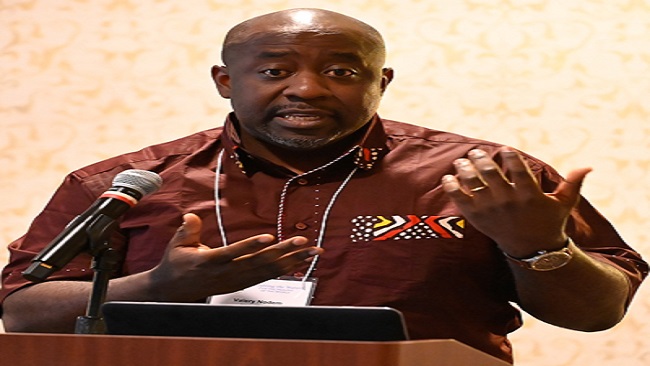
Nodem, who’s from Cameroon, is the Presbyterian Hunger Program’s Associate for International Hunger Concerns. Serving in Lima, Peru, Koball is a mission co-worker serving with the Peru Joining Hands Network.
Nodem spoke about colonization and globalization. He said that although Cameroon gained its independence from Great Britain and France 60 years ago, it’s as if colonizers are still present. In part that’s because Cameroon’s natural resources — including oil, timber and coffee — are exported. Value is added in other countries, and the money made by selling those products remains outside Cameroon’s coffers.
He identified three drivers of colonization in Cameroon: gold, God and glory. The first two are fairly well-known: colonizers had a financial interest in extracting natural resources and were also interested in converting people to Christianity. The “glory” part “was about showing your influence,” Nodem said. “What resources did you find there? It was about showing power.”
As a result of the 19th century “Scramble of Africa,” countries were sliced up arbitrarily, he said. “They weren’t thinking about the consequences” of the warfare those practices would help bring about.
“Colonization makes people feel powerless in their own country,” he said. “The system is still strongly governed by foreign powers who robbed countries of a lot of resources. It’s ripped up regions that used to live in peace.”
As a college student in Cameroon, Nodem “was always going to pretty much any demonstration,” he said. “My parents were always upset. They said, ‘Stay out of trouble and don’t do anything.’” Later they told him it’s because they feared for his life.
Source: Presbyterianmission















10, October 2020
UN Petition Filed for Cameroonian Journalist Thomas Awah 0
Freedom Now and Dechert LLP filed a petition with the UN Working Group on Arbitrary Detention on behalf of Cameroonian journalist Thomas Awah, Jr. Freedom Now and Dechert LLP argue that Cameroon’s detention of Awah violates the government’s obligations under the International Covenant on Civil and Political Rights and the Universal Declaration of Human Rights.
“The continued detention of Thomas Awah, Jr. is yet another example of Cameroon’s sustained campaign against media freedom,” said Freedom Now Legal Officer Adam Lhedmat. “We are confident that the UN Working Group on Arbitrary Detention will conclude Awah’s fundamental human rights have been violated, primarily his right to freedom of expression. Freedom Now calls on the Cameroonian government to abide by its international commitments and immediately release Awah and all other journalists imprisoned in Cameroon.”
Prior to his arrest, Awah worked in the Anglophone region as a correspondent for the privately-owned Afrik 2 Radio, as publisher Aghem Messenger magazine, and communications secretary of the non-violent secessionist Southern Cameroon National Council (SCNC), a group banned by the government. He had prior encounters with the government due to his journalism and activism and has been detained on several occasions in 2015, though he has never been tried or convicted before.
His most recent arrest occurred on January 2, 2017 when he was seeking to interviewing residents of a town in the Anglophone region of Cameroon. Military officers placed Awah under arrest without a warrant or under any specific charges once he identified himself as a journalist. The officers discovered Awah was carrying SCNC documents when they searched him. Two weeks later, the government banned the SCNC on national security grounds.
After his arrest, Awah was taken to an unknown prison where he was interrogated for four hours about the Anglophone secessionist movement. On the same evening, he was transferred nearly 250 miles away to the capital city, Yaoundé, for pre-trial detention.
In May 2018, Awah was tried before a military tribunal along with two other journalists, Tsi Conrad and Mancho Bibixy, as well as five other Anglophone detainees; despite the men having no apparent relationship. It was here that Awah first learned of the charges against him, which included terrorism, hostility to the fatherland, secession, revolution, insurrection, the spreading of false news, the spreading of false news through electronic means, and contempt for civil authority. After a one-day trial he was found guilty of these charges and sentenced to 11 years in prison.
Awah is currently detained in Kondengui Central Prison, where he shares an overcrowded cell with 25 other prisoners, several of whom are forced to sleep on the ground for lack of beds. He suffers from several medical conditions, including tuberculosis and toxoplasmosis, which have been exacerbated by poor prison conditions.