
6, July 2017
Japan: 10 missing, 400,000 flee flooding 0
At least 10 people, including a child, were missing and 400,000 were forced from their homes after record rains battered southwestern Japan for a second day on Thursday, sending rivers surging over their banks, a government official and media said.
Parts of Fukuoka Prefecture on the southwestern island of Kyushu were hit by 774 mm of rain in nine hours on Wednesday, about 2.2 times the amount of rain that falls in a normal July, NHK national television said.
Some 7,500 rescuers, including police, firefighters, and soldiers from Japan’s Self Defense Forces, were mobilized to help with evacuations and search for the missing. Forty helicopters were on standby until the weather improved.
“There are many reports of people whose safety cannot be confirmed, things like ‘a child was swept away by the river’ and ‘my house was swept away and I can’t get in touch with my parents,'” chief cabinet secretary Yoshihide Suga told an emergency early morning news conference.
“We will keep in close contact with the disaster-hit areas and work with all our energy to save lives and ascertain the extent of the damage,” he said. Fukuoka and Oita prefectures, both largely rural areas, were the worst-hit by the rain, which was caused by a low pressure area on the Pacific Ocean that fed warm, moist air into Japan’s seasonal rainy front.
Residents spent a worried night at evacuation centers set up at schools and government buildings on high ground amid reports of landslides and flooded roads. “It wasn’t just the rain, there was thunder and lightning, too. I couldn’t see anything ahead of me,” one woman at an evacuation center told NHK.
A schoolboy sitting with his family told NHK, “I haven’t heard from some of my friends, and I’m really worried.” There were no immediate reports of major transportation problems, but television footage showed a railway line left broken and twisted by floodwaters.
The same area was pounded by heavy rain earlier this week from Tropical Storm Nanmadol, which has since passed out to sea. The rain in Japan comes on the heels of a storm system that caused severe flooding across southern China and that killed 56 people and cost almost $4 billion in damage.
(Source: Reuters)

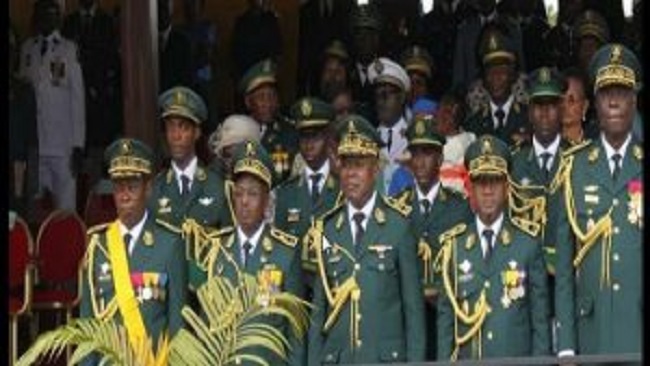
 Since the beginning of the war against the Nigerian Islamic sect, the Biya Francophone Beti Ewondo regime has not spent a single franc on programs aimed at improving morale within the Cameroonian military, which is currently shouldering two major combat deployments in the Central Africa Republic and Boko Haram.


















6, July 2017
Justice Minister Laurent Esso under attack for squalid backing of Biya regime’s handling of the Anglophone Crisis 0
The Biya Francophone regime has voted into law a Common Law Section within the Judicial Chamber of the Supreme Court. The bill was adopted in the Senate on the 4th of July 2017 in two readings. The controversial and anti Anglophone Minister of State in charge of Justice, Laurent Esso said that the project would make the Cameroonian law uniform.
The creation of the Common Law Section within the Judicial Chamber of the Supreme Court was defended in Parliament by Minister Laurent Esso. The bill was passed by the Senators on second reading. Senator Sonken, who asked for clarification on the bill, questioned the raison d’être behind the killing of innocent Southern Cameroonians and arresting hundreds in order to accept a project such as the Common Law Section in the Supreme Court.
Laurent Esso reportedly with too much blood in his hands remained defiant and said that the establishment of the Common Law Section within the Supreme Court was not made to resolve the problems raised in the context of the Anglophone crisis. He arrogantly observed that it is rather a section that is part of the reform process instituted by the President of the Republic in 2015.
Esso dabbled in a typical Francophone pattern and noted that “This bill addresses concerns that may become real problems tomorrow. It is not an adjustment of Anglophone law or Francophone law but a standardization of Cameroonian law.”
By Sama Ernest
Cameroon Concord News