
6, December 2017
Obama trumps Trump in Twitter top 10 of 2017 0
US President Donald Trump is perhaps the world’s most famous Twitter user, but the most popular post of 2017 was from… Barack Obama.
Three tweets by the former US leader made it onto Twitter’s Top 10 list of retweeted messages for this year but there were none from Trump despite his prolific use of the platform.
Trump was, however, the elected leader most tweeted about, Twitter said.
A tweet racking up the most “likes,” about 4.6 million as of Tuesday, came from Obama’s personal Twitter account on the day of a deadly white supremacist rally in Charlottesville, Virginia.
The tweet showed a photo of a racially diverse group of children looking out a window at Obama as he smiled back, and bore a quote from Nelson Mandela.
The same Twitter post was the second most re-tweeted of the year, behind a tweet from a teenager trying to win a year’s supply of chicken nuggets from fast food chain Wendy’s.
(Source: AFP)













6, December 2017
Southern Cameroons Crisis: Nigerian and Cameroonian Troops Clash at Otu Border 0
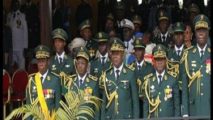
Cameroon and Nigerian troops yesterday clashed at Otu, Cameroon’s last village on the border with Nigeria. Our sources in Otu reported that youthful, sex-starved and alcohol-inflamed Cameroonian forces crossed over into Nigeria and arrested some three Nigerians and brought them to the Cameroonian side where they are being charged with terrorism and murder of Cameroonian security forces.
Our source adds that when news of the arrest was reported to Nigerian border guards, they approached Cameroonian forces that were on patrol and demanded the immediate release of their fellow citizens. The incident has strained relations between Cameroon Defense forces in the region and the Nigerian border guards who view the crossing of the border by Cameroonian forces as a violation of international law and borders.
Meanwhile, Nigerians on the Otu border are threatening to join the fight as their fellow brothers have been arrested and taken to Cameroon. It should be recalled that there is no clear border between Cameroon and Nigeria in Otu and it is easy for any visitor to miss his way into the other country without knowing that they are in another country. The communities in Manyu Division of Cameroon speak the same languages with Nigerian communities along the border with the same accent, especially the Anyang and Ejagham communities that are on both sides of the border.
It should also be noted that over the last week, following a declaration by the government of Cameroon that it would be carrying out military operations along the border region, trade between the two countries has stalled, as Cameroonians living in those border villages have simply crossed over to Nigeria to avoid incurring the government’s wrath. Cameroon government operations have been prompted by a spate of attacks and killings of Cameroon Defense Forces by Ambazonian Defense Forces (ADF) who are fighting for the total liberation of Southern Cameroons.
It is worth noting that most Cameroonians living along the border region have dual nationality and most use the Nigerian Naira for trade purposes, as the Nigerian side of the border is more developed and it is a lot easier to trade with Nigeria due to fewer administrative bottlenecks. However, the Ekok- Mfum border that used to be as busy as a bee hive has become a ghost town. Though it is open and there is some calm, there are very few cars plying the road as Cameroon Defense forces are making it hard for businesspeople to ply their trade. The aggressive checks on the Cameroonian side have prompted many local business people to suspend their operations.
Similarly, in Kembong, a major town in the Eyumojock Sub-Division in Manyu Division, there were reports of clashes between the military and ADF forces and sympathizers. Our sources in Kembong report that two military officers were killed and many injured in a shootout that lasted hours. Cameroon Concord News Group is yet to independently verify these allegations, but there is mounting tension in the region as army soldiers, most of whom are Francophones, are harassing and humiliating the local population.
It should also be recalled that after a few days of operations in Manyu Division, pictures and vidoes containing government atrocities in the border region have begun emerging. According to a video aired by the Southern Cameroons Broadcasting Corporation, residents of Agborkem German, Nsanarakati, Ekang, Out, Mbakem and Nsanakang who have fled to Nigeria have been telling their tales of agony.
The villagers, many of whom are today in Nigeria as refugees, were rushed out of their homes following a press release by the Manyu SDO, Joseph Oum II, advising residents of certain villages to leave their villages and seek refuge in unknown destinations, failure of which they would be considered as terrorists and would incur the government’s wrath . The panic that followed the publication of the press release resulted in many residents of those villages to end up in Nigeria as refugees.
For those who did not leave, theirs has been the kingdom of terror, as many of them have been arrested and taken to unknown destinations. Our sources in Mamfe say many of those arrested have been brought to Mamfe and the jails are already overflowing. Our sources who spoke on condition of unanimity said that there were plans to transport some of the detainees to other cities in the South West Region, adding that many of the detainees were carrying scars of torture and starvation. They added that some of those arrested were already being branded as terrorists even when they were never caught in the act, as the fighting in Manyu Division is a guerrilla warfare and the fighters are using hit-and-run tactics to achieve their goals.
According to Mr. Abang Agbor of Nsanakang, a village along the cross river that serves as a boundary between Cameroon and Nigeria, who left his village out of fear and who is currently in a refugee camp in Nigeria, Cameroon defense forces had vandalized homes and made away with whatever money they could come by. He added that some of the alcohol-inflamed soldiers even undressed women and men and put them in the same location.
In Agborkem German, soldiers undressed women and men and asked them to make love in public and when the men effected erections; their penises were hit with batons.In the same video, women related harrowing stories of what they had lived over the last three days. Many have been sexually abused and their money confiscated by hungry and sex-starved soldiers.
While the government is telling the world that it is conducting its operations in line with international standards, the stories of those who have escaped the brutality of government troops is in sharp contrast with what the government is selling. Many people in the border regions and those who are seeking asylum in Nigeria are calling for an international investigation to clearly establish the facts. From every indication, this story will not be going away anytime soon. The anger and pain of the people of Manyu Division is palpable. It will take a long time for the government to give the people of Manyu a sense of belonging to a country called Cameroon. The brutality with which it has conducted its operations has left the local population with a lot of anger. Many are looking forward to the day Southern Cameroons will be independent. Their minds are made up. The government has a huge and challenging job of winning hearts and minds in this part of the country if it really wants to make Cameroon one and indivisible.
The Southern Cameroons crisis has already lasted for 13 months and from every indication, there are still many scenes. Addressing this issue will surely require international efforts, as many Southern Cameroonians are determined to walk away from Cameroon; a country they claim holds out no hope for them. With Nigerian and Cameroonian troops already clashing, there are chances that this conflict will soon be regionalized and even internationalized, especially with the flow of hordes of refugees into Nigeria.
By Kingley Betek in Agborkem Waterfall in Nigeria