Featured
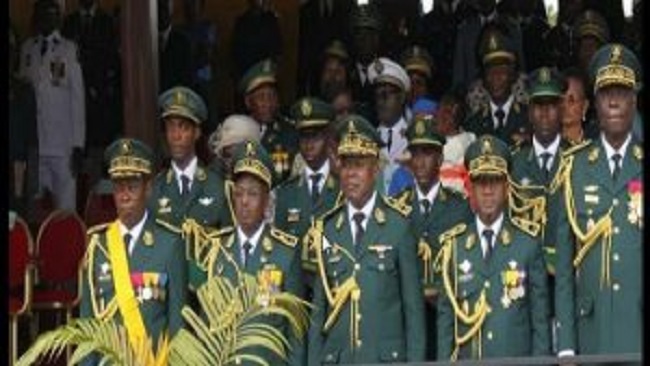 The Cameroonian army must put its conscience to the test
  Who really pushed for the return of the Vice President of the Republic?
  When politics fails a nation, football and the Church become the battleground
  Biya has had his era; Cameroon must now be allowed to enter its next one
  Biya’s hand: a source of glory and shame
Most Commented Posts
 4 Anglophone detainees killed in Yaounde
18 comments Chantal Biya says she will return to Cameroon if General Ivo Yenwo, Martin Belinga Eboutou and Ferdinand Ngoh Ngoh are sacked
13 comments The Anglophone Problem – When Facts don’t Lie
12 comments Anglophone Nationalism: Barrister Eyambe says “hidden plans are at work”
12 comments Largest wave of arrest by BIR in Bamenda
10 comments
Featured
-

Martinez Zogo Trial: questions over missing phone linked to Amougou Belinga
-

Revealed: Colonel Danwe admits ordering Martinez Zogo operation
-
Archbishop Nkea to battle decade of war with new peace Catechism
-

Southern Cameroons Crisis: 7 kidnapped by suspected Amba fighters in Bangourain
-
Southern Cameroons Crisis: 3 killed, 2 injured in bar shooting in Bamenda
-
US military nearing ‘breakdown’ amid sustained Iranian attacks
-
The Cameroonian army must put its conscience to the test
22, April 2026
Cameroon PhD nuisance: academic dwarfs and jokes on steroids 0
by soter • Editorial, Education, Headline News, Life
On February 28, 2026, the US and Israel launched a war against Iran. The war was expected to be short and decisive. It has proven to be anything but a cakewalk. Following a two-week ceasefire that ended today, President Trump now finds himself in an awkward strategic predicament. Opposite him stands Iran, a nation subjected to forty-seven years of sanctions, yet one that has nonetheless cultivated a remarkably sophisticated indigenous missile and drone capability. That capability is not an accident; it is the product of sustained domestic investment in technical education. Iran’s success in this conflict is tied to a large cohort of PhDs trained in fields such as science, nuclear physics, mathematics, and engineering. For over four decades, economic isolation was meant to constrain Iran, yet it has instead compelled self-reliance, yielding technological capacities that now present a tangible challenge to US military dominance.
In Iran, the world is witnessing what a strong cohort of PhDs can do for a nation. But by some strange happenstance in Cameroon and deep within the Cameroonian diaspora, PhD has become something of a national embarrassment bordering on farce. The recent anxiety around doctoral inflation prompted the 92-year-old Head of State and Commander-in-Chief of the Armed Forces President Paul Biya, to instruct the country’s Minister of Higher Education, Professor Jacques Fame Ndongo, to clarify that only state universities are authorized to award doctorates.
Minister Fame Ndongo also warned that students enrolling in offshore online programs do so entirely at their own risk. The concern from the head of state is not difficult to understand in a country with weak infrastructure and unreliable internet connectivity. With poor internet connectivity, how can any genuine student conduct credible online doctoral research?
The minister’s intervention reads as an indictment of an industry that has turned the highest academic qualification into a purchasable title. In Cameroon, the doctorate has become a kind of lifestyle accessory like a watch or Smartphone. The flourishing trade in imported and distance-learning PhDs has become a recurring topic in Aghem, Bakweri, Nso, Manyu, Mankon, Metta, Bakossi, Oroko, Lebialem, Bali, Nkwen and Bafaw culture and development meetings, wake-keeps, naming ceremonies and social gatherings stretching from Toronto to Maryland and from London to Amsterdam. The PhD palaver in Cameroon is now a diaspora community fixation. In fact, it is an inside joke that has ceased to be funny.
Gone are the days when Cameroon’s intellectual landscape was defined by scholars whose achievements carried unquestioned weight and global respect, with figures like Dr Ako Defang Mengot, forged in the rigour of Harvard University and Professor Bernard Fonlon, whose doctorate in Literature from Sorbonne University reflected both depth and distinction. Today, we have Professor Carlson Anyangwe of Walter Sisulu University, who is grounded in the scholarly tradition of the University of London. For these giants, a PhD was a culmination of intellectual discipline, sacrifice and original contribution to knowledge. Today, that standard has fallen miserably and what remains is a hollow imitation of excellence, where the appearance of intellect is celebrated but its substance is increasingly rare.
Distance-learning institutions have emerged offering doctorate programs as easy to enrol in as gym memberships. In Cameroon diaspora circles, individuals with a questionable grasp of written or spoken French and English now brandish doctoral titles acquired from mushroom online colleges in the US, Pakistan, India and many obscure parts of the globe. The subjects’ and doctoral theses are often as weightless as the process bearing little relation to serious scholarship aimed at advancing knowledge or improving society.
Now, contrast Cameroon with a country like Iran, where the expansion of doctoral education has been rapid but not frivolous. Iranian universities have, over the past two decades, produced large numbers of PhDs in engineering, medicine and the natural sciences. These are not disciplines one typically completes online while working in care homes in Minnesota or Leicester. Iran faces its own challenges like bureaucratic hurdles and the ever-present tension between academic freedom and state oversight. Yet even critics would concede that a PhD in electrical engineering, nuclear physics, drone technology, or molecular biology is not a vanity exercise. One either knows the material or not as the laws of physics and science remains unimpressed by titles.
This editorial is not suggesting that only STEM (Science, Technology, Engineering, and Mathematics) deserves doctoral attention. The humanities and social sciences have long produced insights as vital as any laboratory breakthrough. The issue is not the field, but the standard. A rigorous PhD in philosophy or Law from an accredited institution is no less demanding than one in physics. A superficial PhD in any discipline, however, remains precisely superficial.
The purpose of PhDs in Cameroon is not intellectual contribution but to cause people headaches at wake keeps, birthday parties and village meetings where the title “Doctor” is utilized to polish egos. A few years ago, the preferred social currency in Manyu, a constituency in Cameroon, once renowned for academic aptitude, was the title of Sessekou. That of the Nso people was Shey! Today, it is a doctor.
Sadly, in Cameroon circles at home and in the diaspora, a PhD is now a lightweight, portable social accessory. In Iran, it remains closer to what it was always meant to be, a demanding intellectual apprenticeship culminating in a contribution to human knowledge.
President Paul Biya’s intervention is an attempt to restore credibility to doctoral qualifications within the Cameroon community at home and abroad. It is a reminder that a PhD was meant to be difficult, time-consuming, and profitable to society.
In Iran, whatever one thinks of its politics or strategic posture, doctoral education has not been reduced to a public spectacle. It’s PhDs in engineering, physics, mathematics and related fields are not ceremonial titles but functional assets embedded in the architecture of modern warfare. In the ongoing conflict, Iran’s indigenous missile systems, drone swarms, and electronic capabilities are not improvised miracles; they are the downstream product of sustained technical training and research culture. In that sense, the PhD is not a vanity badge but a component of national capability translated from university auditoriums into battlefields. We thank the Head of State for his timely intervention on this matter of national emergency.
By Soter Tarh Agbaw-Ebai