
3, October 2017
Arsenal of weapons, ammo found at Las Vegas gunman’s hotel room 0
Law enforcement authorities have discovered an arsenal of weapons and ammunition from the hotel room and house of the gunman who killed at least 59 people and injured another 527 at a music festival in Las Vegas, Nevada.
A total of 42 guns were found in the hotel room and house of 64-year-old Stephen Paddock, who rained down a barrage of bullets from the 32nd floor of the Mandalay Bay Hotel towards an open-air concert Sunday night, police said.
Las Vegas Police Department Assistant Sheriff Todd R. Fasulo said that 23 guns were found in Paddock’s hotel room, and 19 were discovered out of his home in Mesquite.
Among the guns and ammunition police found in the hotel room were high-powered rifles considered capable of penetrating police armor.
Sheriff Joseph Lombardo said that Paddock brought in at least 10 suitcases into his hotel room over a period of time.

In the aftermath of the massacre, many wondered how the gunman managed to fire for so long and so quickly to cause such carnage, raising questions whether Paddock had used banned automatic weapons.
However, it later emerged that the shooter had used a modified bump stock rifle, a legal trick that allows a gun to simulate rapid automatic gunfire.
In addition, law enforcement officials found “some explosives and several thousand rounds of ammo, along with some electronic devices” in the shooter’s property.
Authorities are also working to establish the motive behind the massacre.
The Bureau of Alcohol, Tobacco, Firearms and Explosives announced that it was “currently conducting an urgent trace on firearms recovered from the scene in Las Vegas.”
Investigators have found no link to international terrorism, despite a claim from the Daesh terrorist group. Some investigators said the gunman might have had psychological issues, but there is no confirmation of this.
Police initially said that they had engaged Paddock but later said they found him dead in the hotel room.

Paddock was described as a gambler who lived in a quiet community of senior citizens and played golf. Officials said he had no criminal history and drew little attention to himself.
The mass shooting has once again thrust the bitter debate over gun control back to the center of politics in Washington.
As horror and disbelief rocked the nation, Congressional Democrats said the massacre underlined the necessity of new firearms laws, while Republicans only offered condolences and prayers.
In a televised address on Monday, President Donald Trump offered his “warmest condolences” for the victims of the mass shooting, but did not address the scourge of gun violence that has become a common occurrence in the country.
White House Press Secretary Sarah Huckabee Sanders said Monday that “there will certainly be a time for that policy discussion to take place, but that’s not the place that we’re in at this moment.”
Culled from Presstv












4, October 2017
Cameroun Vs Cameroon: Crisis has reached a boiling point 0
As Nigeria celebrated her 57th Independence Day on Sunday Oct. 1, her eastern neighbour Cameroon for the first time in over 30 years also officially marked her 56th year of reunification. However, Cameroonians were deeply divided over the Oct.1 anniversary as the internet was disrupted again in the English-speaking regions and security officials opened fire on Anglophone protesters killing as many as 15 people according to reports.
The killings come after renewed massive resistance against perceived marginalization of English-speaking Cameroon by the majority Francophone-led government.
The crisis stems from the country’s colonial history which created modern Cameroon in an agreement between colonial rulers Britain and France. Former British Cameroons (Southern Cameroons) got its independence on Oct. 1, 1961 by joining already independent (Jan. 1, 1960) La Republique du Cameroun to form the Federal Republic of Cameroon. There were two states—West and East Cameroons—operating under the federal system of government which were later fused on May 20, 1972 to form the United Republic of Cameroon.
But over time, citizens of the country’s English-speaking regions, which account for around 20% of the population, have complained to feeling frustrated in the union as they complain of cultural, economic, social and political deprivation.
The long-lingering crisis took a turn for the worst last week when agitators operating under the aegis of the Southern Cameroons Ambazonia Governing Council called for public demonstrations. The mass protests were scheduled to culminate in celebrations on Oct. 1, the day activists had hoped to declare the independence of Southern Cameroons/Ambazonia, a country they clamour to create.
Following up on clashes on Sep. 22, protesters again poured out on the streets on Oct. 1 in villages and towns across the North West and South West regions. Their attempts to hoist blue-white flags of Southern Cameroons/Ambazonia as a sign of independence was met with stiff resistance by armed forces who have been deployed to the troubled regions.
Amnesty International confirmed up to 17 people being kill by security forces during protests in some of Cameroon’s Anglophone towns. International and local media reports said security forces opened fire on protesters in Bamenda, Buea and several other towns. The killings took place despite a call for restraint made by the UN secretary general.
President Paul Biya, who has been in power for 35 years, has yet to return to the country after taking part in the 72nd UN General Assembly in New York last month. He condemned “all acts of violence, regardless of their source and their perpetrators.”
While the troubled regions faced a ban of gatherings of more than four people, restriction of movement and another internet shutdown, demonstrations were organized in other parts of the country to call for unity.
Demonstrators carry banners as they take part in a march voicing their opposition to independence or more autonomy for the Anglophone regions, in Douala.
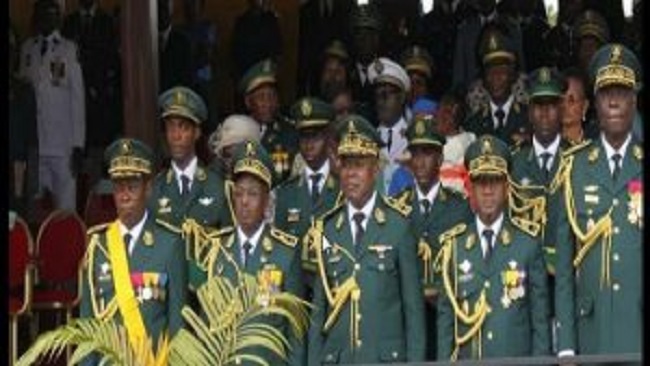
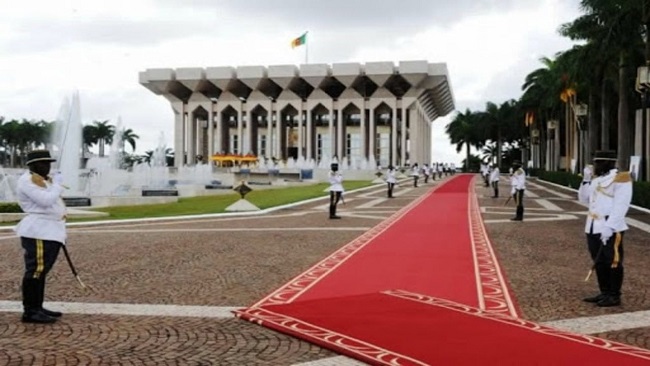
In the capital city Yaoundé, members of parliament gathered at the Reunification Monument to drum up calls for unity and peaceful coexistence. The celebration which is the first of its kind was largely boycotted by Anglophone opposition MPs.
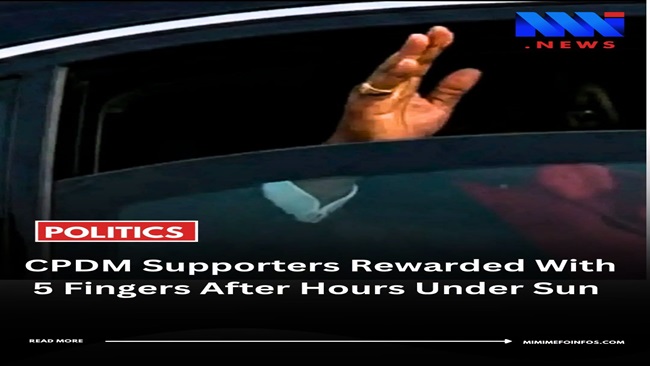
In Douala, like in Yaoundé, members of the ruling Cameroon’s People’s Democratic Movement (CPDM) organized street matches calling for a united Cameroon. The regional organ of the opposition Social Democratic Front party in the economic capital Douala condemned the CPDM outing. The party voiced concerns over the “discriminatory attitude of administrative authorities.”
Source: Quartz Media