
19, April 2019
Sudan protesters hold biggest sit-in since Bashir’s ouster 0
A week after the fall of Sudan’s long-time President Omar al-Bashir, a huge crowd has converged in the streets of the capital, demanding the country’s transitional military council hand over power to civilians.
Hundreds of thousands of people packed the streets outside the defense ministry in Khartoum on Thursday, chanting “Civilian rule, civilian rule.”
Protesters waving national flags were also chanting “Freedom and revolution are the choice of the people.”
“We will remain in the street until power is handed to civilian authority,” said 24-year-old protester Samia Abdallah. “We will bring down military rule.”
Demonstrators joined a sit-in protest that began early this month outside an army complex, which houses the president’s residence and the defense ministry — the culmination of 16 weeks of protests which initially erupted on December 19, 2018, in the face of a government decision to triple the price of bread.
The protests finally led to Bashir being ousted and arrested after almost three decades in power.

The ten-man military council, which has taken power, announced a two-year transition period to civilian rule. The council has also promised to work with Bashir opponents and opposition groups to form an interim civilian government.
“We are completely committed to handing over power within a maximum two years,” one of the members of the council, Lieutenant General Salah Abdelkhalek said on Thursday.
“Perhaps the most difficult issue facing the military council now through its political committee is getting agreement from the political spectrum and the community forces on the naming of a prime minister,” Abdelkhalek said. “The ball is in their court.”
This is while Saudi Arabia and the United Arab Emirates have announced their backing for the transitional military council.
Chairman of Sudan’s Transitional Military Council Abdel-Fattah al-Burhan on Tuesday praised Sudan’s distinguished relations with Saudi Arabia and the UAE), official SUNA news agency reported.
Burhan, who is known for his ties to the Saudi kingdom, met with a joint delegation from Riyadh and Abu Dhabi this week, and received a verbal message from their leaders.
The council’s spokesman said on Thursday that the undersecretary at Sudan’s foreign ministry had been dismissed for preparing for the visit of a delegation from Qatar, the regional rival of Riyadh and Abu Dhabi.
Spokesman Shams El Din Kabbashi said the ministry had made the statement without consulting the council.
Analysts warn that both Riyadh and Abu Dhabi are striving to influence the transition process by backing the military council.
Saudi Arabia and the UAE had cultivated close ties with Bashir before his ouster and were reportedly exhorting him to forge relations with Israel.
With protests raging in Sudan, however, the London-based Middle East Eye reported in March that the head of Mossad had met his Sudanese counterpart in Germany as part of a secret plan by Saudi Arabia, Egypt and the UAE to oust Bashir.
Source: Presstv





















21, April 2019
Regime change in Africa: Next Stop—-Yaounde 0
In under a month, two African dictators have been brought down by mass protests. Algeria’s Abdelaziz Bouteflika, 82, and Sudan’s Omar Al-Bashir, 75, resigned after massive protests. Bouteflika had ruled Algeria for 30 years and was seeking re-election amidst declining health, while Al-Bashir had been at the helm of Sudan since 1989. These events have focused attention on long-serving dictators in Africa and how this wave might affect their political futures. Amongst them is Cameroon’s Paul Biya.
At 85, he has ruled Cameroon for 36 years and was recently declared winner in a hotly contested election that saw now detained opposition leader Maurice Kamto, declaring himself winner. There are striking similarities amongst the African dictatorships that have recently been toppled such as Gambia, Zimbabwe, Algeria and Sudan. These governments are characterized by huge deficits including dictatorship, long rule, abuse of institutions, poverty, corruption, and youth unemployment. These indicators are very present in Cameroon under the Biya regime and have implanted acute feelings of dissatisfaction, frustration and inertia triggering pockets of protest, resistance and rebellion across the country. Recent events in the country contain all the telltale signs of a regime in decline and a failing environment.
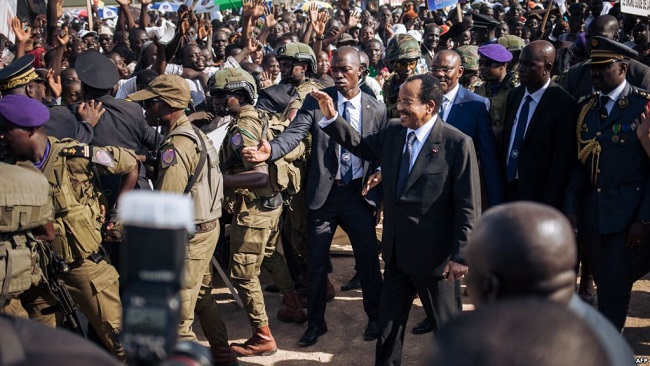
For a long time Paul Biya has relied on the usual dictatorial tactics to maintain his stranglehold on the country; ethnic divisions, brutal military crackdown on dissenters, arrest and imprisonment of opposition leaders, keeping a close college of cronies, most of whom are from his region of origin and have remained blind loyalists. Those that have shown signs of wavering have been quickly thrown in prison. Loyalists make dictators. Because above all else, the sustaining element of dictatorships is the willingness of a cross-section of the oppressed to not just acquiesce but to actively seek the oppression of all others. Biya has shrewdly eschewed a military coup, especially after the April 1984 attempt failed, by neutralizing the power of the military through the creation of several independent military and paramilitary bodies with him as the only centralized commander. In addition, the military, across its ranks is made up of members of his ethnic group.
The uncertainty of where power resides makes it difficult to stage a coordinated takeover. Following the October 7, 2018 presidential election, supporters of the leading opposition party, Cameroon Renaissance Movement (CRM) staged peaceful demonstrations protesting election results and the government’s handling of the ongoing socio-political crisis plaguing the country’s two English speaking regions. The leader of the CRM and presidential candidate, Maurice Kamto was arrested and has been in detention alongside 131 supporters. In the meantime, he has been charged with rebellion, inciting insurrection, offence against the president of the republic and treason amongst others. Charges which if found guilty, he and his supporters will be facing the death penalty. All forms of anti-regime demonstrations are immediately banned in the country ensuring and fostering a system in which there is no space for democratic expression.
The government and its supporters have attempted to downplay demonstrations by CRM as a parochial group of people from the Western region of the country, lacking nationwide support, but who want to muzzle their way into power. The fallout has been the increase in hate speech and tribalism, especially on social media with supporters of Biya and Kamto referring to each other as ‘sardinards’ and ‘tontinard’, respectively. These two derogatory appellations which have gained widespread use are interpreted to mean Biya supporters are a selfish bunch who vote based on receiving cans of sardines, while tontinards means Kamto’s supporters as miserly and cheap. This trend of ‘us’ against ‘them’ has bled through the country manifesting in the description of Anglophones as “Biafrans” and “Ambazonians”, and Northerners as “Sheep”.
This is a country disintegrating on the crucible of hate speech and ethnicity. Perhaps one of the early signs of a crack in the government of Biya is the new trend of leaks of sensitive and classified documents. Because the government has a long history of withholding information from the public, the recent upsurge in leaks is indicative of fault lines within the government ranks. Just over a week ago, classified documents were leaked detailing the president’s planned sojourn to Switzerland and the accompanying security details. Hitherto, this would have been majorly unheard of, and its occurrence now signals a lot. No other happening right now spells more trouble for the Biya reign than the ongoing crisis in the English speaking regions of the country. The crisis is caused by Anglophone perceptions of over 57 years of marginalization by the two successive francophone-led governments. The Anglophone regions voted to join the French speaking side in 1961 in a federation.
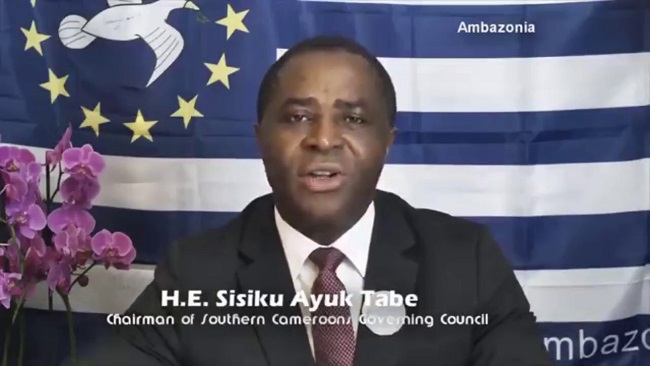
Anglophones have over the years complaint about the abrogation of the terms of the union including the dismantling of the federal system and the destruction and neglect of pristine Anglophone culture and institutions such as the English common law system and the Anglophone educational system and the underrepresentation of Anglophones in government. These grievances have bulged into calls for outright secession to create the putative state of Ambazonia. The government’s reaction to the Anglophone protest was characterized by military clampdown and what has been described as imposition of measures and solutions on the protesters. Essentially, the government has failed to productively handle the grievances leading to armed resistance.
The crisis has dealt a severe blow on the country’s economy with thousands being internally displaced, with over half a million refugees in Nigeria, hundreds have been killed and education has been halted in many areas in the Anglophones regions by separatist militia. This crisis poses a serious existential threat to the country as a whole but more so to the longevity of the Biya reign. And this is largely due to its economic impact. Though Cameroon is not officially classified as a fragile state by the World Bank, it contains all the indicators including weak institutional coping capacity to withstand external shocks, pressures and risks; it is facing violent conflicts, high unemployment, corruption and embezzlement, poor health and educational infrastructure etc.
Quite frankly, the economic threat posed by the Anglophone crisis is what might just tip the country over to open mayhem. It can be argued that the reason why there is still an uneasy stability in the country is because it has not been completely tethered economically. Cameroonians can still afford basic needs and daily food but the prices of basic commodities are on a steady rise especially with the stall of free-flow of economic activities and products from many parts of the English speaking regions. In 2008, the country witnessed a nationwide strike due to hikes in fuel prices. This is indicative, and the government should understand this by now, that it would be brought to its knees by economic pressures as prices of commodities continue to soar.
The state-owned agro-industrial corporation, the Cameroon Development Corporation (CDC), is operating at below 10% of its capacity, losing billions as a result of attacks by separatists on their operations. CDC is one of the major employers in the country and the loss in production capacity has led to non-payment of salaries and arrears and general disgruntlement. It is only a matter of time before separatist block the flow of oil from the southwest region of the country as they have attempted and sometimes succeeded with other produce like timber. Blocking the flow of oil will paralyze the entire CEMAC zone which is dependent on the country’s oil refinery, SONARA. It is clear that the key strategy of separatists is to attack state institutions, stall their functioning, strain the government economically and then bring it to its knees.
Clearly, the government still survives because the crisis in the Anglophone regions and the protests in other regions like those spearheaded by opposition leaders have not been able to coalesce into a nationwide protest. However, with the current trend of economic decline, it is only a matter of time before economic disgruntlement matures into popular uprising. The trigger at that time, like in Sudan, might be something which a notoriously complacent regime would consider insignificant, such as bread.
Culled from Face2face Africa