19, June 2025
Armenia’s PM accuses head of Church of fathering child 0
Armenia’s liberal government has never been an ally of the deeply conservative Armenian Apostolic Church (AAC), but when Prime Minister Nikol Pashinyan made extraordinary allegations against an unnamed senior clergyman, it blew open a deep divide.
“Your Grace, go fool around with your uncle’s wife. What do you want from me?” said Pashinyan.
He also accused the supreme spiritual leader – Catholicos Karekin II – of breaking his vow of celibacy and fathering a child, calling on him to resign. The BBC has approached the Church for comment but has not had a response.
Until now the Church and government had found a way to co-exist, but the row threatens to split an already polarised Armenian society still further – and affect the outcome of next year’s election.
It could also harm peace talks that have the potential to re-shape the entire region of the South Caucasus, after Armenia’s bitter defeat in a war against Azerbaijan.
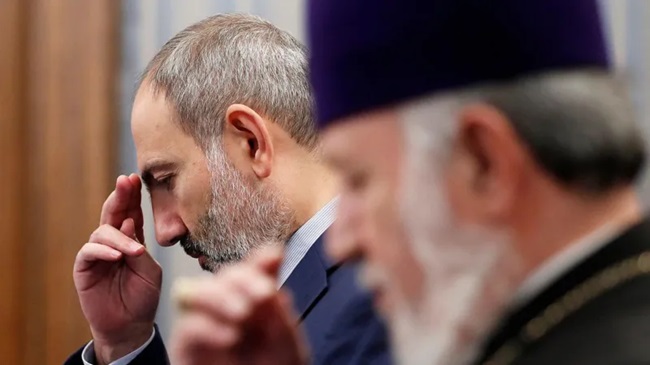
Before their split, Pashinyan and the Catholicos attended public events and visited front lines together
Armenia is believed to be the first nation to make Christianity the state religion, after its king was baptised in 301AD. Although there is a separation of Church and state by law, the Armenian constitution recognises the AAC “as a national Church”.
The Church has not addressed the allegations but said the prime minister had sought “to silence its voice”. It has reiterated that the government has no say in the matters of Church governance.
If true, Pashinyan’s allegation would make the Catholicos unfit for office. Under the Church’s by-laws, only monks who took a vow of celibacy can be elected a Catholicos.
On these grounds Pashinyan now demands Karekin’s resignation, despite having no jurisdiction over the Church. He has presented no evidence but threatened to release it.
Pashinyan has also attacked other senior clergymen, including accusing one archbishop of having an affair, with the extraordinary allegation of “fooling around” with his uncle’s wife.
The opposition parties and two of Armenia’s former presidents, Levon Ter-Petrossian and Serzh Sargsyan, have rallied behind the Church and condemned Pashinyan’s move against it.
The government’s relationship with the Church deteriorated after the defeat in the 2020 war against neighbouring Azerbaijan, when Karekin II joined calls from various political factions for the prime minister to step down.
Pashinyan stayed in power, and the Church became a prominent anti-government voice.
Recently, Karekin II demanded the right of return for the Armenians who fled Nagorno-Karabakh, a region of Azerbaijan that it recaptured in 2023.
The prime minister’s allies are unhappy with such interventions, as they contradict the government’s position in the ongoing peace talks.
Pashinyan pushes for a swift peace treaty that would see both countries drop mutual claims. But Azerbaijani media seized on nationalist opposition demands as proof that Armenia is not ready for peace.
The Armenian Church has benefited from becoming a hub for dissent. With personal rivalries between the leaders of opposition parties, it is drawing in those disaffected with the authorities.
Political analysts in Armenia suggest this might be a real reason for the government’s sudden attack on the Church leader.
The next general election has been scheduled for June 2026, and the anti-Church campaign could be a pre-emptive strike against the stronghold of conservative opposition.
The prime minister himself has linked his position to politics: “We returned the state to the people. Now we must return the Church to the people.”
When a powerful benefactor spoke out in support of the Church this week, the government swiftly moved against him.
Russian-Armenian billionaire Samvel Karapetyan threatened to “intervene in the campaign against the Church in our own way” if opposition politicians failed to defend it.
Hours later, his residence was raided and on Wednesday he was charged with “making public calls to overthrow the government”. He denies the charge.
Source: BBC
















26, September 2025
From Elysée Palace to prison: The stunning downfall of President Nicolas Sarkozy 1
Nicolas Sarkozy, once a dynamic and controversial leader who promised to transform France, has been sentenced to five years in prison for criminal conspiracy tied to illegal campaign funding from Libya. This marks a stunning fall for Sarkozy, who has faced numerous legal battles since leaving office in 2012 and now becomes the first French head of state to face jail time in decades.
Nicolas Sarkozy entered the Elysée Palace in 2007 boasting hyperactive energy and a vision to transform France, but lost office after just one term and the ex-president is now set to go to prison in a spectacular downfall.
Embroiled in legal problems since losing the 2012 election, Sarkozy, 70, had already been convicted in two separate cases but managed to avoid going to jail.
But after a judge sentenced him on Thursday to five years for criminal conspiracy over a scheme to find funding from Libya’s then-leader Moamer Kadhadi for his 2007 campaign, Sarkozy appeared to acknowledge that this time he will go behind bars.
Prosecutors have one month to inform Sarkozy when he must report to jail, a measure that will remain in force despite his promised appeal.
“I will assume my responsibilities, I will comply with court summonses, and if they absolutely want me to sleep in prison, I will sleep in prison but with my head held high,” he told reporters after the verdict.
“I am innocent. This injustice is a scandal. I will not accuse myself of something I did not do,” he added, declaring that hatred towards him “definitely has no limits”.
The drama and defiance were typical of Sarkozy, who is still seen by some supporters on the right as a dynamic saviour of his country but by detractors as a vulgar populist mired in corruption.
Born on January 28, 1955, the football fanatic and cycling enthusiast is an atypical French politician.
The son of a Hungarian immigrant father, Sarkozy has a law degree but unlike most of his peers did not attend the exclusive Ecole Nationale d’Administration, the well-worn production line for future French leaders.
After winning the presidency at age 52, he was initially seen as injecting a much-needed dose of dynamism, making a splash on the international scene and wooing the corporate world. He took a hard line on immigration, security and national identity.
But Sarkozy’s presidency was overshadowed by the 2008 financial crisis, and he left the Elysée with the lowest popularity ratings of any postwar French leader up to then.
Few in France have forgotten his visit to the 2008 agriculture show in Paris, when he said “get lost, dumbass” to a man who refused to shake his hand.
Sarkozy failed to win a second mandate in 2012 in a run-off against Socialist François Hollande, a bruising defeat over which he remains embittered more than a decade on.
The 2012 defeat made Sarkozy the first president since Valéry Giscard d’Estaing (1974-1981) to be denied a second term, prompting him to famously promise: “You won’t hear about me anymore.”
That prediction turned out to be anything but true, given his marriage to superstar musician and model Carla Bruni and a return to frontline politics. But the latter ended when he failed to win his party’s nomination for another crack at the presidency in 2017.
The series of legal woes left Sarkozy a behind-the-scenes political player, far from the limelight in which he once basked, although he has retained influence on the right and is known to meet President Emmanuel Macron.
But Sarkozy is tainted by a number of unwanted firsts: while his predecessor and mentor Jacques Chirac was also convicted of graft, Sarkozy was the first postwar French former head of state to be convicted twice and the first to be formally given jail terms.
Already stripped of the Legion of Honour, France’s highest distinction, he will now be the first French head of state to go to jail since Philippe Pétain, France’s nominal leader during the Nazi occupation.
Source: AFP