1, October 2019
Inside Southern Cameroon’s 100-year old conflict 0
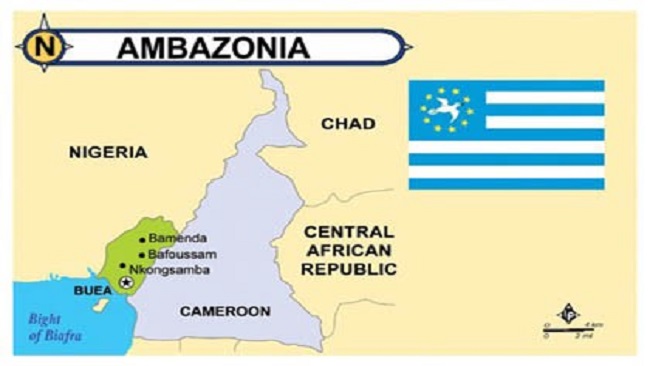
October 1 marks the second anniversary of the declaration of the “Republic of Ambazonia” for Cameroon’s English-speaking minority.
This year’s anniversary comes one day after a national dialogue to try and end the separatist conflict opened in the capital Yaounde.
the dialogue called by president Paul Biya, who has been in power for 37 years, has been boycotted by key leaders of the separatist movement.
In this article, we trace the roots of the Anglophone conflict in Cameroon, that has now escalated to near-daily clashes between security forces and anglophone separatists.
World War I split
Germany was stripped of its African colony of Kamerun after its 1918 World War I defeat when the League of Nations, the forerunner to the UN, split the territory between victors Britain and France.
Four-fifths went to France, becoming independent Cameroon in 1960.
The British portion, along the border with Nigeria, became independent in 1961. A northern Muslim-majority section chose to join Nigeria while the remaining southern area was unified with Cameroon in a federation.
English-speaking minority
The federal structure was scrapped in 1972 and the anglophone portion was annexed.
Largely francophone Cameroon has 10 regions, two of which are mainly English-speaking: Northwest Region, whose capital is Bamenda, and Southwest Region with Buea as its capital.
They are home to around 14 percent of Cameroon’s population of 23 million.
The two regions are permitted some self-governance and language rights, including bilingual schools. But many complain of francophone-favoured discrimination in education, the justice system and the economy.
Deadly protests
Calls for a breakaway English-speaking state mounted in the 1990s with demands for a referendum on independence accompanied by low-level unrest.
In 2001 secessionists defied a ban on rallies to protest the 40th anniversary of unification with Cameroon and were confronted by security forces. Several people were killed and secessionist leaders arrested.
The separatist Southern Cameroons National Council (SCNC) set up a “government” in Britain and leaders moved into exile.
There was a new outbreak of violence in 2016 after lawyers went on strike to demand the right to use Anglo-Saxon common law. Teachers followed, protesting at the appointment of francophones in the region.
While some protesters want only a return to federalism, a minority is pushing for the creation of an independent state called Ambazonia.
Armed revolt
In January 2017 senior secessionist activists were arrested and charged with terrorism and rebellion. President Paul Biya halted their trials in August, apparently trying to calm the situation.
In October 2017 separatist leaders issued a symbolic declaration of independence. At least 17 people were killed in clashes on the sidelines.
Radical separatists took up arms in late 2017, attacking security forces and torching symbols of the administration, such as schools. They also kidnapped police officers, civil servants and businessmen, sometimes foreigners.
‘Civil war’
In April 2018 the main opposition Social Democratic Front (SDF), which defies the separatists, described the violence as “civil war”.
Separatists torched the Northwest Region home of SDF leader Ni John Fru Ndi in October and also kidnapped his sister, who was later released. Fru Ndi was briefly kidnapped twice in 2019.
A US missionary was killed in the unrest in October 2018 and the following month 79 schoolboys were kidnapped in Bamenda but freed two days later.
In December 2018 Biya ordered the release of 289 people arrested in connection with the crisis.
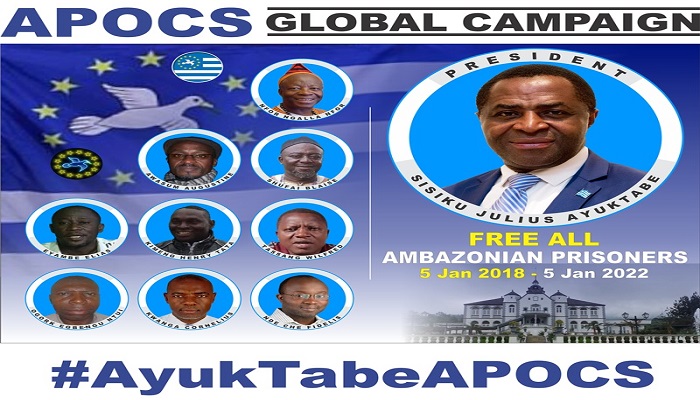
However in August 2019, separatist leader Julius Ayuk Tabe and nine others were sentenced to life in prison for charges including “terrorism and secession”.
More than 2,000 people have been killed in violence between separatists and security forces in the anglophone regions since October 2017, Human Rights Watch says. Around 530,000 have fled their homes, according to the UN.
AFP













1, October 2019
United Nations: Iran president refused to take Trump’s call arranged by Macron 0
In New York, President Hassan Rouhani of Iran refused to engage in a phone conversation with his American counterpart, Donald Trump, which had been secretly arranged by French President Emmanuel Macron, leaving Trump waiting on the line, US media reports say.
The New Yorker magazine reported on Monday that Macron had tried to engineer a three-way conversation by having technicians set up a secure line in a meeting room on Rouhani’s floor at the Millennium Hilton Hotel across the road from the UN General Assembly (UNGA), on September 24 evening.
The French leader, it added, hoped that the telephone conversation would lay the groundwork for the first meeting between an American president and an Iranian president since the 1979 Islamic Revolution.
Sources familiar with last Tuesday’s events said, “The call to Trump’s line came through at 9:30. Macron took the call. But Rouhani never emerged from his room.”
Later on Monday, The New York Times confirmed the report, saying that Rouhani had left Trump hanging and Macron waiting outside his hotel suite.
“The telephone line had been secretly set up. President Trump waited on the other end. All President Hassan Rouhani of Iran had to do was come out of his hotel suite and walk into a secure room where Mr. Trump’s voice would be piped in via speaker,” it said.
“Messages were passed between them via Mr. Rouhani’s aides,” they said. “In the end, Mr. Rouhani refused even to come out of his room. Mr. Macron left empty-handed and Mr. Trump was left hanging.”
Macron has been seeking to play a mediatory role aimed at easing Washington-Tehran tensions, which have been on the rise since the US withdrawal from a 2015 multilateral nuclear deal in May 2018.
The French leader has also been leading European efforts to save the accord, whose fate remains in doubt since Washington’s exit.
Iran has repeatedly rejected Trump’s offer of talks, saying it would not engage in such negotiations unless the US returns to the deal and lifts its unilateral sanctions.
Tehran says negotiations with Washington would be possible within the framework of the P5+1, comprising the US, France, Britain, Russia, China plus Germany, which successfully negotiated the deal with Iran, if Washington meets those conditions.
In a speech at the General Assembly on Wednesday, Rouhani reaffirmed Iran’s position and said he was not interested in a “memento photo” with Trump on the sidelines of the UN meetings, while the US was piling economic pressure on Iran.
“Memento photos are the final stage of negotiations, not the first one,” Rouhani told the world body.
In 2013, Rouhani and then US president Barack Obama held a telephone conversation as the Iranian president was wrapping up his visit to New York for the 68th annual session of the UNGA, as diplomatic efforts were underway between the two sides within the P5+1 format in the run-up to the nuclear deal.
The New York Times cited Cliff Kupchan, chairman of the Eurasia Group, a political-risk consulting firm in Washington, as saying that Trump’s desire for negotiations with Iran was meant to “flip the news cycle” from the Ukraine scandal.
“Trump really wants a foreign policy win and can’t find one,” he said. “He thinks talks with Iran now may be his best shot.”
Trump “was especially desperate at the UNGA — he wanted to flip the news cycle from Ukraine and Biden to a dramatic meeting with Rouhani,” he added.
The US president is facing an impeachment inquiry related to allegations that he pressured Ukraine to smear his top Democratic political rival Joe Biden.
Source: Presstv