1, October 2020
US presidential debate commission to adopt new rules in wake of ‘disgraceful’ first round 0
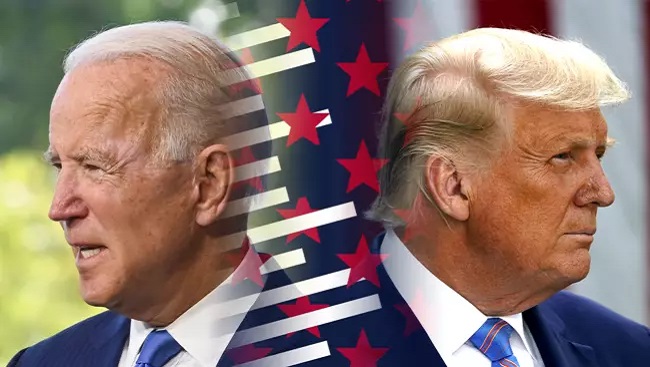
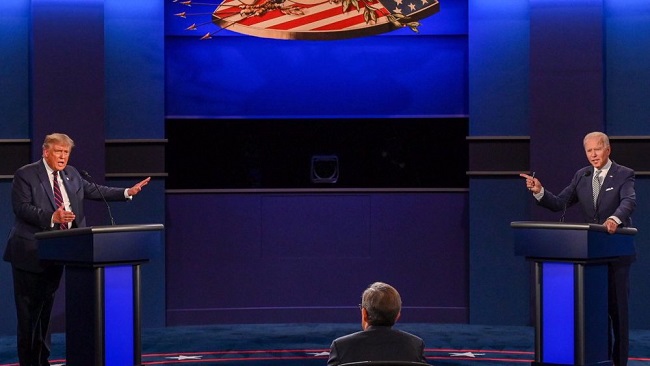
The presidential debate commission says it will soon adopt changes to its format to avoid a repeat of the disjointed first meeting between President Donald Trump and Democrat Joe Biden.
The commission said Wednesday the debate “made clear that additional structure should be added to the format of the remaining debates to ensure a more orderly discussion of the issues.”
One possibility being discussed is to give the moderator the ability to cut off the microphone of one of the debate participants while his opponent is talking, according to a person familiar with the deliberations who was not authorized to discuss the matter publicly and spoke on condition of anonymity.
The next presidential debate is a town hall format scheduled for Oct. 15 in Miami.
Moderator Chris Wallace struggled to gain control of the 90-minute debate in Cleveland because of frequent interruptions, primarily by Trump.
Wallace, of Fox News, pleaded for a more orderly debate, at one point looking at Trump and saying, “the country would be better served if we allowed both people to speak with fewer interruptions. I’m appealing to you, sir, to do that.”
“Ask him, too,” Trump said.
“Well, frankly, you’ve been doing more interrupting than he has,” Wallace said.
Biden on Wednesday called the debate “a national embarrassment.” But despite some suggestions that the final two presidential encounters be canceled, both campaigns said they expected their candidate to attend.
ABC News’ Martha Raddatz, who moderated one of the three debates between Trump and Hillary Clinton in 2016, said Wallace was put in nearly an impossible situation. Faced with the same behavior, she said she might have called a full stop to the debate for a moment to recalibrate.
She never had the option, technically, to cut off the microphone of a candidate four years ago, she said. It also wasn’t in the rules that were agreed to in advance by the candidates and commission.
“To say, ‘he’s not going to follow the rules so we aren’t, either?’ It’s an unprecedented situation,” Raddatz said. “That was so out of control.”
Twitter was ablaze with criticism for Wallace early in the debate for losing control of the proceedings. That was illustrated by MSNBC’s Joe Scarborough, who tweeted “what is Chris Wallace doing? He has no control over the debate. He asks a question and let’s Trump continue yelling. This is a disgrace.”
By the time he was on “Morning Joe” the next morning, Scarborough had cooled off. He called on the debate commission to act.
“While it was extraordinarily frustrating, I think all of us need to walk a mile in his shoes before saying the morning after, ‘he could have done this, he could have done that,’” Scarborough said.
Some of the president’s supporters felt that Wallace was too hard on their candidate. Trump himself suggested he was also debating Wallace, “but that’s no surprise.”
Wallace even got some criticism from opinion personalities on his own network. “Trump is debating the moderator and Biden,” prime-time host Laura Ingraham tweeted during the debate.
Another Fox colleague, Geraldo Rivera, expressed more sympathy.
“The guy signed up to moderate a debate and he ended up trying to referee a knife fight,” he said.
Wallace, host of “Fox News Sunday,” was not immediately made available for comment by Fox.
Wallace is the only presidential debate moderator this cycle with prior experience, after receiving praise for handling the final Clinton-Trump debate in 2016. The other two moderators are Steve Scully of C-SPAN and Kristen Welker of NBC News.
Scully moderates the Miami debate, which will be a town hall format where citizens get to ask questions. That format may make interruptions more difficult.
“Having prepared for these, the town hall is a completely different event in the debate Olympics,” tweeted David Plouffe, an adviser to former President Barack Obama. “If Trump brings the same nastiness to Florida, it will be doubly painful to watch but it will be doubly painful for him politically.”
The Nielsen company’s estimate on how many people watched Tuesday’s debate was expected later Wednesday.
(AP)



















2, October 2020
President Trump, Biden: Covid 19 most serious threat 0
President Donald Trump’s positive coronavirus test has undermined his repeated claims that the US is “rounding the turn” in its handling of the pandemic, with just one month to go before the November 3 election.
Trump announced on Friday that he and his wife, Melania, had tested positive for Covid-19, and were going to quarantine at the White House.
Trump is 74 years old, putting him at higher risk of serious complications from the virus.
His physician has said the president is “well” and will continue to perform his duties “without disruption”.
However, even if the president remains asymptomatic, he will likely have to halt in-person campaigning for an unspecified amount of time while he quarantines at the White House.
“It is unclear exactly what that means for a president of the United States, especially for this one who has spent months not wanting to wear a face mask, not wanting to take physical distancing seriously,”
“The White House published a schedule for tomorrow, with various events that he will presumably not be fulfilling. It does beg the question: will he seat a campaign virtually, as his rival Joe Biden has been doing a lot?” Smith added. “Presumably, if Trump is feeling well enough, he would be able to do that.”
Whatever form Trump’s campaign takes in the coming days and weeks, his diagnosis has seriously undermined his attempts to downplay the pandemic and refocus the race on other issues.
In the past, Trump has wrongfully predicted that the coronavirus “is going to disappear”, and even questioned scientists who contradicted his assertions in public.
‘This could be a really significant blow’
Trump has also largely ignored his own government’s public health guidelines, refusing to wear a mask or observe social distancing.
At the first presidential debate in Cleveland, Ohio, earlier this week, Trump even mocked his Democratic challenger, Joe Biden, for the size of his mask.
“Every time you see him, he’s got a mask,” Trump said of his opponent. “He could be speaking 200 feet away… And he shows up with the biggest mask I’ve ever seen.”
With a number of polls showing that a majority of Americans disapprove Trump’s handling of the pandemic — which has claimed at least 207,000 lives in the United States — his diagnosis will likely only compound this opinion.
“This was a day many people feared, many people saw coming, many people thought may well happen, because he was continuing to hold campaign rallies, a couple of them indoors. He was defying often his own public health guidelines on the coronavirus,” Smith said.
Trump’s positive test result certainly complicates his ability to effectively campaign against Biden, who is currently leading in the polls.
“We’ve seen Trump really thrives off the energy of crowds, of holding big events. It gives him a sense of momentum,” Smith said. “This could be a really significant blow to a presidential campaign that is already struggling with Joe Biden well ahead in the polls.”
It is also unclear how Trump’s positive test will affect arrangements for the second presidential debate, which is scheduled for October 15 in Miami, Florida.
Source: France 24