24, December 2023
Catholic Bishops in Cameroon reject Pope Francis’ new stance on Homosexuality 0
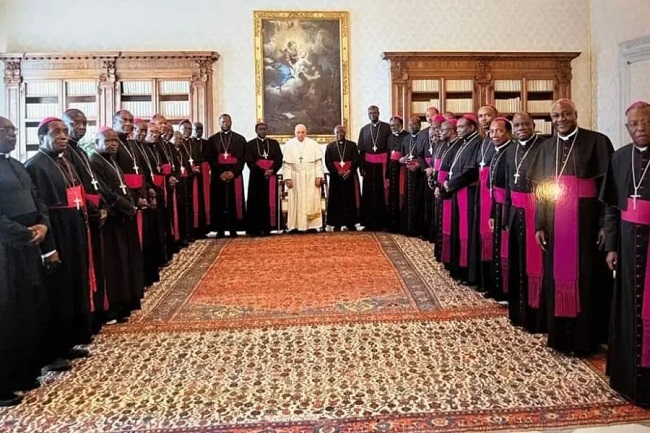
The National Episcopal Conference of Cameroon (NECC) has reaffirmed its stance on sexuality that marriage is between a man and a woman.
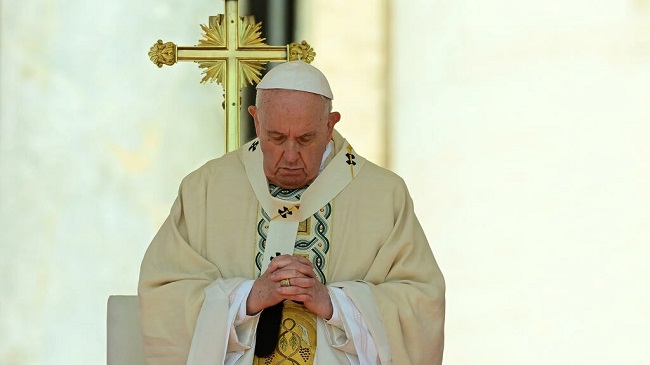
This comes after Pope Francis, who is the head of the Roman Catholic Church, recently allowed priests to bless same-sex couples.
According to a document issued by the Vatican recently, Pope Francis said priests should be permitted to bless same-sex and “irregular” couples, under certain circumstances.
However, in a statement issued on 21 December, the National Episcopal Conference of Cameroon (Catholic Bishops’ Conference of Cameroon) denounced the new position announced by Pope Francis, saying homosexuality is an abomination. Read the statement:
DECLARATION OF THE BISHOPS OF CAMEROON ON HOMOSEXUALITY AND THE BLESSING OF “HOMOSEXUAL COUPLES”
Faced with the semantic abuses designed to distort the value of realities and the true meaning of the notions of family, couple, spouse, sexuality and marriage;
Faced with the wave of indignation, questioning and concern that the Declaration “Fiducia supplicans” on the question of the blessing of same-sex couples has aroused among the people of God;
For the sake of human dignity and the salvation of all humanity in Jesus Christ; We, the Bishops of Cameroon, unanimously declare the following on the subject of homosexuality and the blessing of “homosexual couples”:
1. In conformity with our 2013 Declaration on Homosexuality, we strongly reaffirm the truth of the Church, Mother and Educator, which teaches the sacredness of the sexual identity of man and woman created in the image of God (Gn 1:26), of the dignity of their sexuality and of marriage which is the foundation of the family. The human person is created male and female: “Male and female he created them” (Gn 1:26). This invariable difference, which is the foundation of their relationship and their complementarity, is fulfilled in the bonds of marriage.
2. Homosexuality falsifies and corrupts human anthropology and trivialises sexuality, marriage and the family, the foundations of society. In the African culture, this practice is not part of family and social values. It is a flagrant violation of the heritage bequeathed to us by our ancestors. In the history of people, the practice of homosexuality has never led to societal evolution but is a clear sign of the imploding decadence of civilizations. Homosexuality sets humanity against itself and destroys it.
3. The profound identity of sexuality is misunderstood, hijacked and perverted outside the conjugal relationship between man and woman. Consequently, homosexual acts are not “sexual”, but “acts against nature” (Rm 1, 26).
4. Marriage is an institution that legitimizes sexual relations and procreation for the foundation of a new family. It is the union of a man and a woman who commit themselves to the life of a couple, to find a family and to live together in love. Homosexual unions are not marriages. They distort the meaning of marriage by reducing it to a sterile, pleasure-seeking and perverse bond: “infamy between man and man” (Rom 1:26).
5. Homosexuality is not a human right. It is an alienation that seriously harms humanity because it is not based on any value proper to the human being: it is a dehumanization of love, “an abomination”. (Lev, 18, 22). Rejecting it is in no way being discriminative; it is a legitimate protection of the constant values of humanity in the face of a vice that has become the subject of a claim to legal recognition and, today, the subject of a blessing.
6. Literally, “To bless is to speak well of”. And to “speak well of” to gain grace through the gesture of blessing a “homosexual couple” would be tantamount to encouraging a choice and a practice of life that cannot be recognised as being objectively ordered to the revealed designs of God. What is more, differentiating between liturgical and non-liturgical contexts to apply the blessing to same-sex “couples” is hypocritical. The act of blessing, whether performed in a liturgical assembly or in private, remains a blessing. We therefore declare non-compliant any form of blessing, public or private, that tends to recognize “same-sex couples” as a state of life.
7. Faithful to the constant teaching of Ecclesial Tradition which declares acts of homosexuality intrinsically disordered and contrary to the natural law (Catechism of the Catholic Church n. 2357), we, the Bishops of Cameroon, reiterate our disapproval of homosexuality and homosexual unions.
8. Consequently, we formally forbid all blessings of “homosexual couples” in the Church of Cameroon.
9. Since God does not want the death of the sinner, but his/her conversion to eternal life, we recommend those who are inclined to homosexuality to the prayers and compassion of the Church, with a view to their radical conversion. We also invite them to turn away from their mentality of victimization in which they take pleasure in considering themselves as “victims”, “weak”, and “minorities”; to seize the opportunity for conversion that God gives them in the many exhortations of His Word.
The statement was signed by Andrew Fuanya Nkea, who is the Archbishop of Bamenda and President of National Episcopal Conference of Cameroon









9, January 2024
Cleaning the sinful church: Bishop Bibi prohibits Bushu from celebrating Holy Mass 0
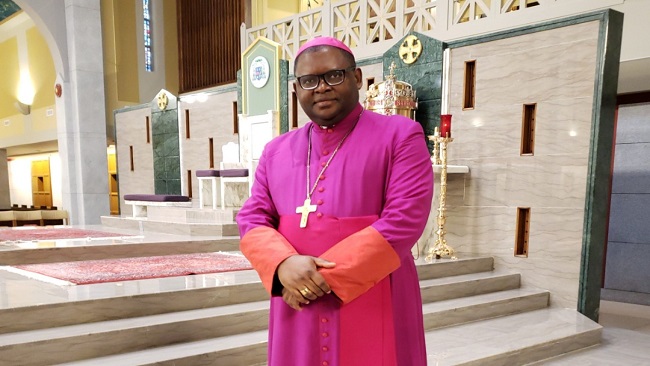
Bishop Emmanuel B. Bushu, who retired from the pastoral care of Cameroon’s Catholic Diocese of Buea in December 2019, has been prohibited from celebrating or concelebrating Holy Mass in public in the Cameroonian Episcopal See without the “explicit permission” of his successor.
In a letter circulated on Sunday, January 7, the Local Ordinary of Buea Diocese, Bishop Michael Miabesue Bibi, communicates to Bishop Bushu two prohibitions after highlighting reasons behind his decision.
“You shall no longer be allowed to concelebrate with me on any Diocesan Liturgical celebration until further notice,” Bishop Bibi tells his immediate predecessor.
In his second prohibition, the Cameroonian Bishop who has been at the helm of Buea Diocese since December 2019 as Apostolic Administrator, and later, from February 2021 as the Bishop of the Diocese, bars Bishop Bushu from celebrating or concelebrating “any public Mass in any Parish in the Diocese of Buea, without an explicit permission from me”.
In the one-page letter dated 22 November 2023, Bishop Bibi cites “deep opposition and interference” as some of the reasons behind his two decisions.
“From the very beginning of my mission in the Diocese of Buea … I have had to live through the unhappy reality of deep opposition and interference from you, that has even led you to the screen media to make this opposition public,” he states.
Bishop Bibi expresses his awareness of Bishop Bushu’s “opposition and interference in my administration for three years now, including, but not limited to your trips to the Nunciature and to Rome against my decisions over certain important sectors of the Diocese.”
“The present state of affairs indicates a total absence of communion between us, which makes you ready to align yourself with persons and groups that seek to bring down my administration,” he further writes.
The Cameroonian Catholic Bishop, who started his Episcopal Ministry in March 2017 as the Auxiliary Bishop of Cameroon’s Bamenda Archdiocese says that his two prohibitions are aimed to “protect” his administration of Buea Diocese.
In his letter, Bishop Bibi wishes his 79-year-old predecessor “grace and peace” from “God our Father and the Lord Jesus Christ in Communion with the Holy Spirit.”
A past decision that 52-year-old Bishop Bibi had to battle with involved the administrative changes he made at the Catholic University Institute of Buea (CUIB) in June 2020, when he appointed Professor Victor Julius Ngoh as Vice Chancellor, to succeed Fr. George Nkeze Jingwa. In his capacity as Apostolic Administrator of Buea, Bishop Bibi asked Fr. Nkeze to take a sabbatical leave.
The University Council disapproved of the 11 June 2020 administrative change, with Sobe Clive Ndikum who was serving as the legal representative of the University describing the change as “improper interference”.
He accused Bishop Bibi of causing “irreparable damage and mistrust amongst students, faculty members, the laity and other well-wishers of our Christian Community by making uninformed, ill-advised and rash decisions beyond the scope of his mandate and authority.”
However, in a 15 June 2020 clarification, the then Apostolic Nuncio in Cameroon, Archbishop Julio Murat, came to the defence of Bishop Bibi, and outlined his mandate of Apostolic Administrator as “having jurisdiction to act for and on behalf of the Diocese of Buea in all matters concerning the Diocese and all other Institutions belonging to the Diocese.”
“The Apostolic Administrator is the legitimate authority over all priests, Religious and other mission personnel within the Diocese of Buea and reserves the right to appoint, transfer, remove, or dismiss persons according to the prescriptions of the Code of Canon Law and the specific instructions given to him by the Holy See,” Archbishop Murat stated.
In March 2022, Bishop Bibi lamented the protracted controversies in the administration of CUIB and affiliate institutions, apportioning blame on the the administration that he had dismissed and that some disgruntled members “aimed at undermining (his) decisions”.
“Sadly still, up to this moment, some of the members of the then Administration of CUIB have resorted to diverse means aimed at undermining the decisions I made, and in the process, they have created confusion in the minds of God’s people and people of good will in the Diocese of Buea and beyond,” Bishop Bibi said in his 13 March 2022 statement in which he also narrated his being drugged to Cameroon’s labor court with “false or misguided” claims.
Earlier, in February 2022, Bishop Bibi weighed in on the online petition, a Facebook post and other attacks against him.
In his 25 February 2022 homily during Holy Mass to mark a year since he took canonical possession of Buea Diocese, the Catholic Church leader bemoaned the “many attacks … over social media, over some newspapers, over some TV stations by clerics, all the staged interviews that were brought out and sent out to the public” as what he termed “signs of total interference in the governance of the Diocese of Buea.”
This was days after members of the Bamenda Provincial Episcopal Conference (BAPEC) Province expressed their “solidarity and communion” with him.
In their 11 February 2022 statement, BAPEC members said that their “hearts were deeply saddened by the unfortunate turn of events in the Diocese of Buea, characterized by gross disrespect of the hierarchy of the Church, casting of aspersions on Bishop Michael Bibi.”
Last November, members of the Clergy of Buea Diocese expressed their support for Bishop Bibi, weighing in on social media posts against their Local Ordinary, including those from Nchumbonga George Lekelefac such as an ongoing apostolic visitation, Seeking Transparency and Accountability: An Examination of Bishop Michael Miabesue Bibi’s Leadership, Bishop Michael Bibi, The Father, The Bishop, The Rock On Which Buea Diocese Is Built, The Truth and nothing but the truth about Buea Diocese under Bishop Michael Bibi, and Ex-cardination of suspended priests of Buea Diocese: a solution?
“We, the Priests of the Presbyterium of Buea, have watched with dismay at the smear campaign orchestrated by some individuals and even some members of the presbyterium and groups on social media against the person of the Bishop and the work he is doing in the Diocese of Buea which is already yielding fruits in abundance,” they said in their statement issued on 22 November 2023.
Despite the controversies, last September, Bishop Bibi was honored by Cameroon’s NewsWatch Newspaper for his “exceptional skills” in leading the people of God and managing the property of his Episcopal See.
Culled from aciAfrica