9, October 2020
2 Ambazonian team members from Bible Society killed by Boko Haram 0
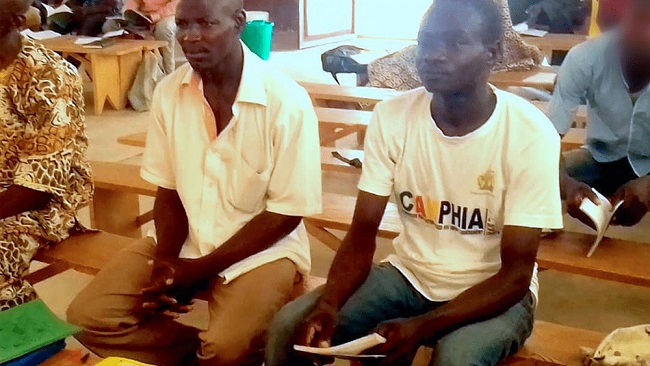
Two facilitators from the Bible Society of Cameroon’s literacy program in the Far North region have been killed by Boko Haram over the past few weeks.
After a two-year lull, attacks by Islamic militant group Boko Haram in that region are on the rise again, and are claiming many victims. Among the lives recently lost were two literacy facilitators from the Bible Society of Cameroon’s Alpha Program in the Parkwa language. One of them died in early August, and the second in mid-September.
“We’ve lost the engine of the church.” – Patrice
Jonas, 42, an elder in the Union of Evangelical Churches in Cameroon, was killed on the night of August 8 while standing guard outside the church with three other people. Patrice*, who lives opposite the church, describes what happened.
“Boko Haram usually turn up in the villages at around 10pm so when it got to 11pm those on guard thought they weren’t coming – so they fell asleep. They didn’t fire their weapons in the air or light torches, which they usually do, so Jonas was taken by surprise in his sleep. The other two managed to escape but Jonas was shot in the head twice.”
The church ‘s pastor confirms Patrice’s words but is still in shock, too overwhelmed to be able to talk about what happened. Marcel*, one of the translators working on the Parkwa Bible, was almost killed by Boko Haram last October. He was a friend of Jonas and describes him as hardworking, someone who was calm and serious in everything he did.
Many people have fled their villages since the attacks resumed in the region. Boko Haram members have warned those who have chosen to stay that they will continue to bury their dead because “living on the mountainsides doesn’t mean you’re in heaven”. In other words, they are not beyond Boko Haram’s reach.
After Jonas’s death, the church built his family a hut at the top of the mountain, which is more difficult for Boko Haram to get to. Olivier*, the Bible Society’s delegate for the Far North, North and Adamaoua regions, went to visit his widow.
“We found her absolutely devastated by the terrible loss she has suffered, but also ill because the humidity on the mountain attracts insects and reptiles,” says Olivier. “They are living in a terribly precarious state. One of the children has festering wounds on his legs and two of them had left for a town 27 kilometres away to find plastic – so that the family can lay it beneath their bed mats, to insulate them from the ground.”
“It is this Bible that will bring hope and heal the wounds of the Parkwa-speaking people”. – Luc Gnowa.
On September 18, barely 40 days after Jonas’s death, Boko Haram killed yet another literacy facilitator, Joseph.
A catechist in the Catholic Church, Joseph was 43 and had eight children. He was a friend of Jonas. Marcel was among the group who went to collect Joseph’s body.
“The villagers were hiding in caves,” he says. “One of Joseph’s children was sick and crying. Fearing that they would be discovered, some of the villagers asked Joseph to take his wife and child and return to his hut. That’s where Boko Haram found them. His wife was able to escape with the child, but not Joseph. We have lost one of our best Parkwa literacy teachers.”
In the village, people live in fear. They can flee … but where to? What would they live on? There is flooding in the area, and living conditions are extremely difficult. Diseases are decimating the population and famine is rising due to a ban on cultivation in the area surrounding the village – this is to ensure that anyone approaching can be seen. But people have nowhere to go.
“After the murder of our two team members, who were responsible for preparing the community for the arrival of the Bible in Parkwa, our task becomes even more urgent,” says General Secretary of the Bible Society of Cameroon, Luc Gnowa.
“It is this Bible that will bring hope and heal the wounds of the Parkwa-speaking people. The translation of the Bible into the Parkwa language is truly taking place under the most painful conditions. Even at the official ceremony to launch the translation project, we had to leave the village in a hurry because we were warned of a possible attack by Boko Haram.”
“You know, when God sends you on a mission, he doesn’t say what conditions you will face when you go. He says, ‘Go, I’m sending you.’ He sent us to this people and we must accomplish our mission. We are convinced that, with him, we will complete our mission, despite the actions of the enemy.”
Please pray for our Parkwa-speaking brothers and sisters, that God will intervene for these people who have seen their men die and for all those in the Far North who have been bereaved due to the actions of Boko Haram.
Please lift up these families who have lost everything and for the Bible translators who are so distressed by what has happened that they are finding it difficult to concentrate. May the Lord’s name be glorified and give us victory, so that his children can finally live in peace and safety.
Source: Eternitynews








17, October 2020
Southern Cameroons Crisis: Jesuit Priest on pilgrimage, prays for reconciliation 0
Carrying only a rucksack, sleeping mat, dressed in black Cassock with his head shaved, Fr. Lado embarked Monday on a 250 km pilgrimage that should take him from Douala to Yaoundé. He wants to draw attention to the suffering brought about by the war in Cameroon, now in its fourth year.
Fr. Lado told Fidespost that his walk was a pilgrimage to pray for dialogue, justice, peace and reconciliation in the Northwest and Southwest Regions of Cameroon.
“To pray, on the one hand, for dialogue, justice, peace and reconciliation in the Northwest and Southwest Regions of Cameroon and, on the other hand, to do penance for the reparation of crimes against human dignity committed in these regions. I draw on these Christian values, which are simply human. These are: Fraternity, dialogue, justice, reconciliation and peace,” wrote Fr. Lado recently in an open letter.
Detained in Edéa
On Tuesday, Fr. Lado’s journey was abruptly interrupted when police detained him in Edéa, a city located along the Sanaga River in the Littoral Region. He was later released and is continuing with his walk. After his release, Fr. Lado said he was in good spirits. “I explained to them (police) that I was on a pilgrimage which has a long religious tradition … but they violated my civil rights,” he said.
Support for the education of children of IDPs
Fr. Lado has placed his pilgrimage under the theme, “Where is your brother?” (Gen 4: 9).
“If the Church, the (Cameroonian) authorities and the Ambazonians do not sit around the table to find a solution to this crisis, I will do my part,” said Fr. Lado when he first announced his decision to walk.
Fr. Lado also says he wants to do penance for the reparation of the crimes against human dignity that have been committed during the conflict. “This march,” adds Fr. Lado, “is a call for solidarity to support the education of children of Internally Displaced Persons or refugees, who are living precarious lives.”
Why else I am walking?
“I am walking so that human blood stops flowing in our country. I walk so that the constitutional right to demonstrate peacefully in Cameroon is respected. I walk in solidarity with internally displaced people and refugees from the Anglophone crisis. I walk to exorcise in me and in us the demon of indifference. Walking is not just a human right, but a divine right. I walk to make it work,” explained Fr. Lado.
Fr. Lado said his march is also in solidarity with hundreds detained, in Cameroon, on 22 September, after demonstrations called by the opposition party, the Movement for the Renaissance of Cameroon (MRC). The demonstrators want national dialogue, electoral reforms and the return of peace to the Anglophone regions of the country. The Cameroonian government deems demonstrations in some regions as illegal.
UN Rights Experts condemn government heavy-handedness
The government has been accused of using excessive force and deploying heavily armed security forces to prevent peaceful demonstrations. UN human rights experts, this week, demanded that authorities release the prominent opposition leader and others arrested during the country-wide peaceful protests. They urge the government to stop intimidating political activists.
The experts further want an impartial investigation into all human rights violations, including allegations of enforced disappearances, arbitrary detentions and ill-treatment of protesters, and that perpetrators be brought to justice.
“We are extremely worried about mass arrests of peaceful protesters and political activists who express dissent,” the experts said. More than 500 people were reportedly arrested after opposition-led protests on 22 September. About 200 of these are still being held in detention. They could face terrorism or national security charges and a trial in a military court simply for exercising their fundamental freedoms, said the UN rights experts.
A four-year war that no one is winning
The four-year separatist conflict has created widespread displacement of half a million people. More than 3 000 persons have been killed. Children in the conflict zones have not been able to attend school for close to four years. Earlier this month, some parents and teachers in the conflict zones braved threats from armed groups and reopened some schools.
At the heart of the crisis, in 2016, was a strike by teachers and lawyers, in the English-speaking regions of Cameroon. The professionals, supported by citizens of their areas, protested the unfair use of the French language and unjustified appointments of French speakers in their territories. Cameroon is a bilingual country. By 2017, the situation had spiralled out of control and developed into a fully-fledged separatist war. Both government forces and separatists are now bogged down in a conflict, that observers say, can only be resolved through dialogue.
Fr. Lado: The outspoken academic
The outspoken and controversial Fr. Lado is not a stranger to the Cameroonian government. He has been raising his voice from about the year 2007 when he was the vice-dean of the Faculty of Social Sciences and Management at the Catholic University of Central Africa, in Yaoundé. He has also been a critic of Paul Biya who has been President of Cameroon for 38 years.
Fr. Lado holds a doctorate in social and cultural anthropology from the University of Oxford. He has written and spoken on issues of Anthropology, Catholic Pentecostalism, trends in African Catholicism, and on social change in sub-Saharan Africa.
Source: Vatican News