18, January 2022
Africa Cup of Nations: CAF boss Motsepe donates $200,000 to a church in Mvog-Ada, Yaounde 0
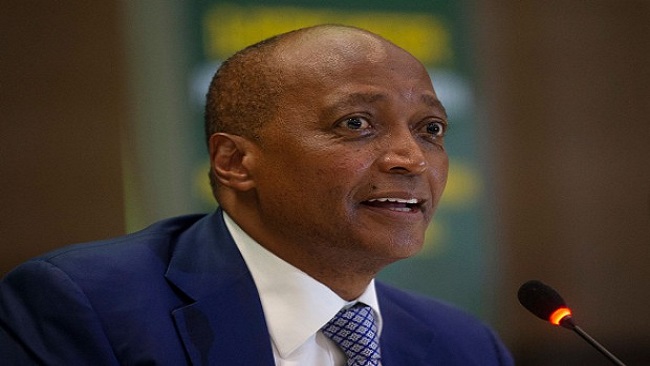
The President of the Confederation of African Football, (CAF), Dr Patrice Motsepe has donated $200,000(Sh440 million) to the Catholic church in Yaounde on behalf of the Motsepe Foundation.
The South African billionaire, who is overseeing the organisation of the 33rd edition of the Africa Cup of Nations, (Afcon), announced the donation during a mass he attended at the St Joseph Anglophone Parish of the Catholic church in Mvog-Ada, Yaounde on Sunday.
The continental football chief was accompanied by the CAF Secretary General, Veron Mosengo-Omba.Motsepe said it was an honour to attend the church service that was officiated by the Archbishop of Yaounde, His Grace Jean Mbarga.
“For the Catholic church in Cameroon, the Motsepe Foundation will donate $ 200,000,” Motsepe announced, throwing close to a thousand worshippers into excitement.The CAF boss clarified that the cash was not from the continental football body, but from the Motsepe Foundation.
Archbishop Jean Mbarga had earlier led an interreligious service to pray for peace for the duration of the tourney that will run till February 6.
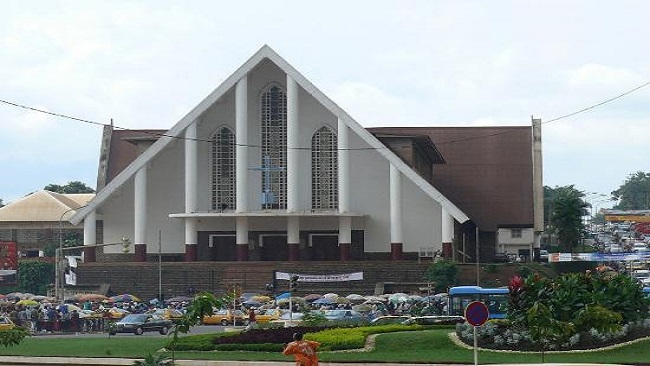
“I am excited to hear that the Bishop organised prayers for the success of the competition in his Basilica,” Motsepe said.During the interreligious service at the Mary Queen of the Apostles Basilica in Yaounde on January 5, Archbishop Jean Mbarga described football and the current competition as a veritable source of unity to the people of Cameroon.
And in what looked like a repetition, perhaps for emphasis, the Archbishop of Yaounde again restated in his homily on Sunday that football is the sport which easily unites Cameroonians.He then prayed for a hitch-free organization of the football fiesta.
“It is a privilege to have you pray together with us,” Archbishop Jean Mbarga told the CAF president and SG before invoking the Holy Spirit to guide and direct the CAF leaders and especially for the success of the ongoing tournament—Motsepe’s first since he became CAF president last year.
Source: The Citizen












9, February 2022
Understanding why Rev Father George Ngalame left the priesthood for love 0
The Holy Roman Catholic Church was a thousand years old before it definitively took a stand in support of celibacy in the twelfth century. Frankly speaking, the decision was reached at the Second Lateran Council held in 1139, when a rule was approved forbidding priests to marry. In 1563, the Council of Trent reaffirmed the tradition of celibacy.
To be sure, priestly celibacy is rooted in tradition, not Catholic dogma, so the Holy Father Pope Francis could change it overnight. Clerics who are happy with the current rules say celibacy allows priests time and energy to focus completely on their flock and to emulate the Prince of Peace, Jesus Christ, who was unmarried, more faithfully.
George Ngalame served as Financial Secretary under retired Bishop Bushu in the Diocese of Buea. He was transferred to Kumba the chief city in Meme Division after it was widely claimed that an audit in the diocese of Buea targeted his person. Kumba eventually became a diocese and the Holy Father appointed His Lordship Agapitus as Bishop.
There is no official document linking George Ngalame to the Diocese of Kumba. Consequently, we of the Cameroon Concord News Group can opine that Bishop Agapitus did not renew George Ngalame’s faculties! The man of God had left Kumba secretly and travelled to the USA.
Arriving the US, the young George Ngalame with the Revered Father title still attached to his name had to start the maneuvers of regularizing his stay. The journey took him through the sea of Bagalum and monikim dancers that separated him most of the times from familiar Cameroon faces.
A friend introduced him to a Cameroon Concord News undercover reporter in the US for him to stage a sham marriage but it never worked out as our colleague later on hinted that she was scared of the repercussion on judgment day.
When George Ngalame was ordained as a Roman Catholic priest, he made a promise to his bishop to be celibate for the rest of his life. It was easy to do at the time with his whole family behind him and very little temptation came his way because of the complete absence of financial resources. But things changed when he was appointed Financial Secretary in the diocese of Buea.
As Financial Secretary, you got the whole world in your hands!! Families will name hundreds of newly born babies after you! Young girls will make you their spiritual leader! You will even use Church money and provide bank statements for relatives and friends travelling abroad and from that office, millions of FCFA shall fall on your left and on your right hand and you will stand tall in the middle and all the good things of the world including beautiful women will come to you. The confident about being celibate will disappear. So, when you are removed from that very lucrative function in the Church hierarchy, the prospect of never having children becomes suspiciously daunting.
To be accurate, a revered father title attached to your name in Europe or America provides the same quality that attracts ladies to any Financial Secretary back home in Cameroon. However, with no support from anywhere in the world, George Ngalame began to fall in love, which needless to say isn’t allowed if you are a Catholic priest.
Yes, it is allowed – but a Roman Catholic cleric shouldn’t do anything about it, apart from suppress it and go to confession. George had to make the most important decision of his life. He really wanted to be a priest and many who know him including Revered Father Maurice Agbaw-Ebai still think it was his calling and that he was good at it. But George Ngalame has taken off his dog collar for the final time and walked away from the Catholic priesthood.
Unreliable sources in Kumba hinted this reporter that Bishop Agapitus ignored George Ngalame’s request for guidance. With no church superior on sight to speak to him, Revered Father George Ngalame has finally choosing love over the church. Some priests have come crawling back within a year but judging from the Nollywood performance on the video posted on face book, George is gone for good.
George Ngalame is not under any pressure from the church to abandon his beautiful wife. But here at last is a Roman Catholic Cleric who was destined for great things if he had stayed in Kumba. Many English speaking Cameroonians thought that he could not break the vow of celibacy – but it turns out that with George Ngalame, it was as easy as making it.
We of the Cameroon Concord News Group do not know whether George Ngalame will be banned from marrying his wife in a Roman Catholic Church because the church still see him as a priest. However, only God knows what his Bishop is thinking of him having sex.
In today’s world, we know men who have left the priesthood for love and have felt lost ever since – wanting to be priests again but being told that they can’t be. We know men who have pushed away the person they love because they are scared to leave the priesthood where they have a home, living expenses and prestige! We also know men caught between both worlds, unable to leave the priesthood and unable to leave their lover. This inevitably leads to secret affairs and even secret children.
So, what’s the outrage about George Ngalame?
By Soter Tarh Agbaw-Ebai