23, November 2023
China expands crackdown on mosques outside Xinjiang, Human Rights Watch says 0
The Chinese government has expanded its campaign of closing mosques to regions other than Xinjiang, where for years it has been blamed for persecuting Muslim minorities, according to a Human Rights Watch report released Wednesday.
Authorities have closed mosques in the northern Ningxia region as well as Gansu province, which are home to large populations of Hui Muslims, as part of a process known officially as “consolidation,” according to the report, which draws on public documents, satellite images and witness testimonies.
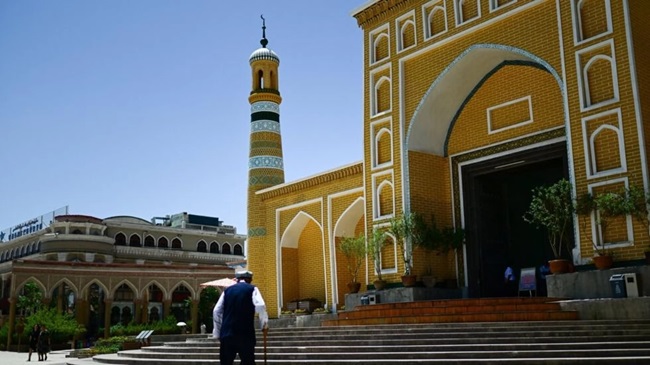
Local authorities also have been removing architectural features of mosques to make them look more “Chinese,” part of a campaign by the ruling Communist Party to tighten control over religion and reduce the risk of possible challenges to its rule.
President Xi Jinping in 2016 called for the “Sinicization” of religions, initiating a crackdown that has largely concentrated on the western region of Xinjiang, home to more than 11 million Uyghurs and other Muslim minorities.
A United Nations report last year found China may have committed “crimes against humanity” in Xinjiang, including through its construction of a network of extrajudicial internment camps believed to have held at least 1 million Uyghurs, Huis, Kazakhs and Kyrgyz.
Chinese authorities have decommissioned, closed down, demolished or converted mosques for secular use in regions outside Xinjiang as part of a campaign aimed at cracking down on religious expression, according to Human Rights Watch.
The Chinese Foreign Ministry did not immediately answer faxed questions seeking comment on the report and its official policies toward Muslim minorities.
One of the first known references to “mosque consolidation” appears in an internal party document from April 2018 that was leaked to U.S. media as part of a trove of documents known as the “Xinjiang Papers.” The file instructed state agencies throughout the country to “strengthen the standardized management of the construction, renovation and expansion of Islamic religious venues” and stressed that “there should not be newly built Islamic venues” in order to “compress the overall number (of mosques).”
“The Chinese government is not ‘consolidating’ mosques as it claims, but closing many down in violation of religious freedom,” said Maya Wang, acting China director at Human Rights Watch. “The Chinese government’s closure, destruction and repurposing of mosques is part of a systematic effort to curb the practice of Islam in China.”
In Liaoqiao and Chuankou villages in Ningxia, authorities dismantled the domes and minarets of all seven mosques and razed the main buildings of three of them between 2019 and 2021, according to videos and pictures posted online and corroborated with satellite imagery by the group’s researchers.
Additionally, the ablution hall of one mosque was damaged inside, according to videos obtained by the group.
The Associated Press could not independently verify the changes described in the report.
The policy of “consolidating mosques” was also referenced in a March 2018 document issued by the government of Yinchuan, the capital of Ningxia. According to the paper, the government wanted to “strictly control the number and scale of religious venues” and called for mosques to adopt “Chinese architecture styles.”
The paper suggested the “integration and combination of mosques” could “solve the problem of too many religious venues.”
In Gansu province, several local governments have detailed efforts to “consolidate” mosques.
In Guanghe County, where the majority of the population is Hui, authorities in 2020 “canceled the registration of 12 mosques, closed down five mosques and improved and consolidated another five,” according to the government’s annual yearbook, referenced in the Human Rights Watch report.
News reports also suggest the Chinese government has closed or altered mosques in other places around the country, occasionally facing public backlash. In May, protesters in Nagu town in southern Yunnan province clashed with police over the planned demolition of a mosque’s dome.
Source: AP









25, November 2023
Diocese of Buea: There are reasons why Retired Bishop Bushu and his acolytes should be on a “permanent sabbatical” 0
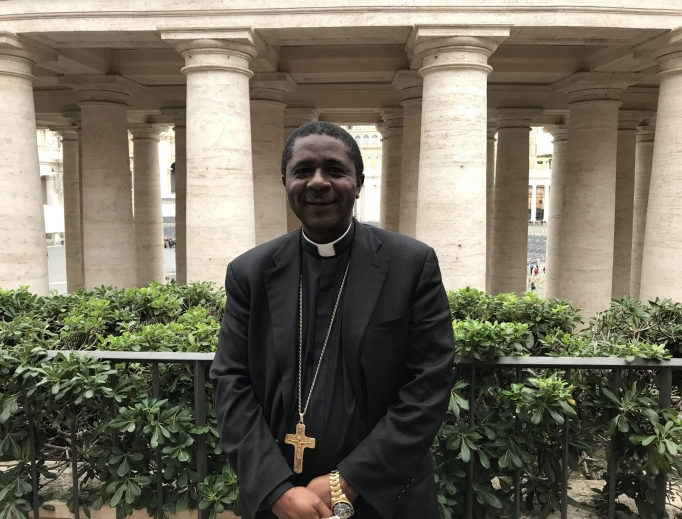
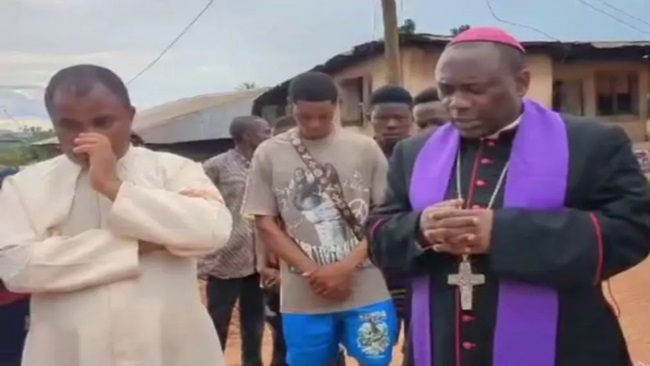
Members of the Clergy of Cameroon’s Catholic Diocese of Buea are supporting their Local Ordinary, Bishop Michael Miabesue Bibi, who is facing social media attacks, which the Clergy dismiss as an unfortunate “smear campaign”.
In a statement issued, Wednesday, November 22, members of the Clergy of Buea Diocese weigh in on social media posts, including those from Nchumbonga George Lekelefac such as an ongoing apostolic visitation, Seeking Transparency and Accountability: An Examination of Bishop Michael Miabesue Bibi’s Leadership, Bishop Michael Bibi, The Father, The Bishop, The Rock On Which Buea Diocese Is Built, The Truth and nothing but the truth about Buea Diocese under Bishop Michael Bibi, and Ex-cardination of suspended priests of Buea Diocese: a solution?
“For the past few months, much has been said and written about the Diocese of Buea and her Chief Shepherd, Bishop Michael Miabesue Bibi,” the Catholic Priests say.
They express their support for Bishop Bibi, saying, “We, the Priests of the Presbyterium of Buea, have watched with dismay at the smear campaign orchestrated by some individuals and even some members of the presbyterium and groups on social media against the person of the Bishop and the work he is doing in the Diocese of Buea which is already yielding fruits in abundance.”
“Unfortunately, some of these publications have had a negative impact on the faith of many of our Christians,” the members of the Clergy of the Cameroonian Diocese lament.
They continue, “At this point, we want, as a Presbyterium, to affirm and declare our support for the Bishop, and in making this affirmation, dissociate ourselves from all those seeking to manipulate and mislead the people of God in the Church of Buea.”
“As Priests serving in the Diocese of Buea, we remain united with the Bishop as he continues to lead this Diocese with grace, compassion and integrity,” they further say.
The members of the Clergy express their awareness of the challenges involved in shepherding the people of God. They say, “The role of a Bishop is fundamental in the spiritual life of every Diocese and yet, pastoring a Diocese is a challenge and a huge responsibility before God and man.”
They call upon the people of God in Buea Diocese to “remain calm and united in the face of these attacks, because we are confident of the words of Jesus in Mt. 16:18, that the gates of the underworld shall never prevail over the Church.”
All Consecrated persons and the Laity need to “stand in support of our Bishop so that he may realize his vision for this Diocese, for the greater Glory of God, and for our Salvation,” they say.
The Clergy laud the 52-year-old Catholic Bishop who has been at the helm of Buea Diocese since December 2019, first as Apostolic Administrator, and since February 2021, as the Local Ordinary.
“My Lord Bishop, we admire your composure in the face of all these attacks and we encourage you to remain calm, confident that God is your strength,” the Catholic Priests implore.
As Apostolic Administrator of Buea, Bishop Bibi made administrative changes in the Diocese-owned Catholic University Institute of Buea (CUIB), leading to controversy among the members of the institution’s Council. The Vatican clarified his mandate as the Apostolic Administrator of the Cameroonian Diocese.
In September this year, Bishop Bibi was honored by the country’s NewsWatch Newspaper for his “exceptional skills” in leading the people of God and managing the property of his Episcopal See.
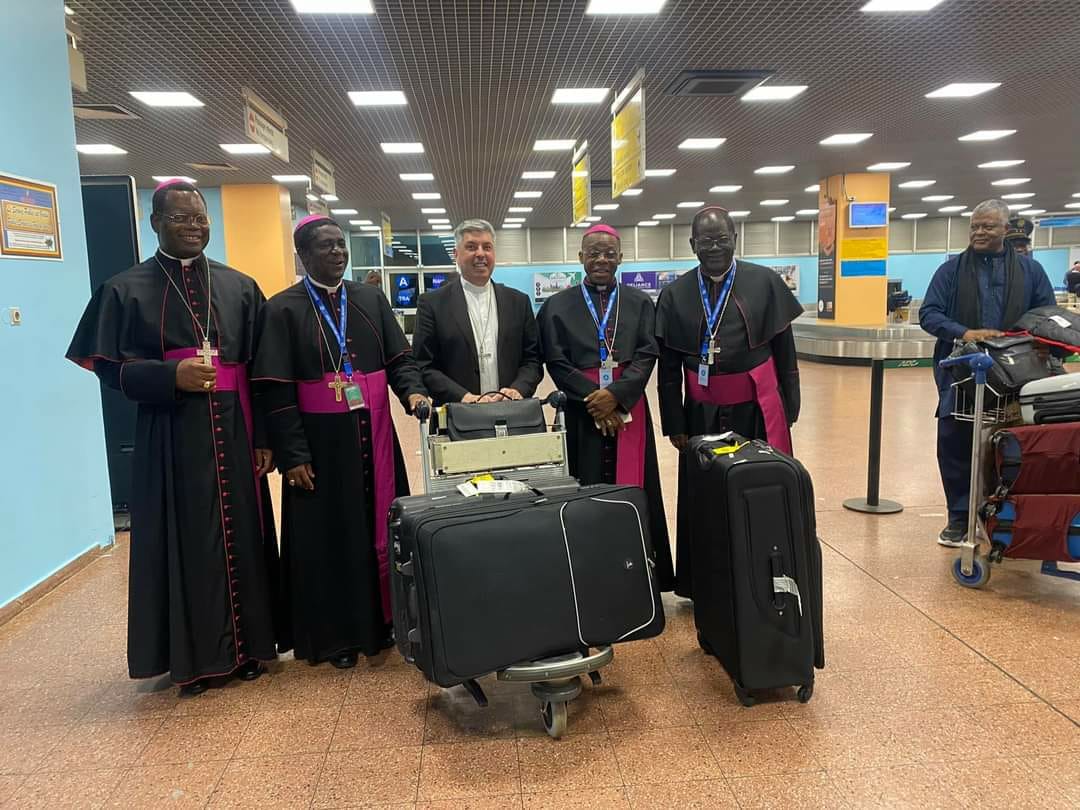
Earlier, in February 2022, Catholic Bishops in Cameroon’s Bamenda Ecclesiastical Province expressed their “solidarity and communion” with their colleague, Bishop Bibi following social media attacks.
In their collective statement dated 11 February 2022, members of the Bamenda Provincial Episcopal Conference (BAPEC) said their “hearts were deeply saddened by the unfortunate turn of events in the Diocese of Buea, characterized by gross disrespect of the hierarchy of the Church, casting of aspersions on Bishop Michael Bibi.”
Source: aciAfrica