13, December 2019
Bishop of Bafang condemns deteriorating human rights situation in Cameroon 0
Cameroon’s leading prelate has condemned the “deteriorating” human rights situation in the African country.
Speaking during a Dec. 10 workshop on the state of human rights in Cameroon, Bishop Abraham Kome of Bafang, the president of the bishops’ conference, said freedom of political expression has been significantly limited.
“We have seen the difficulty with which political parties have to manifest. We see – and I say this with a lot of emotion – when we visit our country’s prisons, what we see there is poor infrastructure, poor treatment of inmates, and overcrowding in prison cells. When one sees that, one can only affirm, if one has to speak the truth, that human rights have deteriorated in our country,” he said.
The bishop’s comments came just days after the country’s National Commission on Human Rights and Freedoms published its 2018 human rights report in Cameroon.
The report documented arbitrary killings, forced disappearances, and a crackdown on political freedom; as well as noting the limited access to justice for aggrieved persons.
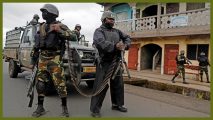
Currently, the government is fighting two major internal conflicts: The first against separatists in the country’s Anglophone regions, and the second against Boko Haram militants in the north.
The report said that in these regions, human rights have been grossly violated, both by insurgents and the country’s military.
“The climate of insecurity degenerated into allegations of violations of the right to life and to physical and moral integrity of persons and property; violations of the right to education, health, private property and access to administrative services and to a fair trial of suspects and the deplorable detention conditions,” the report states.
It further indicated that between January and December 2018, “close to 200 civilians were killed by separatists and government soldiers in the Anglophone regions alone.”
The war that started in 2016 as a protest by Anglophone lawyers and teachers over attempts to destroy the education and common law systems practiced in English speaking regions quickly degenerated into an armed rebellion with many English speakers demanding for outright independence.
The Chairman of the National Commission on Human Rights and Freedoms, Chemuta Divine Banda, said Cameroon’s separatist war was fast becoming an enterprise, “with war lords stepping into the picture to make benefits through kidnappings and ransom taking.”
“There are people who don’t want this conflict to end,” he told Crux.
The report speaks broadly about poor prison conditions, limited access to justice for accused persons, the torching of schools that has forced about 800,000 children out of education, as well as attempts by the government to limit access to freedom of speech and assembly.
The country has come under increasing scrutiny by the international community, with Human Rights Watch stating in its 2018 report that in its fight against separatists in the country’s English speaking North West and South West regions, “government security forces have committed extrajudicial executions, burned property, carried out arbitrary arrests, and tortured detainees.”
Even the Trump administration has weighed in with a damning report on Cameroon’s human rights record.
Electoral code can’t guarantee free and fair elections
In his remarks, Kome also took aim at Cameroon’s electoral code with just weeks until the next legislative and municipal elections in Cameroon and called for its revision.
“The electoral code does not guarantee the transparency and authenticity of electoral results,” the bishop said.
Kome said a revision of the code was needed to “guarantee the peoples’ human right to freely choose the leaders they want.”
The opposition has consistently called for the introduction of a single ballot, the redistribution of electoral constituencies, as well as the complete computerization of the electoral process.
The secretary general of the opposition Social Democratic Front said his party will introduce legislation on the revision of the electoral code during the ongoing parliamentary session. It’s a similar stance taken by the party of Maurice Kamto who claims he won the last presidential election in Cameroon.
Cameroonians will go to the polls February 9 to elect municipal offices and members of the national legislature, but some observers say that election could be a recipe for violence especially in Cameroon’s English-speaking regions.
Source: Crux


18, December 2019
Cardinal Sarah’s profound meditation on the God of love 0
Having mentioned an interview between the late Sir Jonathan Miller and Norman Lebrecht in a recent blog on Advent, I am now thinking of another cultural giant who has recently died: Clive James. A friend has drawn my attention to an interview first broadcast in 2001 between James and the novelist Piers Paul Read in the former’s TV series, “Talking in the Library”.
James makes an interesting contrast to Miller, for whom religious belief appears to have been a matter of utter indifference. James, a cultural and literary highbrow – and a serious poet – who spent much of his life and energies in a lowbrow milieu such as television, recognised the power of the Christian faith, even admitting to Read that “If I were capable of belief, I’d be a happier man.” For him, as with so many of those who reject faith, the “insoluble problem” is how to square evil and the God of love: where was God in Nazi Germany, he wanted to know, further stating “I am with Ivan Karamazov” – a reference to the passage in Dostoyevsky’s The Brothers Karamazov that always haunts those who read it, whether Christian or not. Describing himself as a Manichean, he believed “Evil has a mind” and that Hitler was “Satan’s representative”. Yet it seems James had not chosen, or been driven, to pursue the matter any further.
Such comments always make me ponder the gap between Christians and someone like James, prepared to go so far in recognition of the mystery of evil, but no further. It reminds one that faith is truly a gift, something utterly outside and beyond mere human and intellectual understanding, however rich and well-informed it might be.
As I am a book blogger I should mention here that I have been reading the third volume of Cardinal Robert Sarah’s trilogy, titled The Day is Now Far Spent (Ignatius). For those who have not come across the first two books, they are God or Nothing, and the Power of Silence. Like them, this volume is framed in a long “conversation” with the French journalist Nicolas Diat, and also like them it is in a different league from almost all current spiritual books, probably because it is written in a very direct and personal style by a man who is patently holy.
Sarah is not writing as a theologian or an academic but as someone whose life is simply immersed in prayer. His triptych (as he prefers to describe his three books) is a profound meditation on the God of love, alongside his palpable anguish at the current sexual abuse crisis in the Church – the “mystery of betrayal”, as he describes it. Indeed, his foreword is headed “Alas, Judas Iscariot” and he calls his writing “the cry of my soul!” It is not the territory of a TV show.
Sarah is conscious that “In a little while I will appear before the eternal Judge…what will I say to him then?” Addressing the faithful directly, he challenges them: “If you think your priests and bishops are not saints, then be one for them. Do penance [and] fast to make reparation for their defects and their cowardice.” Accusations against particular individuals are not part of the Cardinal’s vocabulary, as they might in other hands have been; he writes as a saint would write, asking his readers to become saints themselves, for the sake of the Church. “How much God loves us!” he points out, qnd marvels that “he consents to handing over his Eucharistic Body into the sacrilegious hands of miserable priests.” This is plain speaking indeed.
Addressing in particular the “spiritual and religious collapse” in the priesthood, Sarah makes it clear that priestly celibacy should never be regarded as a discipline that can be changed but “the seal of the Cross on our lives as priests.” He goes on to say that “Anyone who would dare to break and ruin this ancient treasure…by seeking to separate the priesthood from celibacy would hurt the Church and the priesthood of the poor, chaste and obedient Christ.”
On the kind of false ecumenism that appears to romanticise paganism the Cardinal, who was born and who grew up in Guinea, gives a note of warning: “You have to be an African to dare to say…that these pagan “traditional religions” are zones of fear and lack of freedom”. He is also critical of the phrase, “anonymous Christians”, coined by Karl Rahner, stating that it “runs the risk of extinguishing our sense of the urgency of mission. Do we still have the anguish about salvation that gripped St Dominic?” Reminding the lay faithful of how we should participate at Mass, Sarah draws attention to the Our Lady and St John at Golgotha: “They were there, silently allowing themselves to be penetrated, imbued and shaped by the mystery of the Cross.” Such quotations provide a brief taste of the tenor of this profound book.
Cardinal Sarah’s triptych should be on the shelves of every Catholic, to remind us that the Christian faith, unlike politics – of which we have had our fill these last few days – is not about focus groups, Twitter trends and catchy slogans; it is about self-transformation, self-sacrifice and the pursuit of holiness. In a fanciful way, I ask myself: what if Clive James had happened to interview this holy cardinal for his TV series rather than the Catholic novelist Piers Paul Read. As it was, these two clever, bookish men chatted in a cordial and civilised way, comfortable in each other’s company, neither of them seriously challenging the other, though Read did say at one point that he was “very conscious of the grace of God and my need of God.” One had the impression that as a well-brought up Englishman he felt it would not be proper to go into more detail on so personal a subject; and as a maverick Australian polymath, more comfortable in the world of books and authors than any spiritual preoccupations James did not pursue the question further.
Cardinal Sarah, an African who was converted from pagan animism as a child, alongside his parents, would not have played by the implicit rules of the interview format: he would gently but insistently have forced James out from his comfort zone, into the real world of good and evil that Dostoyevsky understood so insightfully. Perhaps even a talker as brilliant as James might have paused to contemplate the meaning of life and mortality; what might lie beyond the blandishments of fame and his millions of fans.
Source: Catholic Herald