27, January 2020
Southern Cameroons Crisis: Cardinal Tumi says things are improving 0
Cardinal Christian Tumi is a known critic of the Cameroon government, yet he was one of those chosen by the regime to lead a “peace caravan” to the West African country’s troubled Anglophone regions.
After weeks meeting with various stakeholders, the cardinal now believes peace is gradually returning to the two regions, which contain about 20 percent of the country’s population that has often felt marginalized by the French-speaking majority.
In a wide-ranging interview with Crux, Tumi talks not only about the peace process, but he also examines the historical trajectory of the Anglophone problem in Cameroon, the 2017 death of Bishop Jean-Marie Benoît Balla – which authorities have said was a suicide but the nation’s bishops say was murder – as well as the life of the Church in the country.
Crux: Is the Christian faith still embedded in the hearts of Cameroonians who you meet daily?
Tumi: I think so. When a Christian goes through a difficult situation, it’s at such a time that his faith is tested. Sometimes, when God allows for difficult situations in the life of a Christian, it is to put him in a situation of persevering prayer. It is also to put him in the school of patience.
What do you mean by “the school of patience”?
We tell our Christians every year that no matter the situation, no matter the difficulty, they should always have faith in the Lord who knows our past, our present and our future, and who knows all that is good for our spiritual life and even for our material life, because he is the one who created us.
During the celebration of the Feast of Nativity, the Archbishop of Yaoundé, Jean Mbarga, called on Cameroonians to “take their destiny into their hands.” That seems to contradict your insistence that people should pray and wait for God to decide their fate?
I am not contradicting what the archbishop of Yaoundé said. To wait doesn’t mean to do nothing by oneself. First, the fact that one can take the initiative to ask God to get us out of our difficulties, it’s already something. He himself has said, despite the fact that He already knows our needs, he asks us to pray without ceasing.
Pope Francis during his Christmas message condemned violent uprisings across the world, and went forward to comfort persecuted Christians. Is this message relevant to Cameroon?
Of course! It depends where we find ourselves. In the north of the country – I spent twelve years in the North of the country – and I am convinced that there are Christians in the north of the country who lived their Christian lives like martyrs and I am not only thinking of Catholics. I am thinking also of Christians from other denominations who suffered, who lost their jobs because they were Christians.
And we know many priests have been killed, with many believing Bishop Jean-Marie Benoît Balla was murdered.
Don’t forget that my predecessor in Garoua, Archbishop Yves Plumey was assassinated, and up to now, we don’t know who did it and why. There are people abroad who thought it was Cardinal Tumi who was assassinated. If it were me, there would have been a reason at the time. Archbishop Plumey was cold-bloodedly murdered on his bed. So Bishop Balla’s assassination was not the first case. And know that in the past 20 years, I think about 400 priests have been killed in Africa, because of their positions against authorities in their countries, and those are positions you take in conscience. Jesus told us: do not be afraid. When it comes to condemning evil, no matter its origin, priests and bishops don’t have to be afraid … besides, all the Apostles were killed.
Have you ever been fearful for your life?
No, not at all. Ever since I became priest, I have always been threatened. In Yagoua I was threatened. In Garoua, I was summoned to the military courts. In Douala, I was threatened after denouncing the assassination of 9 people in Bepanda … up to now, we are not told what happened. The Church must condemn with all its force such killings.
And there is a feeling that as a result of all this, the Church has a conflictual relationship with the state?
No, there is no conflict between us. All we want is that they should explain to us why this or that priest was killed …we are not at war with the state.
Cardinal, let’s talk about the Anglophone problem. What in your opinion are the fundamental causes?
Remember that before President Paul Biya called the major national dialogue to resolve the Anglophone problem, some retired clerics from other denominations and I had initiated an Anglophone General Conference to examine the root causes of the conflict. It did not take place, but we carried out a research to determine the causes, and to make proposals.
So, we produced a 400-page document with a 10-page summary.
For the causes, they are many: Bad government in the management of public affairs. At the time we were carrying out that investigation, the majority – 69 percent – said separation was the only way forward. But the problem escalated because the government intervened late, and the people became radicalized. But the problem started way back in 1972 when the name of the country was changed from the Federal Republic of Cameroon to the United Republic of Cameroon.
Why did the change in name constitute a problem?
Because we began to forget all that was specific to Anglophones-their heritage. Do not forget that from 1961-1972, we had a government there, [in Anglophone Cameroon], with a Prime Minister and his ministers. Anglophones had a system of governance that they inherited from the British.
We were raised in a democracy because the British governed by ‘indirect rule.’ They governed us through traditional rulers. They listened to the people. There was so much self-development, for instance, the roads. The roads that linked villages were dug by the people, for free. They were not paid. And they did that with so much joy … In Anglophone Cameroon, the policeman was a friend, all he had was a baton. We never saw the army. The army was in the barracks, because they were not there to attack the population. I saw an armed policeman for the first time during the reunification.
So how did the change in name affect all of that?
We had the impression that the goal of that change in 1972 was to assimilate the Anglophones; to abolish all that was Anglo-Saxon. I remember a Frenchman who told me that he was surprised that just months after the abolition of federalism, he visited Cameroon and discovered that all public notices and signboards were in French, so he thought he was already in a francophone country. And I have never ceased to recount a story that I lived in Rome with a French diplomat. We were invited to the French embassy in Rome, and one of the employees there approached me and asked me which country I came from. I told him I was from Cameroon. He told me: “Thank you for all you are doing to assimilate the Anglophones. That was a French diplomat.”
What effect did that have on you?
It all dawned on me: that is the goal. That is the source of the problem. When I told this story to some Frenchmen, they said, that’s not possible, because it was not diplomatic for him to say that. It revealed everything.
Should all of that frustration lead youths to take up arms?
No, I condemn that. Nothing can be resolved through violence. It’s always good to come together and dialogue.
Cardinal, after the national dialogue, you and the Bishop of Mamfe [Andrew Nkea Fuanya, who was named Archbishop of Bamenda on Dec. 30] were designated to lead “peace caravans” to the two regions. You have said the situation on the ground is changing for the better. What makes you say that when we still see daily killings on the ground?
And I still hold that opinion. You know, my mother’s house was attacked, and the doors broken. I stand to repeat exactly what I said: The situation is changing. What are the proofs today? The proofs are some people are going back to their communities. That is a simple example.
Yesterday, somebody was here to tell me that his mother was kidnapped in the Ndop plains and they were asking for money. The mother said: ‘I prefer to die.’ Thirdly, there is contradiction now between the separatists and the population. There are some cases, like in Bamenda … I got a letter from a priest in Bamenda who said there are tracks which are thrown in the town of Bamenda which say: “No school, no amba.” This means if the amba boys do not allow children to go to school, there will be no amba. [Editor’s note: The amba boys is the common name for separatist rebels.]
Some parents are ready to fight back, so that their children go to school. And the Bishop of Mamfe said almost all his schools are functioning now. So we can cite examples to show that what was happening yesterday is changing. And finally, many of these boys are coming now to see us. They don’t go to see those people who are contradicting me…
What justifies this change in attitude?
There are 29 separatist fighters in Boyo who want to come to Douala. There are 15 in the Ndop plains. They trust us, and I think that is why the state got us involved in all of this. There are four right here with me, and the Prime Minister is aware.
There may be many reasons. First of all, the prayers of the faithful that this crisis ends. Those who have come here say they heard about me and they agree with my positions …. believe them. One of the reasons is that they don’t have the means anymore … I received an amba boy, married, and university student who told me when he came to see me, that they were fooled by the diaspora. The diaspora was saying that the UN would intervene, and they would have salaries of over 400,000 CFA [around $675] per month. In the last pastoral letter by the Bishops of the Bamenda Ecclesiastical Province, they say not even one quarter of the promises made by the diaspora had been attained.
What is pushing the young people out of the forests?
First, they have got nothing to eat. Secondly, many are dying from disease. I can tell you that in Cameroon and out of Cameroon, no one has been in contact with the heads of these armed separatists. It’s only the Bishop of Mamfe and I. And they want an end to the crisis. They want to create a political party. They don’t have a political party. How would they conquer political power without a political party? The Bishop of Mamfe and I are encouraging them to create their political party, to fight politically. It’s the only means by which they can get to power.
One recommendation to resolve the Anglophone problem emanating from the grand dialogue was the special status for the English-speaking regions. Are you comfortable with the contents?
I was among the first to make a proposition for the content. I was clear, and the Prime Minister’s office too, said that I was the clearest: I proposed a government, I proposed a house of parliament, I proposed a house of elders, the independence of the civil service … the civil service is to serve the government, not a party; so therefore, during campaigns, civil servants should not be seen campaigning. The independence of the educational and legal systems. We should be in the Anglo-Saxon style that we inherited …To be frank, what will satisfy Cameroonians is a sort of federalism. But the present political authority doesn’t want to hear about federalism. I’ve told people that federalism is in my blood. That is what we voted for at reunification.
What is lacking in the special status?
Even though there is a regional council – an assembly of representatives of the region – they cannot vote a law, they cannot initiate a law.
Personally, I am not satisfied with the contents of this Special Status.
Be it as it may, what do you think is the way forward for a Cameroon, now described as “sick” by some?
Truth. The truth will save Cameroon. How many billions have been stolen from our coffers? Don’t forget, when Paul Biya came to power, he said that economically and financially, we were faring well, and that we will not go to the Bretton Woods institutions to borrow. No sooner after that – in two or three years – we were on our knees begging to be accepted as a poor and heavily indebted country.
And what message do you have for Cameroonians as they go into a new year?
Let’s love our country. Let’s love each other, and to love your neighbor means you do to him what you would love to be done to you. Do not do to your neighbor the evil that you won’t want done to you. And we should love the other virtues, like living together so we fall in line with our communities, as citizens and as brothers and sisters of the same nation.
Crux


13, February 2020
Pope decides against ordaining married priests in the Amazon 0
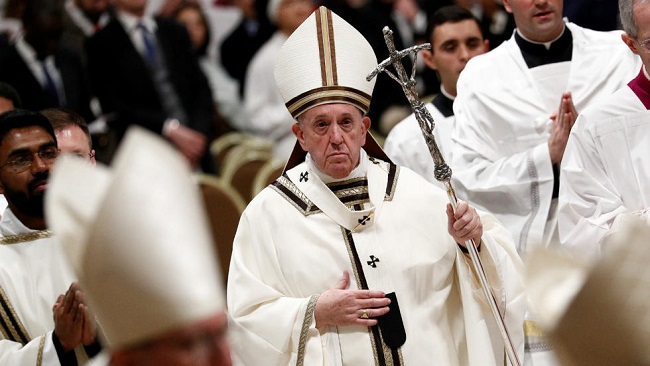
Pope Francis declined Wednesday to approve the ordination of married men to address a shortage of priests in the Amazon, sidestepping a fraught issue that has dominated debate in the Catholic Church and even involved retired Pope Benedict XVI.
Francis, in an eagerly awaited document, did not refer to the recommendations by Amazonian bishops to consider the ordination of married men or women deacons. Rather, the pope urged bishops to pray for more priestly vocations and to send missionaries to a region where faithful Catholics in remote areas can go months or even years without Mass.
The papal dodge disappointed progressives, who had hoped he would at the very least put both questions to further study. It outraged liberal Catholic women’s groups. And it relieved conservatives who have used the debate over priestly celibacy to heighten opposition to the pope, whose strongest conservative critics have accused of heresy.
Francis’ document, “Beloved Amazon,” is instead a love letter to the Amazonian rain forest and its indigenous peoples, penned by history’s first Latin American pope. Francis has long been concerned about the violent exploitation of the Amazon’s land, its crucial importance to the global ecosystem and the injustices committed against its peoples.
Pope Francis✔@Pontifex
I dream of Christian communities capable of generous commitment, incarnate in the Amazon region, and giving the Church new faces with Amazonian features.
Quoting poetry as frequently as past papal teachings, Francis addressed the document to all peoples of the world “to help awaken their affection and concern for that land which is also ours and to invite them to value it and acknowledge it as a sacred mystery.”
“Beloved Amazon” is in many ways a synthesized and focused version of Francis’ 2015 landmark environmental encyclical, “Praised Be,” in which he blasted wealthy countries and multinational corporations for destroying the world’s natural resources and impoverishing the poor for their own profit.
Francis said he has four dreams for the Amazon: that the rights of the poor are respected, that their cultural riches are celebrated, that the Amazon’s natural beauty and life are preserved, and that its Christian communities show Amazonian features.
Francis had convened bishops from the Amazon’s nine countries for a three-week meeting in October to debate the ways the church can help preserve the delicate ecosystem from global warming and better minister to the region’s people, many of whom live in isolated communities or in poverty in cities.
The Argentine Jesuit has long been sensitive to the plight of the Amazon, where Protestant and Pentecostal churches are wooing away Catholic souls in the absence of vibrant Catholic communities where the Eucharist can be regularly celebrated.
In their final document at the end of the October synod, the majority of bishops called for the establishment of criteria so that “respected” married men in their communities who have already served as permanent deacons be ordained as priests.
In addition, the bishops called for the Vatican to reopen a study commission on ordaining women as deacons, a type of ministry in the church that allows for preaching, celebrating weddings and baptisms, but not consecrating the Eucharist. Francis had created such a commission in 2016 at the insistence of religious sisters who want more say and roles in church governance and ministry, but the group ended its work without reaching consensus.
Francis didn’t mention either proposal in “Beloved Amazon” and didn’t cite the synod’s final document in his text or in a single footnote. But he did say in his introduction that he wanted to “officially present” the synod’s work and urged the faithful to read it in full, suggesting that he at least valued the input.
Francis did echo many of the synod’s recommendations, calling for greater lay participation in the life of the church and saying the training of priests in the Amazon must be overhauled so they are more able to minister to indigenous peoples. He said “every effort should be made” to give the faithful access to the Eucharist.
“This urgent need leads me to urge all bishops, especially those in Latin America, not only to promote prayer for priestly vocations, but also to be more generous in encouraging those who display a missionary vocation to opt for the Amazon region,” he wrote.
Francis dismissed suggestions that ordaining women to any ministry would serve them or the church. While agreeing that women should have greater decision-making and governance roles, Francis argued that they must find “other forms of service and charisms that are proper to women.”
Groups that advocate for women’s ordination and giving women greater roles in the Catholic Church blasted the document. Francis justified his refusal to consider ordained ministry for women as sparing them the risk of being “clericalized,” or placed on a pedestal.
“This is a dereliction of his duty as a leader with the power to make positive change and challenge discrimination,” said Miriam Duignan of the Wijngaards Institute for Catholic Research, a British-based progressive Catholic think tank.
Kate McElwee, executive director of Women’s Ordination Conference, said the document betrayed women in the Amazon and elsewhere who perform the lion’s share of the church’s work, pass the faith from generation to generation, and yet enjoy no official recognition or authority.
“Recognizing women’s work with diaconal ordination would be the first, most basic step towards righting the wrong of institutional sexism that hobbles our church as it attempts to respond to the moral crises of our time,” McElwee said in a statement.
The Catholic Church retains the priesthood for men, arguing that Christ and his apostles were male. While Eastern rite branches have married priests, and Anglican and Protestant priest converts can be married, the Roman rite church has had a tradition of priestly celibacy since the 11th century, imposed in part for financial reasons to ensure that priests’ assets pass to the church, not to heirs.
In the weeks leading up to the document’s release, the question of a celibate priesthood made headlines after the publication of a book penned by the retired pope, Benedict, and a conservative Vatican official, Cardinal Robert Sarah, reaffirmed the “necessity” of a celibate priesthood.
Benedict’s participation in the book sparked controversy, since it appeared the retired pope was trying to influence the thinking of the current one, despite his promises to remain “hidden from the world” when he resigned seven years ago.
Vatican spokesman Matteo Bruni noted that Francis finished the document in December, before the book came out, making clear the pope wasn’t swayed by Benedict’s intervention.
Francis avoided the issue altogether, dedicating instead the entire first half of the document to the “injustice and crime” committed against the Amazonian peoples and their environment by local governments, foreign corporate interests, and illegal mining and extraction industries.
“We cannot allow globalization to become a new version of colonialism,” he wrote.
He said the church in the Amazon must have social justice at the forefront of its spirituality, saying ministry that focuses excessively on discipline and rules will turn people away when in fact they need “understanding, comfort and acceptance.”
The traditionalist blog Rorate Caeli, which has been highly critical of Francis, said that by closing the door to a married priesthood and female deacons, the document was “the best possible document we could have hoped for in the current pontificate and in the current age.”
Clare Dixon, Latin America chief for the British Catholic aid agency CAFOD, focused on the environmental good it might do in the global debate about how to fight climate change.
“But Francis is also imploring us to listen to the wisdom of the people of the Amazon, insisting that we learn from the way they live with the environment rather than in competition with it,” she said.
Francis called for the church to incorporate indigenous traditions and cultures into its ministry, including song and dance, myth and festivals, and urged patience when confronted with apparently pagan practices and symbols.
It was a reference to the controversy that punctuated the synod over the appearance in the Vatican of wooden statues of a pregnant woman that critics said were pagan idols. At one point, a conservative activist stole the statues from a Vatican-area church and threw them in the Tiber River in a videotaped stunt that galvanized traditionalist opposition to Francis and the synod itself.
(AP)