22, June 2018
Government Refugee aid inflames Southern Cameroonians 0
The Cameroon government announcement on Wednesday, June 20, 2018, to bring some relief to Southern Cameroonian refugees in Nigeria and those internally displaced across the country has instead provoked anger among Southern Cameroonians who hold that there can never be anything good from the Yaoundé government that has been maiming and killing its own people.
Many people across the country, especially Southern Cameroonians in the Diaspora hold that this may be a ploy by the struggling government to deceive the international community into believing that it is caring and it wants to help resettle those displaced by a conflict that has been complicated by the government’s military action.
The announcement was made all the more ridiculous by the fact that the aging and ailing government does not have the resources and it is calling on members of the ‘crime syndicate’ to generously donate to a cause many knew was doomed to failure.
Since the announcement of this phoney aid, Cameroonians have been reacting in different ways. While some hold that it is an initiative that will help the refugees many of whom have been living in the jungle for months, critics of the government see it as an opportunity for the corrupt Yaoundé government to prove that it is still capable of doing things.
According to some of the fighters on the ground, the package comes too late. “We have made up our minds to quit our French speaking colleagues. We have been complaining for 56 years and nobody has ever taken us serious. At best, they have ignored us, and at worst they have killed our brothers and burned down our homes. We are never going to forgive this folks and we have warned our people not to receive such blood-tainted assistance. We will kill anybody who goes to get that money or anybody who comes here from Yaoundé to tell the people those cock and bull tales,” a member of the Lebialem-based Red Dragon, who elected anonymity, said.
He advised Southern Cameroonians to continue fighting the Yaoundé government that had thought that by killing a few people the rebellion would be over.
“I am calling on southern Cameroonians to keep on resisting the corrupt Yaoundé regime. Our collective efforts and our unity of purpose have sent a strong message to Mr. Biya and government who thought by using military force they would silence us forever. That will never happen. We are walking away from the mistakes made by Foncha and Muna and there is no better time to dump our French speaking colleagues who have displayed unparalleled indifference to our fate for 56 years. In trying to silence us, the government has ended up with a sticky situation. Pressure from abroad is mounting on the frail regime and our successes on the ground have left the government really embarrassed, he said.
“For those who are having intercourse with the Yaoundé regime, let them know theirs is the kingdom of death. We will behead any government officials, especially those Southern Cameroonians in Yaoundé if they dare show up here with their dirty money in the name of refugee assistance. They cannot kill us, chase our brothers from their homes and turn around to bribe us. We have thrown them up and woe betides anybody who makes the mistake of coming to our territory with such money. I would like to send this message to Chief Tabetando. Minister Mengot Arrey, Mr. Elvis Ngolle Ngolle and Prof. Nalova Lyunga that we are ready and willing to send them to their graves for all the hardship they have brought on us. They have abetted and aided the enemy who has killed our people. We will never forget, he stressed.
“For Yang Philimon and Paul Atanga Nji, they know they are already dead. They have been the architects of the cataclysm that has befallen people in Belo, Mamfe, Kwakwa, Pinyin and Mbonge. We will never forgive. Let them keep their dirty money. Our focus is on securing our land anybody who does not play by our rules will be promptly taken to our green jails for professional interrogation,” he warned.
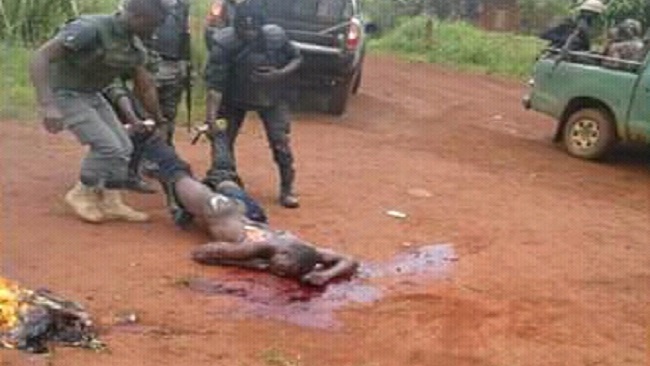
In Mamfe, Kumba, Limbe, Buea, Mbengui, Kumbo, etc, the feeling is the same. Southern Cameroonians do not trust the government and they hold that the relief assistance maybe a way of killing more of them, after all, it had used a press release once to tell the people of Mamfe to quit their homes and used the governor to deceive the people to stay home where they later were butchered.
For the Diaspora that has been the brain behind this revolution, the refugee relief assistance is nothing more than a publicity stunt by the government. The internet is awash with criticism of the government’s action which many consider as a poisoned gift.
“This government seems to be out of touch with reality. The people of Southern Cameroons have been transformed into refugees by the government and it now wants to show to the world that it is magnanimous,” one activist wrote, adding that “Southern Cameroonians across the globe should kill the government’s bluff by contributing massively to fundraising efforts that are underway in many cities across the globe so that the refugees will not be tempted to accept the government’s poisoned gift.”
He added that “As southern Cameroonians, we have the capacity to bankroll the return of our displaced people once our independence has been secured. We cannot trust anything from the Yaoundé government that has overstayed its welcome.”
“We might have lost some of our brothers due to this war. We might be going through tough times, but that does not make us beggars. We have the numbers and we can use those numbers to change our fate. We are about four million living abroad and that is good enough for us to underwrite the military efforts some of our fellow brothers in ground zero are making.”
“Besides, we cannot let this fake refugee fund distract us. We must continue to resist these infidels until they pack their stuff and leave our land. The kidnapping and killing of soldiers have left the government in a quandary. It wants to negotiate, but it does not know who to talk to. The people’s revolution is working and it will work until we quit these infidels who have brought death and destruction to our land.”
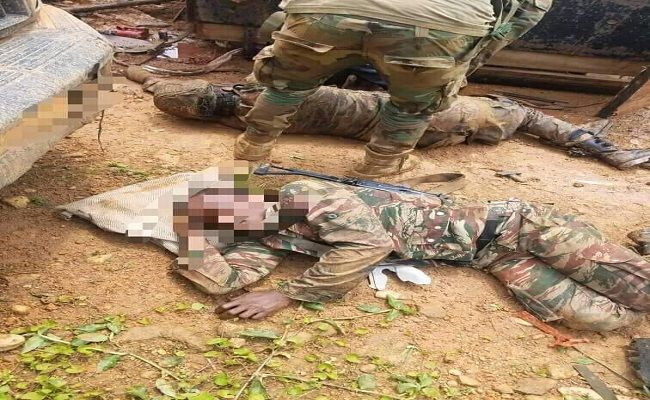
Meanwhile the fighting in many parts of the English-speaking region has intensified. In Buea and Mutengene, some uniformed soldiers were killed yesterday, Thursday, June 21, 2018 while two others were kidnapped. The situation has remained tense, especially as many army soldiers are refusing to go to the war front.
On Tuesday, a soldier killed his boss before turning his weapon onto himself after learning that his boss was insisting on sending him to the restive English-speaking region. Such situations are on the rise and many army soldiers are even shooting themselves in the foot just to avoid going to the war front which they have nick-named the cemetery.
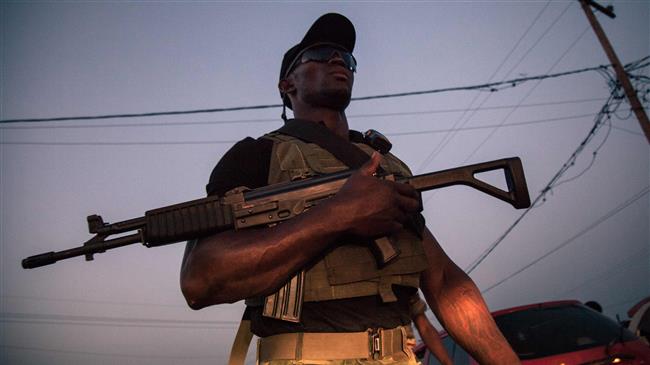
The situation on the ground is really dicey and the days ahead look really gloomy as Russian-made AK-47s have finally made their way into Southern Cameroons. The killing machines clearly spell death to army soldiers who are viewed in the region as enemies.
The government really has a crisis on its hands. A crisis that started as protests by lawyers and teachers has finally developed into a civil war and this is putting the country in the spotlight for the wrong reason.
With many deaths registered on both sides, it will hard for both sides to sit and talk about a common future. Southern Cameroonians have totally migrated from federalism to secession and they hold that independence is within reach.
Today, the government seems to be warming up to the idea of federalism, but this seems to be too late. Many people have died and the pain will make it hard for the two parties to meet and talk. However, all hopes are not lost. With the international community already getting involved, it is likely that dialogue will soon replace the sound of guns that have been part of life in the English-speaking regions of Cameroon.
By Kingsley Betek


22, June 2018
Southern Cameroons Crisis: Biya regime launches emergency humanitarian plan 0
The PM on June 20, 2018 gave details on the strategy and how the money will be raised to restore a conducive environment for the socio-economic development of the affected areas.
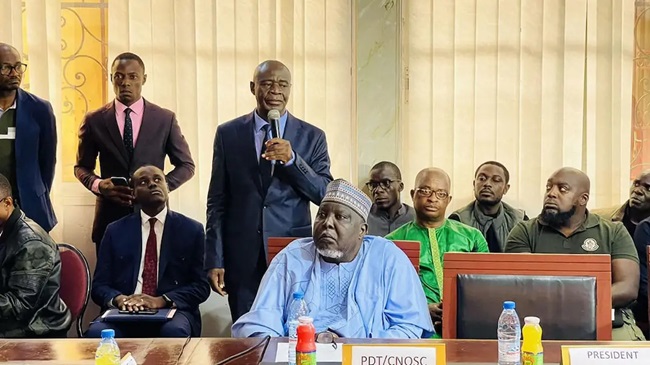
People and structures affected in one way or the other by the close to two-year socio-political crisis raging on in the North West and South West Regions will receive multifaceted assistance from an Emergency Humanitarian Assistance Plan put in place by government with instructions from the Head of State, Paul Biya. Prime Minister Head of Government, Philemon Yang, launched the Contingency Plan in Yaounde yesterday June 20, 2018 in a ceremony at the Cabinet Meeting Hall of the Star Building hugely attended by Cabinet Ministers, Members of the Diplomatic Corps and some elite of the restive regions.
Setting The Base
The Head of Government used the launching ceremony to remind the attendees of the atrocities committed thus far by terrorists since the second quarter of 2016 when legitimate concerns on the functioning of the Common Law System and the English System of Education were hijacked by lawbreakers to wreak havoc on the population and government structures. Prime Minister Yang notably highlighted the attacks on security forces, administrative and traditional authorities as well as acts of arson that have left far-reaching consequences on the population. For instance, he said as at June 11, 2018, some 123 attacks had been perpetuated on security officers causing 84 deaths, cases of arson on some 120 schools in the North West and South West Regions as well as some 15 attacks on traditional rulers. Cases of children being forced into the terrorists forces, racketeering, looting, rape and gruesome killing of citizens by the terrorists, the PM said, were regrettable and could not leave the Head of State indifferent. This as it created a serious humanitarian crisis that today requires substantial resources to guarantee a promising future for the affected population.
Telling Statistics
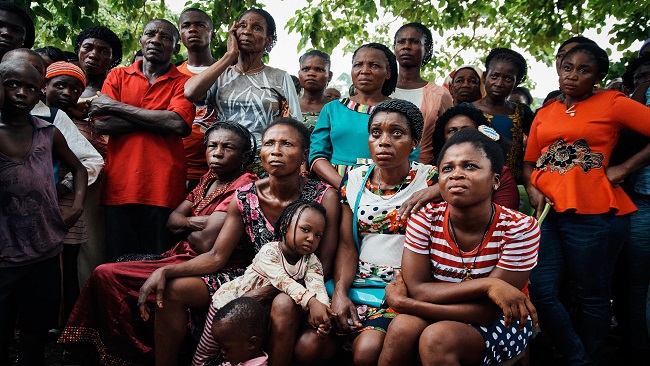
The Prime Minister disclosed that so far, the two regions have registered over 74,966 internally displaced persons from the crisis. 8,554 for the North West and 66,412 for the South West. He said children who could not brave the odds in the regions took refuge in others to pursue education thanks to which they successfully sat end-of-course and year examinations.
Priority Areas of the Emergency Plan
QIt emerged from the Head of Government’s presentation that priority will be given to the protection of displaced persons, healthcare, education, the resumption of economic and agricultural activities and housing among others. Restoring a conducive environment favourable to the return to normalcy of the socio-economic development of the affected areas, promotion of social cohesion and living together, he added, will be given due consideration. Mr Yang disclosed that emphasis will be given to the rehabilitation of health structures either destroyed or abandoned likewise school edifices that equally suffered the same fate before the resumption of the next academic year. Meanwhile, farm inputs will be dished out to the affected population to boost agro-pastoral activities which have been the mainstay of the affected population.
The Funds And Sources
The Emergency Humanitarian Assistance Plan, the Head of Government said, needs FCFA 12,716,500,000 to attain set objectives. The money, he added, will come from the State budget, call for national and international solidarity as well as assistance from development partners. An Ad Hoc Committee placed under the Minister of Territorial Administration will pilot the plan to fruition. The Prime Minister will flag off the fundraising in Yaounde this June 21, 2018.
Talking points on the Emergency Humanitarian Assistance Plan for the North West and South West regions
1. The socio-political crisis in the North West and South West Regions started with some concerns raised by some lawyers and teachers of English expression in the two Regions.
2. The Government has been taking measures to dialogue with representatives of the two socioprofessional groups. Two Ad Hoc Committees were created to this effect in November 2016, on the instruction of the Head of State.
3. The Head of State took important measures to respond to the concerns raised by the teachers and lawyers of English expression. The Head of State has provided more than what was requested.
4. Representatives of the teachers’ trade unions have continued to dialogue with the Government.
5. The President of the Republic went further and created the National Commission for the Promotion of Bilingualism and Multiculturalism (NCPBM) which is currently at work.
6. Terrorists have transformed such legitimate concerns into an opportunity to create terror in the North West and South West Regions of Cameroon.
7. Acts of terrorism are directed on schools, economic activities, security forces, and administrative and traditional authorities.
8. These acts of terror have resulted in the death of many security officials: 84 deaths have been recorded.
9. The Head of State is working to restore peace and security in the two Regions in line with the laws and regulations in force.
10. Terrorist activities have led to internal displacement of some people, while others have sought refuge in foreign neigbouring and friendly country.
11. Under the authority of the President of the Republic, the Government is responding to the problem of internally displaced persons (IDPs), and wishes to increase support measures in collaboration with its partners and people of good will.
12. In the face of these challenges, the Head of State has instructed the putting in place of the Emmergency Humanitarian Assistance Plan for the North West and South West Regions, placed under the supervision of the Minister of Territorial Administration, with a budget of 12.7 billion CFAF.
13. The call for solidarity and generosity to finance this humanitarian plan is not new to Cameroonians. A similar show of solidarity and generosity was recorded in the case of the humanitarian crisis caused by Boko Haram
14. The following areas have been identified as priority: protection of displaced persons, food and basic needs, healthcare, education, the resumption of the economic and agricultural activities, housing, and the reconstitution of individual administrative documents.
Culled from Cameroon Tribune