16, March 2020
Coronavirus leadership crisis: Is Trump presidency over? 0
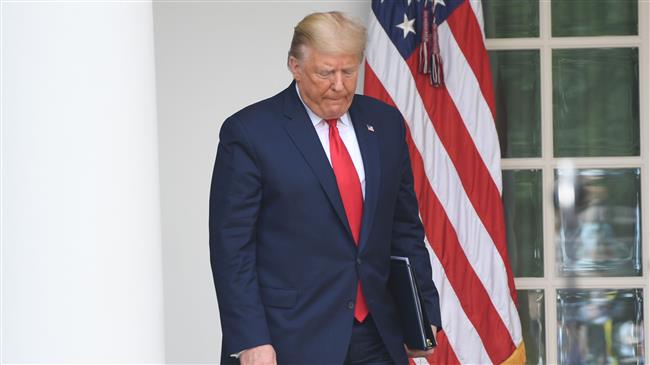
The Trump administration’s response to the novel coronavirus has been characterized by misinformation, missteps and bureaucratic infighting. President Trump has tested negative for the coronavirus, but will he pass the leadership test as new cases of the highly-contagious respiratory disease pop up across the United States?
While Trump is not responsible for the coronavirus hitting the American shores and spreading throughout the country, he is certainly responsible for grave errors that critics say could even cost him his presidency.
“These mistakes have left us blind and badly behind the curve, and, for a few crucial weeks, they created a false sense of security,” Peter Wehner, a senior fellow at Ethics & Public Policy Center, wrote for The Atlantic.
President Trump has sent mixed messages on the outbreak in the US, going out of his way to deny evidence and brush aside the threat. He has also shrugged off blame for any mistakes his administration has made that have hampered efforts to contain and mitigate the spread of the virus that has killed dozens of people across the nation.
Since taking office, Trump has taken steps that experts have warned would prove disastrous during a public health crisis.He has shut down the National Security Council’s entire global health security unit, ignored an expert panel’s warning that the US is unprepared to deal with a pandemic and proposed budget cuts for Centers for Disease Control and Prevention and the Department of Health and Human Services.
The most recent mistakes include the epic manufacturing failures in diagnostic testing, cutting personnel from pandemic preparedness,the decision to test too few people for the coronavirus and the delay in expanding testing to labs outside the CDC.
“No, I don’t take responsibility at all,” Trump said Friday when asked whether he took responsibility for the inadequate number of COVID-19 tests in the US. He instead blamed the testing failures on “rules, regulations, and specifications from a different time.”
Anthony Fauci, director of the National Institute of Allergy and Infectious Diseases,acknowledged in congressional testimony early in the week that America is still not providing adequate testing for the coronavirus.
“The idea of anybody getting [testing] easily, the way people in other countries are doing it, we’re not set up for that. I think it should be, but we’re not,”Fauci said.
Trump on Friday declared an emergency, unblocking tens of billions of dollars in federal aid. The administration has also negotiated a spending bill with Congress to provide assistance to the economy during the crisis.

However, the measure has proven too little too late. States across the country have largely been left on their own as they struggle to help their citizens.
For weeks, Trump and his team had had been too preoccupied by the potential political damage of an outbreak in an election year to acknowledge the true scale of the disaster. The president repeatedly contradicted health officials, claiming that the virus was contained in the US when it was actually spreading. He had also called the outbreak a Democratic “hoax” designed to hurt his reelection chances.
“They’ve simply lost time they can’t make up. You can’t get back six weeks of blindness,” Jeremy Konyndyk, who helped oversee the international response to Ebola during the Obama administration, told The Washington Post.
“To the extent that there’s someone to blame here, the blame is on poor, chaotic management from the White House and failure to acknowledge the big picture,” said Konyndyk, who is a senior fellow at the Center for Global Development.
So far none of President Trump’s disastrous policy decisions have caught up on him like his failure on the coronavirus. He has largely escaped the fallout from his trade war with China because the US economy was strong. He walked away from a critical global climate accord relatively unharmed because global warming happens slowly.
“But now, in the face of a global health threat that is immediate and all around us—and requires, more than anything, a coordinated global response—Trump finds that his errors are flying back in his face like clown pies almost every time he opens his mouth,” wrote Michael Hirsh for the Foreign Policy magazine.
“All the defining attributes of his presidency—his ‘America First’ arrogance, his us-versus-them pettiness toward the rest of the world, his obvious desire for American self-isolation—are suddenly working against him. Trump had very little credibility before; it appears to be all but shot now,” Hirsh said.
Financial markets have suffered their worst losses since the 1987 stock market crash, wiping out nearly three years of economic gains. As the pandemic threatens to derail the US economy, reports say President Trump grows more worried about his reelection chances.
“The president, enraged for having been unmasked, will become more desperate, more embittered, more unhinged. He knows nothing will be the same. His administration may stagger on, but it will be only a hollow shell. The Trump presidency is over,” Wehner argued in his piece.
Culled from Presstv
















16, March 2020
After fleeing abroad, Chinese football teams rush home again to avoid virus 0
Most Chinese Super League (CSL) clubs fled abroad when the deadly coronavirus hit the country but they are now rushing back again as it takes hold elsewhere.
The national side is still training in Dubai — where many CSL teams also went in recent weeks — but they too are now making hasty arrangements to get home as soon as possible.
Wuhan Zall, from the city at the epicentre of the outbreak, had been training in Spain since late January but left at the weekend because of the worsening situation in Europe, now the focal point of the pandemic.
Wuhan will reportedly continue their chaotic pre-season preparations in Shenzhen. Wuhan itself is still in lockdown, despite virus numbers in China reducing.
The CSL season was supposed to begin on February 22 but was indefinitely postponed. It could start behind closed doors in May, according to reports.
Leo Baptistao, Wuhan’s Brazilian attacker, told Chinese media before departing Spain that the situation “has flipped”.
“We are more in danger (here). It now appears… better to leave,” he said.
Fabio Cannavaro’s CSL champions Guangzhou Evergrande, who were in Dubai, and runners-up Beijing Guoan are among the clubs that have recently returned to China.
Guangzhou R&F, coached by former Arsenal and Barcelona star Giovanni van Bronckhorst, on Monday became the latest club to say they were cutting short their Dubai training camp.
However, getting back to China is not straightforward because of flight disruptions and strict quarantine rules when coming home.
Wuhan Zall were stranded in Frankfurt, Germany on Sunday, according to Chinese media, and their current location was not immediately available.
The Beijing News reported that Li Tie’s national team were curtailing their stint in Dubai and had planned to fly back to the Chinese capital from Dubai.
However, their return is also becoming complicated, as Beijing authorities are now sending all international arrivals in the capital to quarantine facilities.
After declaring it had “basically” curbed the spread of the disease within the country, China is now worried about an influx of infections from other countries.
There have been more than 6,400 confirmed deaths globally from the coronavirus, which emerged in Wuhan in December. Many prominent sports competitions across the globe have been halted.
Source: AFP